
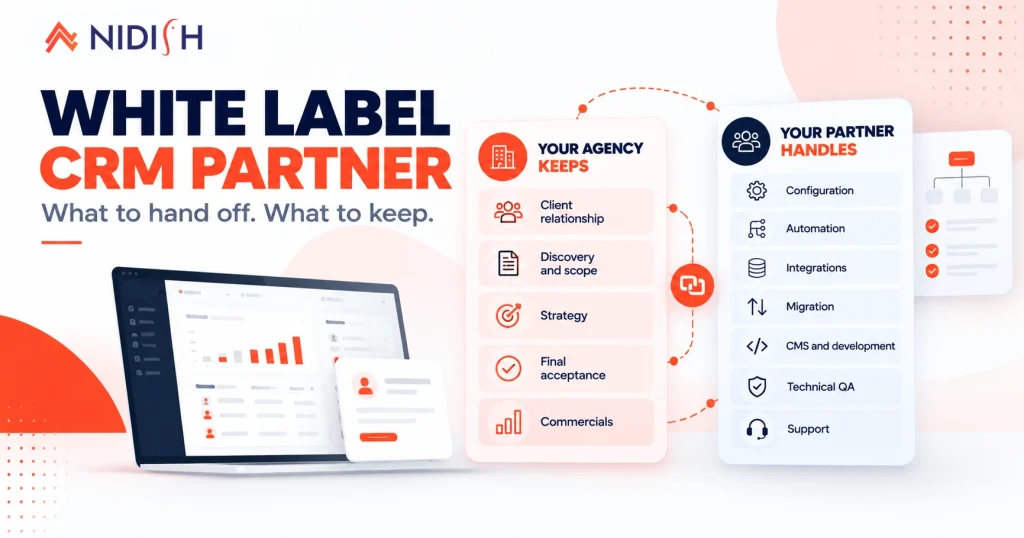
Most agencies never actually decide what a white label CRM partner should handle. They decide what they are too busy to do this month, hand that over, and call the result a partnership. Six months later the partner is drafting client emails, the agency is debugging a workflow it did not build, and nobody can say who is accountable when an integration quietly overwrites a few thousand contact owners.
The line between what you hand off and what you keep is the most important decision in any white label relationship. It matters more than the hourly rate, more than the time zone and more than the tech stack. Drawn well, a white label CRM partner becomes delivery capacity you do not have to carry. Drawn badly, you have added a second team that needs managing, and a client who can tell something changed.
This guide is written for agency owners, delivery leads and HubSpot partners who already sell CRM, RevOps or marketing automation work. We are a white label CRM partner ourselves, so read it with that in mind. The split below is still the one we would recommend if you never worked with us, because the relationships that last are the ones where both sides know exactly what they own.
Table of Contents
What a White Label CRM Partner Actually Does
A white label CRM partner is a delivery team that builds, configures, integrates and supports CRM systems for an agency’s clients under the agency’s brand. The client contracts with the agency, communicates with the agency and, in most cases, never knows the partner exists. The partner is responsible for the quality of the technical work. The agency is responsible for everything the client experiences.
That last distinction is the whole article in one sentence. Everything else is detail about where the boundary sits.
It also helps to separate a white label CRM partner from the arrangements it gets confused with:
- Freelance subcontracting adds an individual to your capacity. It solves a resourcing gap but rarely brings process, documentation standards or cover when that person is unavailable.
- Referral partnerships pass the client to another firm. The client knows, contracts with them directly, and the relationship is no longer yours.
- Co-delivery puts both brands in front of the client. It works for very large programmes, but it changes how the client sees your agency.
- White label CRM implementation keeps the client entirely yours while a specialist team does defined parts of the build behind you. This is the model this guide covers.
Why the Split Matters More Than the Rate
Deloitte’s Global Outsourcing Survey has tracked a clear shift: access to skilled talent and agility now sit alongside cost as reasons organisations outsource, rather than behind it. Agencies are living the same shift. The reason most agency owners start looking for outsourced CRM development is not that their own hours are expensive. It is that they won a Salesforce to HubSpot migration, or a NetSuite integration, and the person who could do it is already fully booked.
The rate a white label CRM partner charges determines your margin on one project. The split determines whether the relationship survives its third project. In our experience, white label relationships rarely fail because of bad code. They fail because of unclear ownership: the partner made a judgment call that was not theirs to make, or the agency held on to work it had no capacity to do well.
The Principle Behind a Good White Label CRM Partner Split
There is one rule that resolves most of the decisions below:
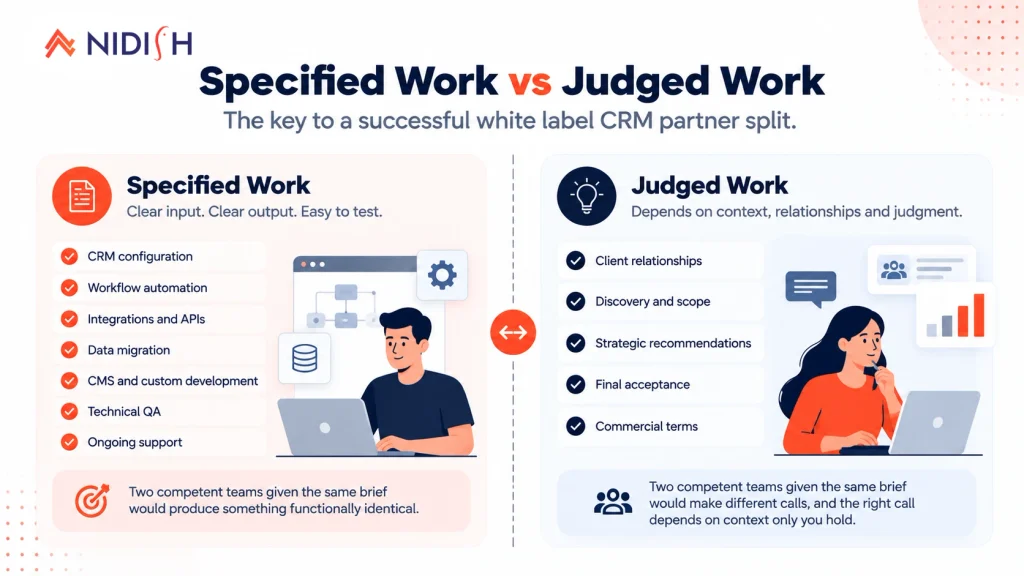
Hand off work that can be specified. Keep work that has to be judged.
Specified work has a clear input, a clear definition of done and a result you can test. A lead rotation workflow, a field mapping, a custom module, a data migration with reconciliation counts. Two competent teams given the same brief would produce something functionally identical.
Judged work depends on things a partner cannot see from a ticket: the client’s internal politics, what was promised in the sales process, which stakeholder needs a win this quarter, how much risk this particular client tolerates. Two competent teams given the same brief would make different calls, and the right call depends on context only you hold.
There is a second test for anything that is still unclear. If this goes wrong, who explains it to the client? The answer is always the agency. So anything that shapes what the client is told, what they are promised or what they are charged stays with the agency, even when the partner does the underlying work.
7 Things Your White Label CRM Partner Should Handle
1. CRM configuration and build
Pipelines, deal stages, properties, lifecycle stages, record views, required fields, permission sets and teams. Once the design is agreed, this is precisely specified work, and it benefits from being done by people who build it every week rather than every quarter. A good white label CRM partner, and especially a good white label HubSpot partner, will also flag design decisions that will cause reporting problems later, which is a different thing from making those decisions.
2. Workflow and automation build
Workflows, sequences, lead routing, lifecycle automation, task creation and, where needed, custom coded workflow actions in Operations Hub. This is where naming conventions and documentation matter most, because undocumented automation is the thing that breaks a year later when nobody remembers why it exists. Expect your white label CRM partner to name every workflow consistently and leave a short written purpose for each one.
3. Integrations and API work
Native connectors, middleware such as Celigo, Zapier or Make, custom API integrations and webhooks. This is the area where agencies most often find the limit of their in-house team, and it is the area where a specialist partner adds the most. Field mapping, sync direction, error handling and retry logic are engineering decisions, and integration quality is defined by how failures are handled rather than by how the happy path works. Our article on UKG integration with HubSpot or NetSuite walks through what that looks like in a real architecture.
4. Data migration
Moving records from Salesforce, Pipedrive, Zoho or a spreadsheet estate into the new CRM. Mapping, deduplication, test loads, association rebuilding and reconciliation counts are all specifiable and testable. What to migrate at all is a separate question that belongs partly to the agency and the client, but the execution belongs with the white label CRM partner. Our Pipedrive to HubSpot migration guide shows the level of planning a migration needs before a single record moves.
5. CMS, theme and custom development
HubSpot CMS modules and themes, custom objects, UI extensions and, when the CRM genuinely reaches its ceiling, a custom application layer around it. White label HubSpot development is often where the agency’s design team and the partner’s developers work most closely, so agree early who owns the design file and who owns the code. If the question is whether to customise further or build something separate, our guide on when to build custom software instead of customising a CRM is a useful starting point, and HubSpot custom objects: when to use one and when not to covers the most common data model decision.
6. Technical QA and testing
Your white label CRM partner should test that what they built works: workflows fire on the right triggers, integrations handle bad data, forms map to the right properties, pages render on mobile. They should hand you a test record of what was checked. This is different from the acceptance check covered below. The partner confirms it works. The agency confirms it is right.
7. Ongoing administration and support
Once a client is live, the backlog of small requests rarely stops: a new property, a changed routing rule, a broken form, a new user. A white label CRM partner can work this backlog under an agreed turnaround, which keeps your account team focused on the client rather than on tickets. If you want to see how we structure this for direct clients, our HubSpot support page outlines the scope.
5 Things Your Agency Should Keep
1. The client relationship and every client-facing message
Status updates, bad news, delays, recommendations and the weekly call. A partner can draft any of these, and often should, because they know the technical detail better. But the message goes out from you, in your voice, after you have read it. The moment a partner starts emailing your client directly, even once and even with good intent, the client starts to wonder who they are actually working with.
2. Business discovery and scope sign-off
What problem is the client trying to solve, what is in scope, what is explicitly out, and what does success look like? This is judged work in its purest form. A white label CRM partner can and should join technical discovery to ask the questions that change the estimate, but the agency owns the problem definition and signs off the scope. If the scope is wrong, that is a conversation only you can have with the client.
3. Strategic recommendations
Which platform, which phase first, whether to customise or build, whether a requirement should be pushed back on entirely. Your white label CRM partner should advise, with reasons, and you should expect them to disagree with you when they think you are wrong. The decision and the presentation to the client stay with the agency, because the agency carries the consequences of it with that client.
4. Final acceptance
Before anything reaches the client, someone needs to ask whether it is right for this client, not just whether it works. Does the pipeline match how their sales team actually talks? Will the dashboard answer the question their CEO asked in the kickoff? Only the agency has the context to answer that, so acceptance is never fully handed off.
5. Commercial terms and change requests
Pricing, scope changes and the decision about what to absorb as goodwill. Your partner quotes you. You quote your client. When a partner spots scope creep, their job is to flag it to you immediately, not to absorb it quietly and not to negotiate it with the client.
The Grey Zone: Work You Share With a White Label CRM Partner
Some responsibilities do not sit cleanly on either side. These are the ones worth writing down before the first project starts.
| Activity | Agency role | Partner role |
| Solution architecture | Approves and presents | Proposes, with trade-offs |
| Technical discovery | Leads the session | Attends as part of your team, asks technical questions |
| Documentation | Owns, stores and shares with the client | Writes it during the build |
| End-user training | Delivers to the client | Prepares materials, trains admins if asked |
| Post-launch hypercare | Communicates with the client | Fixes issues against an agreed turnaround |
| Estimates | Sets the client price | Provides effort and risk estimates |
When your white label CRM partner does appear on a call, agree in advance how they are introduced. “Our solutions engineer” or “our integration lead” is honest about the role without turning a delivery conversation into a disclosure about your supply chain.
Access, Credentials and Branding
This is the section most agencies skip, and it is where white label arrangements most often become visible to the client by accident.
Decide whose identity the partner works under
In HubSpot, every edit to a workflow, property or page is logged against a user, and those names are visible to the client’s admins. If your white label CRM partner’s staff appear in the portal under their own company’s email domain, the arrangement is not really white label. Many agencies add partner staff with agency email addresses for exactly this reason.
Know how this interacts with your HubSpot partner status
If you are a HubSpot Solutions Partner, the way partner employees are given access to a client portal affects which partner account is recognised as managing it. HubSpot’s documentation on managing partner employee access to client accounts explains how access is granted through the Client Access Manager, which permission sets apply, and that employees without a partner email domain must be linked to the client manually to count. Read it before you set up access, not after.
Keep the client as Super Admin
HubSpot’s partner tooling is designed so that partner admins cannot remove Super Admins or change billing. That is a sensible default for white label work too. The client owns the portal, the agency manages access, and the partner works within a scoped permission set.
Check every artefact for branding
Screen recordings, documentation templates, file metadata, code comments, email signatures and calendar invites all carry names. Agree on a clean template set at the start.
Plan the offboarding on day one
If the relationship with your white label CRM partner ends, which users are removed, who holds the credentials for integrations and middleware, and where does the documentation live? An integration running on a partner-owned middleware account is a dependency your client never agreed to.
How a Handover to a White Label CRM Partner Should Actually Work
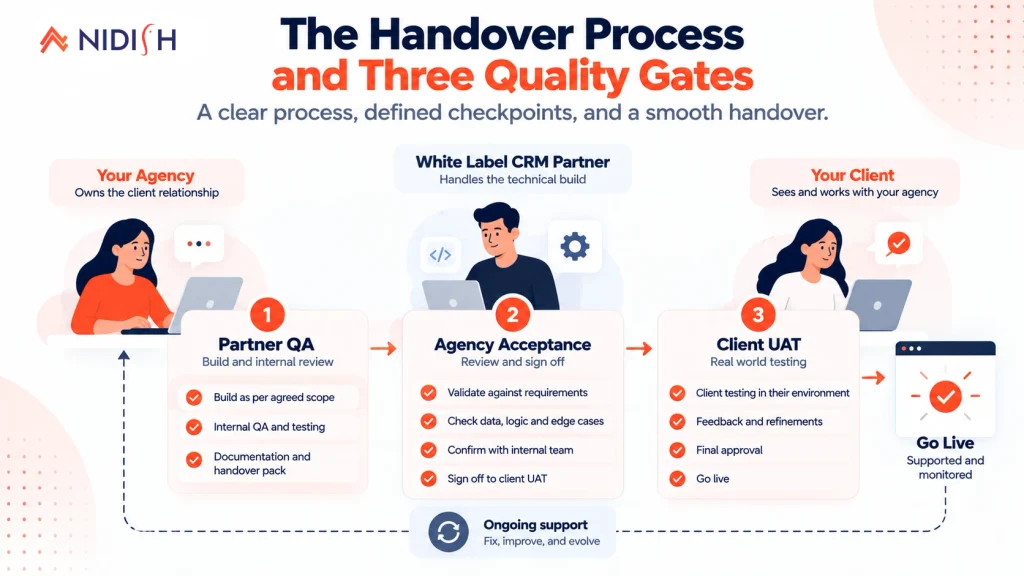
A good handover looks less like a ticket and more like a short brief. The sequence we have found works for agency delivery partners:
- Brief with business context: Your white label CRM partner needs more than “build a lead rotation workflow”. They need to know who the sales team is, why rotation matters to them, and what went wrong with the last attempt.
- Definition of done for each deliverable: What the partner hands back, in what state, with what documentation.
- One channel and one owner on each side: A shared Slack channel or project board, with a named lead at the agency and a named lead at the partner.
- A deliberate overlap window: If your white label CRM partner works from another time zone, decide when both teams are online. A distributed team can deliver progress overnight, but only when the brief is complete at the end of your day. A vague brief costs a full day rather than an hour.
- Three quality gates: Partner technical QA, then agency acceptance, then client UAT. Each gate has an owner.
- Change control routed through the agency. Anything outside the brief is flagged to you before work starts on it.
- Documentation handed back with the build: Not as a follow-up, and stored where your team and the client can find it.
Common Mistakes Agencies Make With a White Label CRM Partner
- Handing off discovery to save time: It feels efficient and it produces a technically correct build that solves the wrong problem.
- Letting the partner talk to the client “just this once”: Once is how every direct relationship starts.
- Treating the partner as a ticket queue: Without context, a partner can only build exactly what was written, which is rarely exactly what was meant.
- Keeping too much: If your project manager rewrites every specification and reviews every line of configuration, you are paying for the work twice and the partner is reduced to typing.
- No ownership of documentation: When the relationship ends, the knowledge leaves with it.
- Choosing on rate alone: The cheapest quote is a fine starting point and a poor deciding factor, for the reasons covered above.
Questions to Ask Before You Choose a White Label CRM Partner
- Will you sign an NDA and a non-solicitation agreement covering our clients?
- Which platforms can you deliver beyond HubSpot: Salesforce, Zoho, Pipedrive, Odoo, NetSuite?
- Who will actually do the work, named people or a rotating pool?
- How do you design integrations to handle failures, and how will we find out when one fails?
- What documentation do you deliver as standard, and in what format?
- What does your QA process check, and what do you hand back as evidence?
- How do you flag scope creep, and to whom?
- What is the daily overlap with our working hours?
- Can you provide US-based resources if a client contract requires it?
- Can we see examples of comparable work, under NDA if necessary?
- What happens to access, credentials and documentation if we end the relationship?
A white label CRM partner who answers these clearly, and is comfortable telling you which work should stay with your team, is usually a partner who has done this before.
How Nidish Works as a White Label CRM Partner
Nidish is registered in Austin, Texas. Most of our delivery team works from India, and we add US-based developers when a contract calls for it. We are platform agnostic: HubSpot, Salesforce development, Zoho, Pipedrive, Odoo, NetSuite, Celigo and UKG, alongside HubSpot CMS, custom development and email marketing work.
As a white label CRM partner for agencies, we work under your brand, sign NDA and non-solicitation terms, and never contact your client unless you ask us to. We hand back documentation you own, and we will tell you when a piece of work should stay with your team rather than come to us. We would rather turn down a task than have it go wrong under your name.
If you want to see the kind of work involved, our pages on HubSpot integration, HubSpot migration and HubSpot development describe the services we deliver directly and for partners.
Frequently Asked Questions
What is a white label CRM partner?
A white label CRM partner is a specialist delivery team that builds, configures, integrates and supports CRM systems for an agency’s clients under the agency’s brand. The client contracts and communicates only with the agency. The partner is accountable to the agency for the technical work, and the agency remains accountable to the client for the overall result.
What should an agency outsource to a white label CRM partner?
Agencies should outsource work that can be clearly specified and tested: CRM configuration, workflow and automation build, integrations and API work, data migration, CMS and custom development, technical QA and ongoing administration. These tasks have a clear definition of done, so a specialist team can deliver them reliably without needing the full history of the client relationship.
What should an agency never outsource?
An agency should keep the client relationship, business discovery and scope sign-off, strategic recommendations, final acceptance and all commercial decisions. These depend on context only the agency holds, such as what was promised during the sale and how much risk the client tolerates. The agency also carries the consequences of these decisions, so it should make them.
Will my client know I am using a white label partner?
Not if the arrangement is set up properly. That means the partner never contacts your client directly, partner staff work under agency email addresses where they appear in the client’s systems, and every deliverable uses your templates. The most common accidental disclosure is a user name in the CRM audit log, so agree on credentials before work begins.
How does a white label partner affect my HubSpot partner status?
How partner employees are given access to a client portal affects which HubSpot partner account is recognized as managing it. HubSpot’s Client Access Manager controls this access, and employees without a partner email domain must be linked to the client manually. Agencies that are HubSpot Solutions Partners should agree on the access method with their white label partner before the first login.
How do I protect my client relationships when using a white label partner?
Use an NDA and a non-solicitation agreement that covers your clients, route every client-facing message through your agency, keep the client as Super Admin in their own CRM, and make sure integrations and middleware run on accounts the client or the agency owns. Documentation should be stored where your team controls it, not only with the partner.
Where This Goes Next
The agencies that get the most from a white label CRM partner are not the ones that hand off the most work. They are the ones that hand off the right work, keep the judgment and the relationship, and write the boundary down before the first project rather than after the first problem.
If you are weighing up a white label CRM partner for an upcoming CRM implementation, migration or integration, book a 30 minute call. Bring the project you are actually trying to staff. We will tell you honestly which parts we would take, which parts should stay with your team, and whether working with a partner makes sense for it at all.


 Blog
 Case Studies
 Career