
Introduction
Enterprise Resource Planning (ERP) systems like NetSuite are designed to centralize business operations. However, when surrounding business systems remain disconnected, organizations often experience operational bottlenecks that slow down critical processes.
Our client had successfully implemented NetSuite as their ERP platform to manage financial operations, inventory, order processing, and customer records. However, multiple departments were still relying on separate systems for CRM, order management, customer support, shipping, and reporting.
As business volume increased, employees spent significant time manually transferring information between platforms, creating delays that impacted sales operations, order fulfillment, invoicing, and customer service.
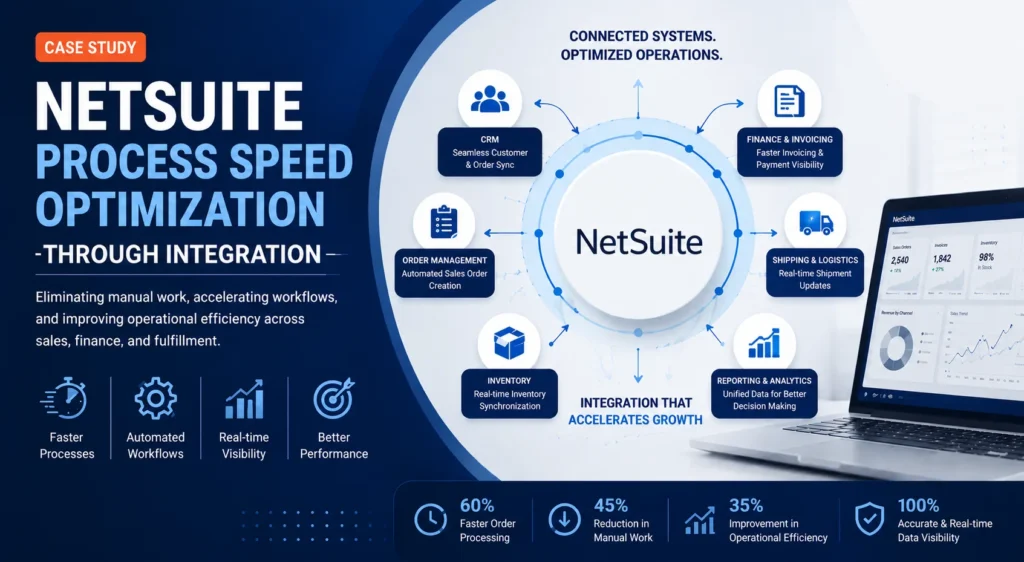
Nidish designed and implemented a custom integration framework that connected NetSuite with the client’s operational ecosystem, dramatically reducing processing times and improving workflow efficiency across departments.
Table of Contents
Client Background
The client is a rapidly growing distribution and services company processing thousands of customer transactions every month.
NetSuite served as the organization’s primary ERP system, managing:
- Customer records
- Product inventory
- Purchase orders
- Sales orders
- Invoicing
- Financial reporting
Alongside NetSuite, the organization used several third-party applications for customer relationship management, customer support, logistics management, reporting, and internal operations.
While each system functioned effectively on its own, the lack of integration created significant inefficiencies throughout the organization.
Challenges
As transaction volumes increased, operational delays became more noticeable across departments.
1. Sales Orders Required Manual Processing
When opportunities closed in the CRM, employees manually recreated customer information, products, pricing details, and order information within NetSuite.
This process often introduced delays and increased the risk of data entry errors.
Sales teams frequently waited for back-office staff to process orders before fulfillment activities could begin.
2. Inventory Updates Were Not Real-Time
Inventory information stored within NetSuite was not automatically available within external sales and ordering systems.
As a result:
- Inventory counts were often outdated.
- Sales representatives occasionally sold unavailable products.
- Customer service teams lacked visibility into actual stock levels.
This created unnecessary communication between departments and delayed customer responses.
3. Invoice Generation Delayed Revenue Operations
Once orders were fulfilled, finance teams needed to manually verify transaction data before generating invoices.
The process required employees to compare information across multiple systems before releasing invoices to customers.
These delays affected cash flow and increased administrative workload.
4. Customer Service Teams Lacked Complete Visibility
Customer service representatives often switched between multiple applications to answer simple customer inquiries.
Information such as:
- Order status
- Shipment tracking
- Invoice status
- Payment history
was spread across multiple systems.
This increased response times and reduced operational efficiency.
5. Reporting Was Time-Consuming
Leadership teams relied on reports generated from multiple data sources.
Because information was stored across disconnected systems, employees spent hours exporting, combining, and validating data before creating management reports.
As a result, business leaders often worked with outdated information when making operational decisions.
Our Approach
Rather than replacing existing systems, we focused on eliminating the friction between them.
Our team mapped every major business process involving NetSuite and identified the points where employees were manually moving information between applications.
We then designed an integration strategy that prioritized:
- Sales order automation
- Inventory synchronization
- Financial process acceleration
- Customer visibility
- Executive reporting
The objective was not simply to connect systems but to reduce the time required to complete critical business processes.
Solution
Nidish developed a custom integration architecture that established real-time communication between NetSuite and the client’s supporting business applications.
The solution leveraged NetSuite APIs and middleware services to automate data movement across departments.
Automated Order Processing
When a sales opportunity reached a closed-won stage within the CRM, customer and order information automatically flowed into NetSuite.
Sales orders were generated without requiring manual intervention.
This eliminated duplicate data entry and significantly reduced order processing time.
Real-Time Inventory Synchronization
Inventory levels maintained in NetSuite were automatically synchronized with external systems.
Sales and customer service teams gained access to accurate inventory information without requiring manual updates.
This reduced stock-related issues and improved customer communication.
Automated Financial Workflows
Invoice creation, order updates, and payment-related information were automatically synchronized between NetSuite and connected systems.
Finance teams could process transactions faster while maintaining complete data accuracy.
Unified Customer Visibility
The integration consolidated customer information from multiple systems, providing teams with a complete view of:
- Orders
- Shipments
- Payments
- Support interactions
- Account history
Customer service representatives could access information instantly without switching between multiple platforms.
Real-Time Operational Reporting
Data from NetSuite and connected systems flowed into centralized reporting dashboards.
Executives gained immediate access to accurate operational metrics without relying on manual spreadsheet preparation.
Implementation Highlights
The integration framework included:
- NetSuite API integration
- CRM and ERP synchronization
- Automated sales order creation
- Inventory synchronization across platforms
- Invoice and payment data automation
- Customer account synchronization
- Shipment and fulfillment status updates
- Centralized reporting architecture
- Automated exception handling and validation
- Scalable integration infrastructure
The solution was designed to support growing transaction volumes without requiring additional administrative resources.
Results
Following implementation, the organization achieved significant improvements in operational efficiency.
Reduced Order Processing Time
Sales orders that previously required manual intervention could now be processed automatically, accelerating order fulfillment activities.
Faster Inventory Visibility
Teams gained access to real-time inventory information, improving customer communication and reducing stock-related issues.
Accelerated Invoice Processing
Finance teams reduced administrative effort while improving billing speed and accuracy.
Improved Customer Service Response Times
Representatives could access complete customer information from connected systems without switching between multiple applications.
Better Executive Decision-Making
Leadership teams gained access to accurate real-time reporting, improving visibility into sales performance, operations, inventory management, and financial outcomes.
Increased Organizational Scalability
The business was able to process a higher volume of transactions without increasing operational headcount.
Conclusion
As organizations grow, disconnected systems can create significant operational bottlenecks that impact productivity, customer experience, and profitability.
By implementing a custom NetSuite integration framework, Nidish helped the client eliminate manual processes, accelerate business operations, and create a connected ecosystem that supports long-term growth.
The result was a faster, more efficient organization where information moved automatically between systems, allowing teams to focus on serving customers and driving business performance rather than managing administrative tasks.
At Nidish, we specialize in designing custom NetSuite and HubSpot integrations that streamline operations, automate workflows, and help organizations scale with confidence.



 Blog
Blog Case Studies
 Career