
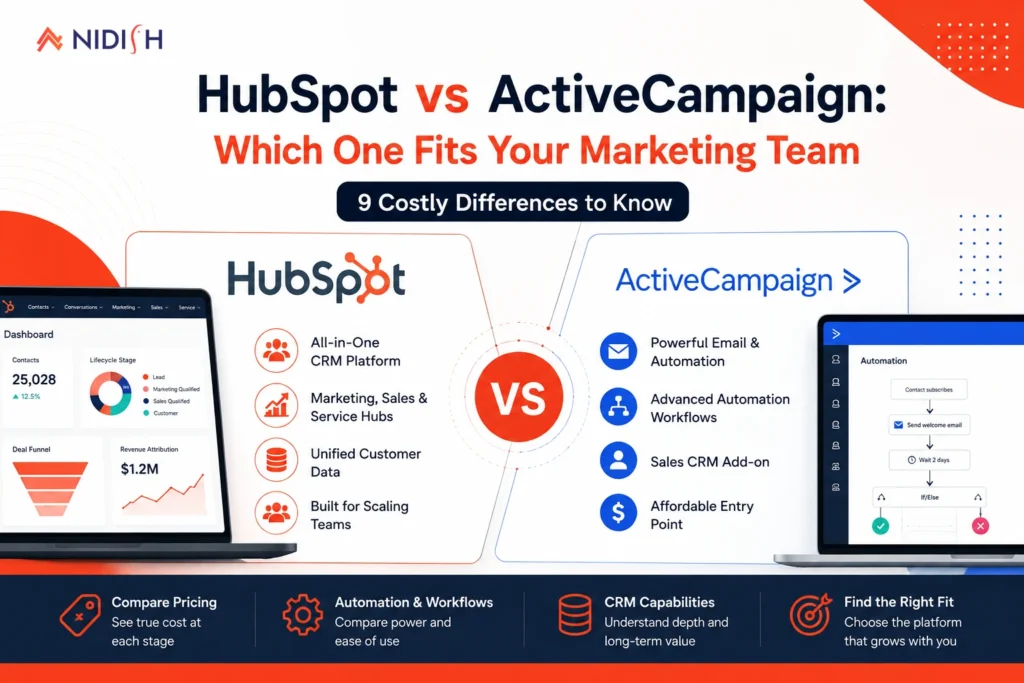
If you have spent any time comparing marketing platforms, you already know the HubSpot vs ActiveCampaign question does not have a clean answer. Both platforms do email marketing. Both do automation. Both call themselves a CRM. But the moment you actually use them side by side, the differences show up fast, in the pricing structure, in how deep the CRM goes, and in how much your team has to build versus how much comes ready out of the box.
This is not a surface-level feature checklist. We work inside HubSpot every day as an implementation partner, and we have watched marketing teams switch platforms in both directions, so this comparison is built around the decisions that actually determine whether a switch pays off or turns into a six-month headache.
Table of Contents
Quick Answer
HubSpot vs ActiveCampaign comes down to how much your team needs beyond email. ActiveCampaign is the better fit if you want strong marketing automation and a lightweight CRM at a lower monthly cost, especially under 10,000 contacts. HubSpot is the better fit if your marketing, sales, and service teams need to operate off the same data, or if you expect to outgrow a marketing-only tool within the next two years. Cost of ownership matters more than sticker price here: HubSpot’s Professional tier includes a mandatory onboarding fee, while ActiveCampaign’s advanced features and contact limits scale up faster than most teams expect.
HubSpot vs ActiveCampaign at a Glance
Before getting into pricing and features, it helps to understand what each platform was actually built to do.
HubSpot: started as an inbound marketing tool and expanded into a full customer platform. It now covers Marketing Hub, Sales Hub, Service Hub, CMS Hub, and Operations Hub, all built on a single shared contact record. That shared record is the entire point. A support ticket, a deal stage, and an email open all live on the same customer profile.
ActiveCampaign: started as an email service provider and grew into a marketing automation platform with an add-on CRM. Its automation builder is genuinely excellent, often rated ahead of HubSpot’s at comparable price points, but the CRM sits beside the marketing tool rather than being the foundation it is built on.
Neither approach is wrong. They serve different shaped teams.
Pricing Breakdown: What You Actually Pay
This is where most HubSpot vs ActiveCampaign comparisons get vague, so here are current list prices as of mid-2026. Both vendors update pricing periodically, so treat this as a directional guide and confirm current numbers on their official pricing pages before budgeting.
| Tier | ActiveCampaign | HubSpot Marketing Hub |
|---|---|---|
| Free | Not available (14-day trial only) | $0, limited contacts, no automation |
| Entry | Starter: ~$15 to $19/month, 1,000 contacts, 1 user | Starter: $20/seat/month, 1,000 contacts |
| Mid | Plus: ~$49 to $59/month, 1,000 contacts | No direct equivalent tier |
| Advanced | Pro: ~$79 to $99/month, 1,000 contacts, 3 users | Professional: $890/month, 2,000 contacts, 3 seats, plus a $3,000 onboarding fee |
| Enterprise | Custom, starts around $145/month | $3,600/month, 10,000 contacts, 5 seats, plus a $7,000 onboarding fee |
The number that catches most teams off guard is the jump between HubSpot’s Starter and Professional tiers, sometimes described as a 40x price increase once you factor in the mandatory onboarding cost. ActiveCampaign’s pricing climbs more gradually as your contact list grows, but it climbs continuously. At 10,000 contacts, ActiveCampaign’s Professional plan lands somewhere around $400 to $420 a month, which is still meaningfully below HubSpot Professional, but the gap narrows the more hubs you eventually add on HubSpot’s side.
The honest takeaway: if you only need marketing automation and a basic CRM, ActiveCampaign is cheaper at nearly every contact tier. If you are pricing in the CRM, sales pipeline, and service desk you will eventually need anyway, the comparison changes.
Which Platform Has Stronger Marketing Automation?
Automation is genuinely close, and this surprises people who assume HubSpot wins by default because it is the bigger platform.
ActiveCampaign’s automation builder was designed by an email marketing company first, and it shows. Conditional splits, dynamic content blocks, and multi-path branching are intuitive and fast to build, even at the Plus tier. Site and event tracking feed directly into automation triggers without much setup.
HubSpot’s workflow tool is more powerful at the Professional tier and above, particularly once you bring in custom properties, deal-based triggers, and cross-hub actions like creating a support ticket from a marketing workflow. But that power is gated behind the Professional price jump, and at the Starter tier, HubSpot’s automation options are genuinely limited compared to ActiveCampaign Plus at a similar price.
Automation Trigger and Workflow Comparison
Here is a practical breakdown of what triggers and actions are actually available at comparable pricing tiers, since this is usually where the HubSpot vs ActiveCampaign decision gets made in practice.
| Trigger or Action | ActiveCampaign (Plus/Pro) | HubSpot (Professional) |
|---|---|---|
| Email open or click trigger | Yes | Yes |
| Website page visit trigger | Yes, all paid tiers | Yes |
| Deal stage change trigger | Only with CRM add-on | Yes, native |
| Form submission trigger | Yes | Yes |
| Custom object trigger | No | Yes |
| Ticket creation from workflow | No | Yes |
| Multi-branch conditional logic | Yes, strong | Yes, strong |
| Cross-channel actions (ads, SMS) | Partial, SMS metered separately | Yes, native ad sync |
| Predictive send time | Pro tier only | Yes |
| Revenue attribution reporting | Pro tier only | Yes, native |
If most of your workflows live inside marketing, ActiveCampaign covers the list comfortably. If your workflows need to touch deals, tickets, or custom data objects, that is HubSpot territory, and it is one of the clearest dividing lines in this whole comparison.
CRM Depth: Marketing Tool vs Revenue Platform
This is the part of the HubSpot vs ActiveCampaign debate that gets underweighted in most comparisons, and it is usually the one that matters most a year after the decision gets made.
ActiveCampaign’s CRM is a genuine CRM, not a gimmick, but it is sold as an add-on to the marketing platform and built around contact records rather than a full deal and company data model. It works well for small sales teams who mostly need pipeline visibility layered on top of email activity.
HubSpot’s CRM is the actual foundation of the platform. Contacts, companies, deals, and tickets are native objects with their own properties, and every hub reads from the same record. If your marketing, sales, and support teams need to see the same customer history without exporting and reimporting data, this is the structural difference that decides it.
We wrote a deeper breakdown of this in our HubSpot vs Salesforce comparison, and a lot of the same CRM-depth logic applies here, just at a different price point.
Where HubSpot Falls Short
To keep this comparison honest, HubSpot is not the right answer for every team.
- Price scales fast. The jump from Starter to Professional is steep, and the mandatory onboarding fee catches teams off guard during budget planning.
- Overkill for email-only teams. If your team’s entire job is sending newsletters and running drip campaigns, you are paying for sales and service infrastructure you will not touch.
- Learning curve is real. The shared data model that makes HubSpot powerful also makes it more complex to onboard a small team quickly.
- Free and Starter automation is thin. You do not get meaningful workflow automation until Professional, which is where the price jump hits.
Where ActiveCampaign Falls Short
ActiveCampaign has its own real limitations once a team grows past a certain size.
- CRM is an add-on, not a foundation. Sales and service teams eventually hit a ceiling on custom objects, ticketing, and cross-department reporting.
- Costs climb with contact count on every tier. There is no flat enterprise ceiling the way HubSpot’s Customer Platform offers once you are paying for the whole suite.
- No native service or ticketing hub. Support teams need a separate tool, and that tool will not share the same customer record automatically.
- Custom objects and advanced permissions are Enterprise-only, which puts them out of reach for most mid-size teams.
Who Should Choose HubSpot?
HubSpot tends to be the right call if any of these describe your situation:
- Marketing, sales, and service teams need one shared view of the customer
- You are already planning to add a sales CRM or help desk within the next 12 to 18 months
- You need custom objects, complex reporting, or a CMS built on the same platform
- Your team is willing to absorb a steeper price and a real onboarding investment in exchange for long-term consolidation
Who Should Choose ActiveCampaign?
ActiveCampaign tends to win when:
- Your team’s core need is email marketing and automation, not a full CRM suite
- You want strong automation logic without paying HubSpot Professional pricing
- Budget predictability matters more than platform breadth
- You are a lean marketing team without a dedicated sales operations function
Switching Platforms? What to Plan For
If the comparison points you toward switching, plan for three things regardless of direction:
- Data mapping. Custom fields rarely map one to one between platforms, and this is where most migrations lose data quietly.
- Automation rebuilds, not exports. Workflows do not transfer between platforms. Every automation gets rebuilt from scratch, so document your current logic before you start.
- A parallel run period. Keep both platforms live for at least one full campaign cycle before fully cutting over, so you can catch gaps before they hit your list.
If you are weighing a move toward HubSpot specifically, our guide on what a HubSpot migration actually involves walks through the phases in more detail, and our piece on using HubSpot for email marketing covers what changes day to day for a marketing team once you are on the platform.
FAQ
Is HubSpot more expensive than ActiveCampaign?
At the entry level, pricing is close. The gap widens significantly once you move into HubSpot’s Professional tier, which adds a mandatory onboarding fee that ActiveCampaign does not have at any tier.
Does ActiveCampaign have a CRM?
Yes, ActiveCampaign includes a CRM on its Plus tier and above, but it is built as an add-on to the marketing platform rather than the foundation the way HubSpot’s CRM is.
Can I migrate from ActiveCampaign to HubSpot without losing my automations?
Automations do not transfer automatically between platforms. They need to be rebuilt in HubSpot’s workflow tool, so document your existing automation logic before starting a migration.
Which platform is better for a small marketing team with no dedicated sales ops?
ActiveCampaign is usually the better fit for lean marketing teams without a dedicated sales operations function, since it delivers strong automation without the added cost of HubSpot’s full CRM suite.
Does HubSpot or ActiveCampaign integrate better with other business tools?
Both integrate with major tools like Shopify, Salesforce, and Zapier. HubSpot’s native integrations tend to go deeper for sales and service use cases, while ActiveCampaign’s ecommerce integrations are strong for Shopify, WooCommerce, and BigCommerce specifically.
The Practical Next Step
Neither platform is objectively better. HubSpot vs ActiveCampaign really comes down to whether you are buying a marketing tool or a shared system for your whole customer-facing team. If you already know email and automation are the whole job, ActiveCampaign will get you there for less money. If you can see sales and service joining the picture soon, the HubSpot investment tends to pay for itself faster than the price tag suggests.
If you are still weighing the switch and want a second opinion on what a HubSpot setup would actually look like for your team’s size and budget, that is a conversation worth having before you commit either way.


 Blog
Blog Case Studies
 Career