
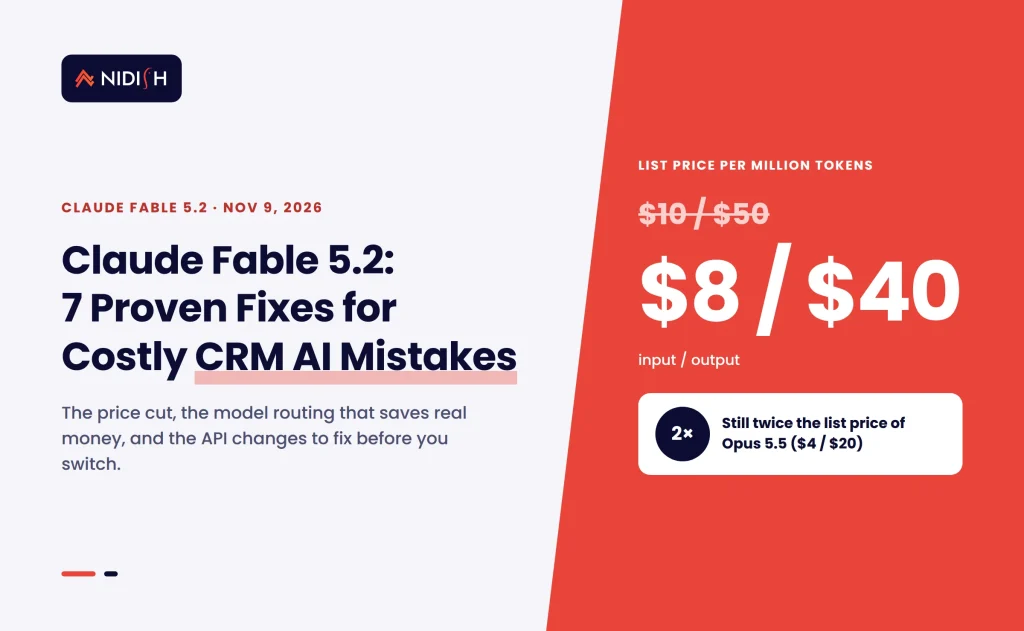
Claude Fable 5.2 is cheaper than the model it replaces, and that is exactly why some CRM automations will get more expensive next month. Anthropic released Claude Fable 5.2 and Claude Mythos 5.2 on November 9, 2026, with list pricing cut from $10/$50 to $8/$40 per million input/output tokens. Teams will read “cheaper” and point every HubSpot, NetSuite and n8n workflow at the new model. That is the mistake.
This guide is for RevOps leads, CRM admins and integration owners who already run Claude inside their stack. You will get the real pricing math and a model-routing table for common CRM and ERP jobs. You will also get the breaking API changes to fix before you switch, and a plan for where the new model actually earns its price.
Table of Contents
Key takeaways
- Claude Fable 5.2 launched on November 9, 2026 at $8 per million input tokens and $40 per million output tokens, 20% below Fable 5.1 list pricing.
- It is still 2x the price of Claude Opus 5.5 ($4/$20), which Anthropic itself calls its “strongest daily driver”. Most CRM jobs belong on Opus, Sonnet or Haiku.
- Fable 5.2 earns its cost on long, multi-step agent work: reconciliations, multi-system research and computer-use tasks where accuracy saves rework.
- The upgrade is not a model-ID swap. Forced tool use, sampling parameters and the old computer-use tool now return 400 errors.
- Mythos 5.2 is gated to organizations verified through Anthropic’s programs, so plan around Fable for business systems.
What Claude Fable 5.2 changed on November 9, 2026
Claude Fable 5.2 is Anthropic’s new top general-access model, released November 9, 2026 alongside the verification-gated Claude Mythos 5.2. It is faster and cheaper than Fable 5.1, has a 1M-token context window and 128K max output, and is available on the Claude API, Amazon Bedrock, Google Cloud and Microsoft Foundry.
Here is what the official Anthropic announcement and the Fable 5.2 model documentation confirm:
- Pricing: $8 input and $40 output per million tokens, down from $10 and $50 for the 5.1 models.
- Speed: Anthropic says the 5.2 models are “up to 30% faster” than the 5.1 versions.
- Fast mode: $16/$80 per million tokens for up to 2.5x higher output tokens per second, per the Claude API release notes.
- Model ID:
claude-fable-5-2on the Claude API, andanthropic.claude-fable-5-2on Amazon Bedrock. - Data retention: both 5.2 models require 30-day data retention and are not available under zero data retention unless Anthropic expressly authorizes it.
The benchmark story matters for business systems too. On Anthropic’s own published table, Claude Fable 5.2 scores 51.4% on AutomationBench, a business-workflow benchmark, versus 42.5% for Opus 5.5. It also scores 89.3% on the OSWorld 2.1 computer-use set. These are vendor-reported numbers, so treat them as directional, not as a promise for your portal.
One honest note: on that same AutomationBench row, Google’s Gemini 4 Carbon is listed at 53.9%. Claude Fable 5.2 is strong for workflow automation, not uncontested.
What the Claude Fable 5.2 price cut means for CRM teams
The Claude Fable 5.2 price cut lowers the cost of top-tier reasoning by 20%, but it does not make Fable the cheap option. For most CRM and ERP automation, the bigger savings still come from routing each job to the smallest model that does it well.
Look at the list prices side by side. All figures are per million tokens, at time of writing, from Claude’s pricing page. Confirm current rates with Anthropic or your cloud provider before you budget.
| Model | Input ($/MTok) | Output ($/MTok) | Access | Best CRM/ERP fit |
|---|---|---|---|---|
| Claude Fable 5.2 | $8 | $40 | General API, Bedrock, Google Cloud, Foundry | Long multi-step agents, reconciliations |
| Claude Fable 5.1 (previous) | $10 | $50 | Previous version | Plan a tested move to 5.2 |
| Claude Mythos 5.2 | $8 | $40 | Verified organizations only | Security and specialist work |
| Claude Opus 5.5 | $4 | $20 | General | Daily driver for most agent work |
| Claude Haiku 5.5 | from $0.10 | from $0.50 | General (prompts up to 100K tokens) | Classification, tagging, routing |
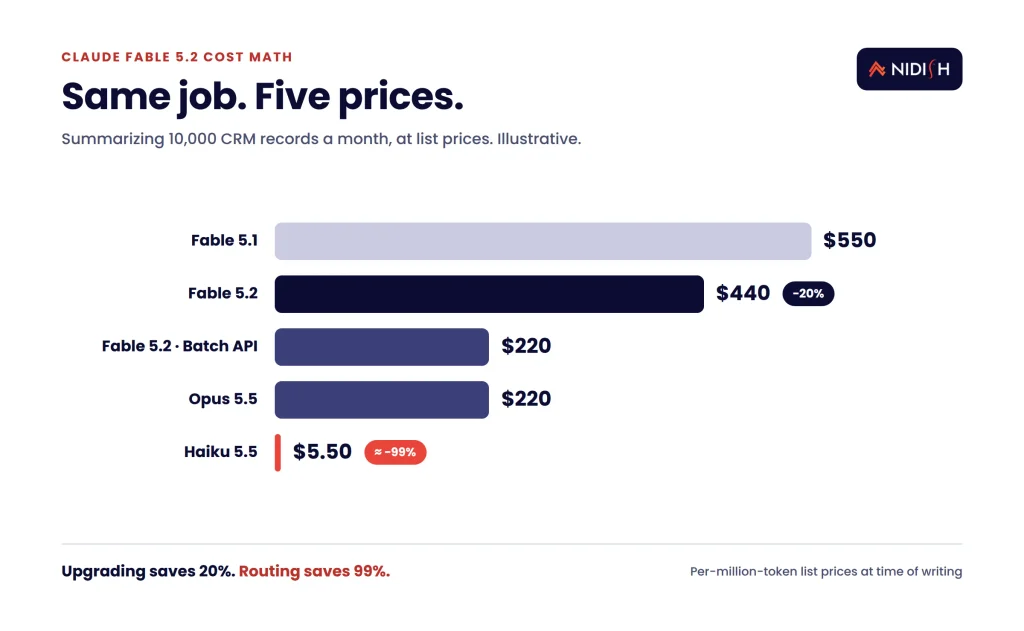
Now run the numbers on a typical job. Say you summarize 10,000 CRM records a month, at roughly 3,000 input tokens and 500 output tokens each. That is 30 million input tokens and 5 million output tokens. This is an illustrative calculation at list price, not a quote:
- Fable 5.1: $300 input + $250 output = $550
- Claude Fable 5.2: $240 input + $200 output = $440
- Claude Fable 5.2 on the Batch API (50% off): $220
- Opus 5.5: $120 input + $100 output = $220
- Haiku 5.5: $3 input + $2.50 output = $5.50
The pattern is the whole story. Moving from 5.1 to 5.2 saves 20%. Moving a summarization job from Fable to Haiku saves about 99%. Batching overnight jobs halves the bill on any tier.
The mistake we see constantly is a team picking one “best” model and wiring it into every HubSpot workflow action. Six months later, finance asks why the AI line item tripled. The model was never the problem. The routing was.
Which Claude model should run each CRM automation job?
Use the new Fable model only where a cheaper model fails often enough to cost you real rework. Anthropic’s own guidance is to start with Opus 5.5 and move up to Fable only when the task needs it, or down to Sonnet or Haiku when it doesn’t.
Here is the routing table we use as a starting point on client builds. Adjust it after you test on your own data.
| CRM / ERP job | Start with | Move up to Claude Fable 5.2 when… |
|---|---|---|
| Lead and ticket classification | Haiku 5.5 | Almost never; accuracy gains rarely justify the cost |
| Email and call summaries into CRM | Haiku 5.5 or Sonnet 5.5 | Summaries need cross-record context from many objects |
| Enrichment and research agents | Opus 5.5 | Research spans many sources and steps, and errors are costly |
| Quote, invoice and order reconciliation (HubSpot ↔ NetSuite) | Opus 5.5 | Multi-entity edge cases keep failing review |
| Data migration mapping and cleanup | Opus 5.5 | Schemas are messy and mapping errors are expensive to unwind |
| Computer-use agents on legacy ERP screens | Opus 5.5 | No API exists and the task chain is long |
| Custom code for workflow actions and integrations | Opus 5.5 | Large refactors across many files |
Two rules make the table work. First, measure failure rate, not vibes. Run 50 to 100 real records through each candidate model and count the outputs a human had to fix. Second, price the fix. If a failed NetSuite reconciliation costs an analyst 20 minutes, a more expensive model that avoids it may be the cheaper choice.
Claude API breaking changes to fix before you switch
Claude Fable 5.2 is not a drop-in replacement for older Claude models. Several request patterns that worked before now return HTTP 400 errors, and integrations built a year ago are the most likely to use them.
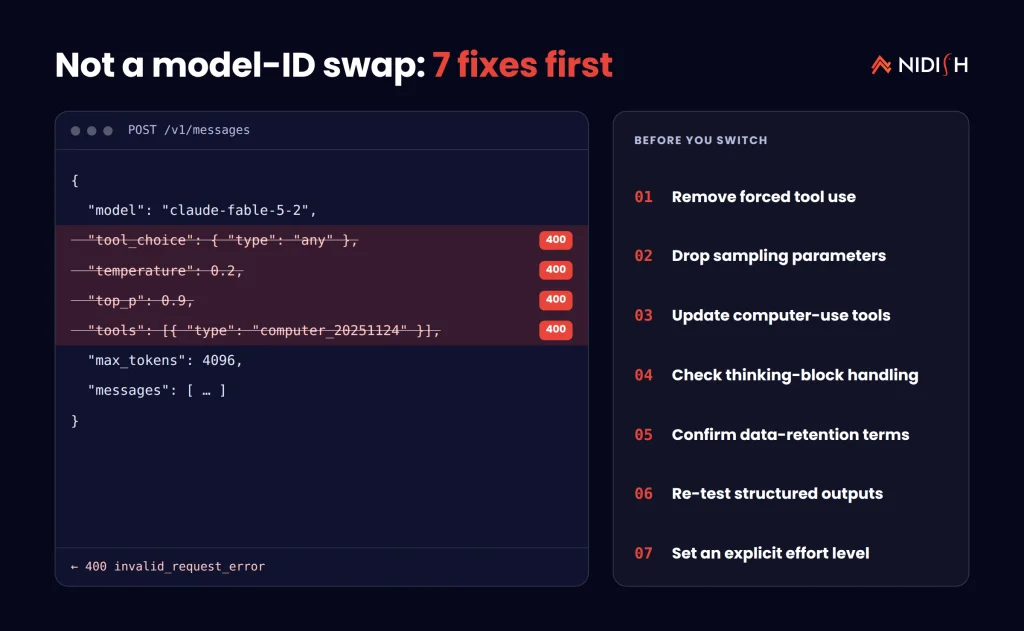
Work through this checklist before you change a single model ID in production:
1. Remove forced tool use
On Fable 5.2, tool_choice set to any or a specific tool returns a 400 error. Integrations that force a “create_contact” or “update_deal” tool call need to rely on instructions and validation instead.
2. Drop sampling parameters
temperature, top_p and top_k must be omitted. Many integrations set temperature: 0 explicitly, so check node and action settings, not just your own code.
3. Update computer-use tools
Requests that declare the older computer_20251124 tool return a 400 on every platform except Amazon Bedrock. Move to computer_toolset_20260801.
4. Check thinking-block handling
Editing system prompts, tools or earlier messages and then sending back a thinking block now returns a 400. Agents that rewrite conversation history need a fresh look.
5. Confirm data-retention terms
Fable 5.2 requires 30-day retention. If your legal team approved a zero-data-retention setup for CRM data, you need a new review, not a config change.
6. Re-test structured outputs
Even without errors, a new model can format JSON or field values differently. Re-run your schema validation on real CRM payloads.
7. Set an explicit effort level
The API default effort is high, which costs more tokens. Set effort per workflow so simple steps don’t pay for deep reasoning.
Each of these is small on its own. Together, they are why “we just switched the model” turns into a weekend incident. If your HubSpot or NetSuite integration was built by someone who has since left, this checklist is your audit plan.
If you’re weighing this for your own stack, we audit and rebuild AI steps inside CRM and ERP integrations. See how we handle HubSpot integration →
Where Fable 5.2 fits in HubSpot, NetSuite and n8n
Fable 5.2 fits best as the “senior reviewer” step in a workflow, not as the engine behind every action. Put cheap models on volume and Fable on the decisions that are expensive to get wrong.
HubSpot
Most teams call Claude from HubSpot through custom coded workflow actions or a custom LLM action. Our guide to HubSpot custom LLM workflow actions covers the pattern. Use Fable 5.2 for account research that feeds a deal review, not for tagging every inbound form fill. Keep lead qualification on a smaller model, as we describe in our post on HubSpot AI agents for lead qualification.
NetSuite and ERP
ERP work rewards accuracy. A wrong revenue line or a duplicated vendor bill costs far more than tokens. That makes reconciliation and exception handling a strong fit for Fable 5.2, especially when NetSuite’s own agents handle the in-ERP steps. We covered that side in our breakdown of NetSuite’s Autonomous Suite and HubSpot integration.
n8n and other iPaaS tools
In n8n, route by node. A cheap model triages, and a Fable 5.2 node handles only the branch that needs deep reasoning. If you’re also upgrading the platform, our n8n 3.0 upgrade guide lists the fixes to make first, so you don’t stack two migrations in one sprint.
The architecture principle is the same across all three: a composable, AI-ready CRM stack treats the model as a swappable part. If changing one model ID breaks five workflows, that’s a design problem worth fixing now.
Claude Fable 5.2 vs Opus 5.5: is the upgrade worth it?
For most CRM automation, no. For long, multi-step agents where errors are costly, yes. Anthropic says Claude Fable 5.2 at high effort matches Opus 5.5 at max effort on its FrontierCode benchmark “for roughly half the cost per task”, which favours Fable on hard, long tasks.
That claim is about coding tasks at the top of the effort range. For short CRM tasks, Opus 5.5 at half the token price will usually win. The Aragon Research analysis of the launch makes a similar point: the price cut rewards teams with model-routing discipline.
A practical test settles it. Pick your three most expensive AI workflows by monthly spend. Run each on Opus 5.5 and on Fable 5.2 for a week. Compare cost per correct outcome, not cost per call. Keep whichever wins, workflow by workflow.
A 30-day rollout plan for your CRM AI stack
A safe upgrade takes about four weeks for a mid-sized HubSpot or NetSuite stack. The goal is simple: every AI call ends up on the right model, and nothing breaks along the way.
Week 1: inventory
List every place your stack calls a Claude model. Include HubSpot workflow actions, serverless functions, NetSuite scripts, middleware, n8n or Boomi flows, and any internal tools. For each call, note the model ID, the job it does, monthly volume and who owns it.
Week 2: fix and test
Apply the breaking-change checklist above in a sandbox. Remove forced tool use and sampling parameters, update computer-use tools, and re-run schema validation. Then run 50 to 100 real records through each candidate model and log cost and failure rate.
Week 3: route and stage
Move high-volume, low-risk jobs to Haiku 5.5 or Sonnet 5.5 first, because those changes save the most money. Then move one complex workflow to Fable 5.2 and watch it closely for errors, latency and spend.
Week 4: lock it in
Add the winning routes to your integration documentation. Set spend alerts per workflow, so one runaway agent can’t drain the monthly budget. Schedule a quarterly review, because model prices and versions will keep changing.
This plan works for a five-person RevOps team and for a larger IT group. The only difference is how many workflows you have to inventory in week one.
Common mistakes to avoid when upgrading Claude models
Switching every workflow at once
Change one integration, watch it for a week, then move the next. A staged rollout makes a 400 error a small fix rather than an outage.
Ignoring the Batch API
Overnight enrichment, data cleanup and weekly summaries don’t need instant answers. Batching cuts those costs by half on any model.
Leaving effort on high
The API defaults to high effort. That’s right for reconciliations and wasteful for field formatting.
Assuming Mythos is the “better Fable”
Claude Mythos 5.2 is restricted to verified organizations and aimed at specialist work. For business systems, plan around Fable 5.2 and Opus 5.5.
Skipping the data review
The 30-day retention requirement can conflict with what you promised customers about CRM data. Check before you send contact records to a new model.
Treating benchmarks as guarantees
Vendor benchmarks show direction. Your own records, with your own messy fields, are the only test that counts.
How Nidish approaches this
We start with a short audit of every place your CRM and ERP stack calls an AI model: HubSpot workflow actions, NetSuite scripts, n8n or Boomi flows, and custom services. We map each call to a job, measure cost and failure rate, and then route it to the right Claude tier. Breaking API changes get fixed in the same pass, so the upgrade happens once. If your stack needs a rebuild rather than a tune-up, our HubSpot integration and custom development teams handle both sides of the sync.
Frequently asked questions
When was Claude Fable 5.2 released?
Anthropic released Claude Fable 5.2 on November 9, 2026, together with Claude Mythos 5.2. It is available on the Claude API as claude-fable-5-2, and through Amazon Bedrock, Google Cloud and Microsoft Foundry. Mythos 5.2 is limited to organizations verified through Anthropic’s programs.
How much does Claude Fable 5.2 cost?
Claude Fable 5.2 costs $8 per million input tokens and $40 per million output tokens at list price, down from $10 and $50 for Fable 5.1. The Batch API takes 50% off, and fast mode costs $16 and $80. Confirm current pricing with Anthropic before you budget.
Is Claude Fable 5.2 worth it for CRM automation?
Claude Fable 5.2 is worth it for long, multi-step CRM and ERP agents where errors are costly, such as reconciliations and complex research. For classification, summaries and routine updates, Haiku 5.5 or Opus 5.5 can often handle the job at a fraction of the cost.
Will my existing Claude integration break if I switch to Fable 5.2?
It might. Forced tool use, temperature, top_p and top_k settings, and the older computer-use tool now return 400 errors. Integrations that rewrite conversation history can also fail. Test each workflow in a sandbox and fix these patterns before changing the production model ID.
What is the difference between Claude Fable 5.2 and Claude Mythos 5.2?
Both launched on November 9, 2026 at the same $8/$40 list price with a 1M-token context window. Claude Fable 5.2 is generally available. Claude Mythos 5.2 is restricted to organizations verified through Anthropic programs, such as its Cyber Verification Program, and targets specialist work.
Can I use Claude Fable 5.2 with HubSpot or NetSuite?
Yes, through the Claude API. Teams typically call it from HubSpot custom coded workflow actions, from NetSuite scripts or middleware, or from iPaaS tools like n8n and Boomi. There is no native “Fable 5.2” switch inside these platforms, so you need an integration layer.
Where to start
Claude Fable 5.2 is a real step forward, and the price cut is welcome. But the teams that save money this quarter will be the ones that route work to the right model, not the ones that move everything to the newest one.
Start small. List every AI call in your CRM and ERP stack, tag each one by job type, and fix the breaking changes before you touch model IDs. Then test Claude Fable 5.2 on the two or three workflows where accuracy really pays.
Book a 30 minute call. We’ll tell you honestly whether you need Claude Fable 5.2, a cheaper model, or no change at all.


 Blog
 Case Studies
 Career