
HubSpot just replaced its CEO with its founder. On November 12, 2026, the company announced that co-founder Brian Halligan was back as chief executive, effective that day, and that Yamini Rangan was stepping down as CEO and from the board. Halligan called it “a refounding.”
If you run your sales, marketing or service on HubSpot, the HubSpot CEO change is not just stock-market gossip. The new CEO has promised to “reimagine HubSpot from the ground up – across product, go-to-market, and culture.” That will change what you buy, how you are billed and what the product looks like in a year. Most of those changes have not been announced yet.
This guide covers what was confirmed, what was only hinted at, and seven practical moves to protect your CRM, your integrations and your budget while the dust settles.
Key takeaways
- What happened: Brian Halligan returned as HubSpot CEO on November 12, 2026. Yamini Rangan stays through December 1, 2026 to hand over.
- Why now: Q3 2026 revenue grew 17%, but Q4 guidance points to about 12% growth, net revenue retention sits at 101%, and about 7% of staff were cut in October.
- What “refounding” means: a rebuild of product, go-to-market and culture around a “customer relationship harness.” No product roadmap has been published yet.
- What it means for you: nothing breaks today. Contracts, renewals, the credits pilot and your integrations are where surprises are most likely over the next 6–12 months.
- What to do: document your setup, review your renewal terms, decouple integrations and track the roadmap at each earnings call.
Table of Contents
What happened in the HubSpot CEO change?
The HubSpot CEO change was announced on November 12, 2026 and took effect the same day. Co-founder Brian Halligan replaced Yamini Rangan, who had led the company since September 2021. Rangan stepped down as CEO and from the board, and will remain with the company through December 1, 2026 to support the transition, according to the HubSpot leadership transition announcement.
Halligan co-founded HubSpot in 2005 with CTO Dharmesh Shah. He ran the company for 16 years and stepped down as CEO in 2021, but stayed on the board. The board chair said the board is “united in its support of his refounding of the company.”
The finance team is changing too. Karen Burgess, currently CFO of Adobe’s Creativity & Productivity business, joins HubSpot on November 30, 2026 and becomes CFO on February 11, 2027. Current CFO Kate Bueker retires on that date and moves into an advisory role through December 31, 2027. CFO Dive reported the compensation terms from HubSpot’s SEC filing.
Investors liked it. HubSpot shares rose roughly 6–7% on the day, after losing about half their value earlier in 2026.
HubSpot refounding: what Halligan has said and what he hasn’t
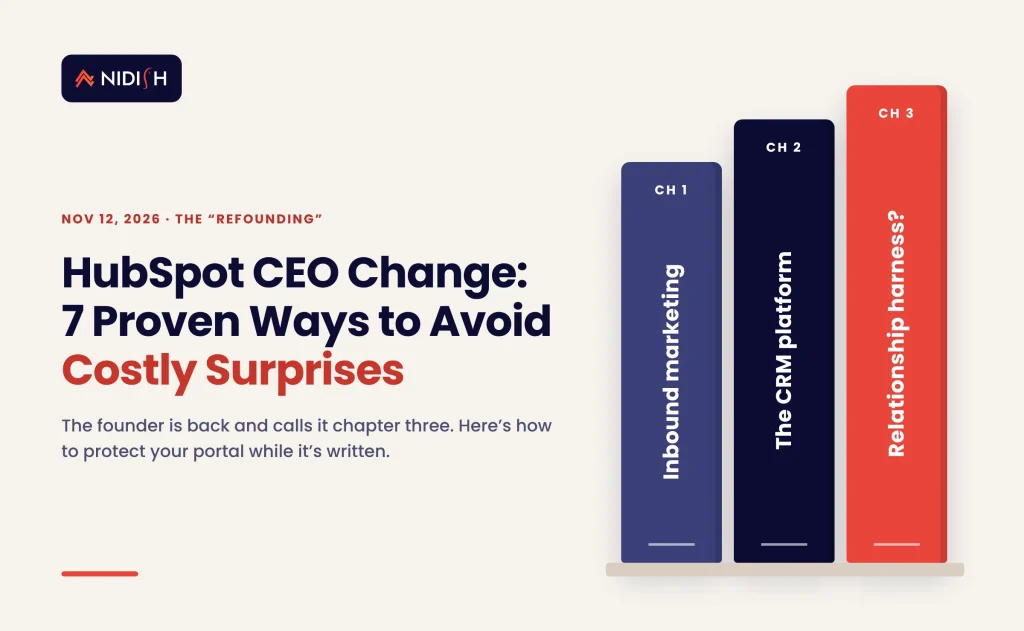
Halligan framed the move as a third chapter. Chapter one was inbound marketing. Chapter two was the CRM platform that hundreds of thousands of businesses use. In his words, “Chapter three is building the customer relationship harness that will enable millions to grow better.”
That phrase, “customer relationship harness,” is new. Halligan has not defined it in product terms yet. Reading it plainly, a harness is something that connects, controls and directs. The likely meaning is a CRM that acts as the system AI agents and other tools plug into, rather than a set of screens people click through. That is our reading, not HubSpot’s definition.
A few other signals are worth noting:
- “Headless HubSpot.” According to CX Today, Shah posted on X that HubSpot will accelerate “Headless HubSpot” and that Duncan Lennox is now president of product. Six days later, HubSpot made it official (see below).
- Independence. The Next Web, citing Bloomberg, quotes Halligan saying he does not want HubSpot “swallowed up by a private equity firm or shrink.”
- Product over short-term targets. The same report says Halligan believes HubSpot may have focused too much on short-term financial targets rather than great products.
The first concrete move came on November 18, 2026. Lennox published HubSpot is headless. Here’s how we’ll price it. The key points:
- “Every HubSpot seat comes with enough headless access to complete your everyday work from Claude or ChatGPT, at no additional cost.”
- That covers HubSpot’s connectors for Claude, ChatGPT, Gemini and Microsoft Copilot, plus its MCP server and Agent CLI.
- Third-party agents on existing APIs count toward your plan’s API capacity and “will not consume credits.” For teams already using those APIs, “nothing changes.”
- Power users and agents working “at scale” in a new governed agent environment will pay with HubSpot Credits. Credit allowances and the launch date were not published.
What has not been said matters just as much. There is no full product roadmap, no change to partner programs and no change to existing contracts. Halligan has said he will share more of the refounding plan. If someone tells you more than this, ask for the source.
Why the HubSpot CEO change happened now
The short answer is slowing growth. HubSpot’s Q3 2026 results, reported on November 4, 2026, looked fine on the surface and worrying underneath.
| Metric (Q3 2026) | Figure | Why it matters to customers |
|---|---|---|
| Revenue | $947.6M, up 17% year over year | Still growing, still profitable |
| Q4 2026 revenue guidance | $945M–$947M, up about 12% | Sharp slowdown expected |
| Customers | 311,704, up 12% | Customer growth is slowing |
| Average subscription revenue per customer | $12,038, up 4% | Upsell is getting harder |
| Net revenue retention | 101% | Existing customers are barely expanding |
| October 2026 restructuring | About 7% of staff, roughly 660 people | Support and partner teams may feel it |
Figures from PPC Land’s Q3 earnings coverage and CX Today. Confirm against HubSpot’s investor relations filings before quoting.
Net revenue retention of 101% is the number to watch. It means the average customer is spending only slightly more than a year ago. For a platform built on upsell from Starter to Pro to Enterprise, that is a warning sign. Halligan himself acknowledged it, telling Bloomberg, “the numbers aren’t great.”
What it means for HubSpot customers today
Nothing breaks on Monday. Your portal, workflows, sequences, reports and integrations keep running. Your contract terms do not change because the CEO did.
The risk is in the next 6–18 months. A refounding usually means new packaging, new pricing and new product bets. Here is where we expect HubSpot customers to feel it first:
- HubSpot pricing and packaging. HubSpot is already piloting a single “go-to-market seat” for new customers, with usage moving into a shared credits pool. It started in the Nordics in April 2026, expanded to Benelux in June, and extends to all new EMEA customers in Q4 2026.
- Existing contracts. On the Q3 call, Rangan said existing customers are not included in that pilot and there is no migration timeline. A new leadership team can revisit that. We covered the mechanics in our HubSpot credits pricing breakdown.
- AI agents. HubSpot reported over 5,600 custom agents deployed by Pro-and-above customers. The November 18 pricing post confirms that agent work at scale will be paid in credits.
- APIs and integrations. Headless means more API and connector surface. That is good news for custom integrations, but it can also bring API version changes and deprecations.
- Support and partner experience. One analyst writing for TechTarget warned that cutting about 7% of staff while changing both CEO and CFO could cause temporary hiccups in support responsiveness.
We see this pattern constantly with platform resets: the product gets better in the long run, but customers who never documented their setup pay for every surprise in the short run.
7 proven ways to avoid costly surprises after the HubSpot CEO change
These are the steps we recommend to every HubSpot client this quarter. None of them requires betting on what Halligan will do. They make you resilient to whatever he does.
1. Document your portal before anything moves
Export a list of every workflow, custom property, custom object, pipeline, integration and private app. Note who owns each one and why it exists. Most portals we inherit have dozens of workflows nobody can explain.
The fix: a one-page system map plus a property dictionary. If HubSpot changes packaging, you will know exactly which features you depend on and which tier they sit in. Our guide to HubSpot data model design is a good starting template.
2. Read your renewal terms now, not 30 days before renewal
Find your renewal date, your notice period, your price-lock clause and your seat and contact tier limits. Many HubSpot contracts auto-renew. If a new pricing model lands in 2027, the timing of your renewal decides whether you are protected.
The fix: put your renewal date and notice deadline on the calendar today. If you are close to renewal, ask your HubSpot rep in writing what pricing applies at that date.
3. Track credits usage as if you were already billed for it
Everyday Claude or ChatGPT use is included with a seat, but “everyday” has no published ceiling. Agent work at scale and power-user overflow run on credits. Measure how much AI, enrichment and automation you use now, so you have 6 months of usage data, not a surprise invoice.
The fix: a simple monthly log of AI actions, enrichment calls and agent conversations. Set a budget threshold and an owner.
4. Decouple your integrations from the UI layer
HubSpot is now openly headless. Integrations built on clean APIs will adapt. Integrations built on brittle workarounds will not. That applies most to ERP sync, billing and quoting.
The fix: route critical syncs (HubSpot to NetSuite, QuickBooks or Xero) through a documented middleware or service layer with error logging. Our comparison of REST API vs native integration for HubSpot and NetSuite explains the trade-offs.
5. Keep a clean, portable data model
Leadership changes are when companies start asking “should we switch?” Whether you stay or not, clean data gives you options. Duplicates, unused properties and free-text fields make every future move more expensive.
The fix: run a data hygiene sprint. Merge duplicates, archive dead properties and standardise picklists. The CRM data migration checklist nobody follows applies even if you never migrate.
6. Pilot new AI features in a sandbox, with guardrails
Expect a wave of agent and AI announcements in 2027. Turning them on in production because a sales rep demoed them is how teams lose data quality and budget.
The fix: test new agents in a sandbox or on a limited pipeline first. Define what the agent may write to the CRM, who reviews it and what it costs per month.
7. Watch three dates and decide at each one
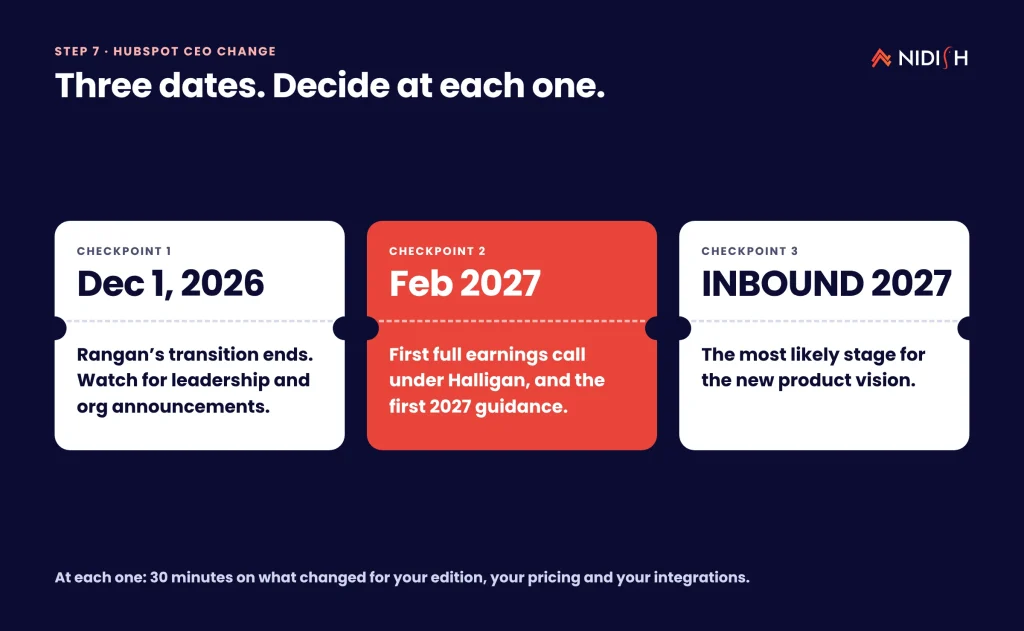
You do not need to react to every headline. Set three checkpoints:
- December 1, 2026: Rangan’s transition ends. Watch for leadership and org announcements.
- February 2027 earnings call: the first full call under Halligan, and the first 2027 guidance.
- INBOUND 2027: the most likely stage for the new product vision.
The fix: at each checkpoint, spend 30 minutes reviewing what changed for your edition, your pricing and your integrations. Then decide: stay the course, adjust, or plan a change.
If you want a second pair of eyes on your portal before renewal, our HubSpot consulting team runs exactly this kind of review.
HubSpot roadmap: what to watch over the next 12 months
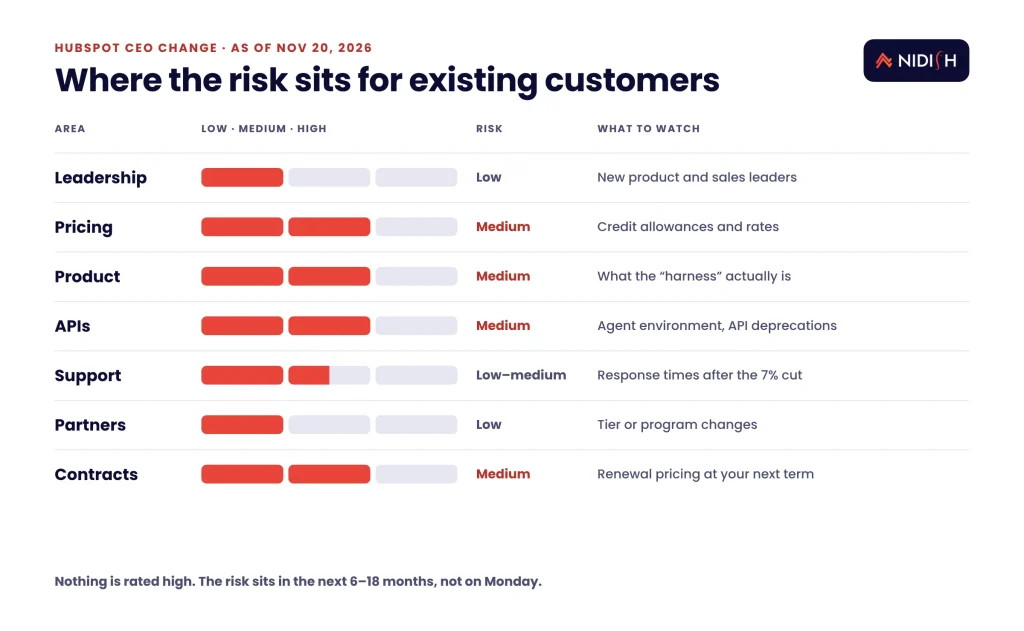
Use this table to separate confirmed facts from speculation when your leadership team asks what is changing. It reflects public announcements and reporting up to November 20, 2026.
The pattern to expect is simple. Leadership and finance changes land first, then packaging, then product. Your exposure depends on how much of your revenue process runs through HubSpot features that are still evolving, such as AI agents, credits-based tools and connectors.
| Area | Confirmed as of November 20, 2026 | What to watch | Risk level for existing customers |
|---|---|---|---|
| Leadership | Halligan CEO; Burgess CFO from Feb 11, 2027 | New product and sales leaders | Low |
| Pricing | Everyday AI connector use included per seat; agents at scale use credits; seat-and-credits pilot for new EMEA customers | Credit allowances, rates and any extension to existing customers | Medium |
| Product | Breeze, agents and connectors continue | “Customer relationship harness” definition | Medium |
| APIs | Existing API use unchanged; agent API calls use plan capacity, not credits | Governed agent environment launch, API version deprecations | Medium |
| Support | No change announced | Response times after the 7% restructuring | Low to medium |
| Partners | No change announced | Partner tier or program changes | Low |
| Contracts | Existing terms stand | Renewal pricing at your next term | Medium |
Should you switch from HubSpot because of the CEO change?
No, not because of the CEO change alone. A leadership change is a reason to review, not a reason to migrate. HubSpot remains profitable, it still grew revenue 17% in Q3 2026, and its founders are now running it again with a stated focus on product.
Switching CRMs costs real money and months of disruption. It only makes sense if HubSpot already fails your requirements today, for example on complex CPQ, deep ERP logic or enterprise permissions. If that is your situation, compare honestly. Our HubSpot vs Salesforce comparison is a fair starting point.
There is also a cost to waiting too long. If HubSpot announces a packaging change that removes a feature from your tier, you want options ready, not a rushed project. That is why the review steps above matter more than the switch question.
For most teams, the better move is to tighten what you have. A cleaner portal, documented integrations and clear contract terms make you stronger whatever HubSpot does next.
Common mistakes to avoid during the transition
Panic-migrating
Moving CRMs because of a headline usually costs more than any price change HubSpot could make.
Renewing on autopilot
Letting a multi-year renewal roll over without reading the terms gives away your leverage.
Buying features on roadmap promises
Buy what is generally available today. Roadmaps change, and new CEOs change them faster.
Ignoring integration debt
API changes hit undocumented, hard-coded integrations first.
Assuming support will stay the same
Log critical issues formally and keep a partner who knows your portal.
How Nidish approaches this
We have been building on HubSpot through several of its platform shifts, from Operations Hub to Breeze to the credits pilot. Our approach is boring on purpose. We map what you have, find what is fragile, and fix the integrations and data that would make any future change expensive. We do not tell clients to switch platforms on a headline. When a HubSpot client needs ERP or billing sync, our HubSpot integration services focus on clean, logged, API-based connections that survive product changes.
Frequently asked questions
Who is the new CEO of HubSpot?
Brian Halligan, HubSpot’s co-founder, became CEO on November 12, 2026. He previously led the company for 16 years before stepping down in 2021. He replaced Yamini Rangan, who stepped down as CEO and from the board and stays with the company through December 1, 2026 to support the transition.
Why did Yamini Rangan step down as HubSpot CEO?
HubSpot has not given a detailed public reason. The change followed Q3 2026 results with Q4 guidance of about 12% growth, net revenue retention of 101% and an October restructuring of about 7% of staff. Halligan said publicly that the recent numbers “aren’t great” and described his return as a refounding.
Will HubSpot pricing change after the CEO change?
Partly. On November 18, 2026, HubSpot said every seat includes everyday AI access from Claude or ChatGPT at no extra cost, while agent work at scale uses credits. A seat-plus-credits pilot also covers new EMEA customers. Credit allowances are not published yet, so review your contract terms now.
What does “customer relationship harness” mean?
It is the phrase Halligan used for HubSpot’s next chapter. HubSpot has not formally defined it. Our reading is a CRM that acts as the data and control layer AI agents plug into, backed by its new headless pricing post. Treat it as direction, not a feature list.
Should I switch CRMs because of the HubSpot leadership change?
Not because of the leadership change alone. HubSpot remains profitable and grew revenue 17% in Q3 2026. Switching only makes sense if HubSpot already fails your needs today. For most teams, documenting the portal, cleaning data and reviewing renewal terms is the better response.
Will my HubSpot integrations break?
Not from the leadership change itself. HubSpot’s November 18 pricing post says that for teams already using its APIs, “nothing changes.” The longer-term risk is new API versions and deprecations. Integrations built on documented APIs with error logging adapt easily. Hard-coded workarounds are the ones that break.
Where to start
The HubSpot CEO change is a signal, not an emergency. HubSpot is about to change how it builds, sells and prices its platform. The teams that come out ahead will be the ones who know exactly what they run, what they pay and what they depend on.
Start with the first two steps this week: document your portal and read your renewal terms. Then set your three checkpoint dates.
Book a 30 minute call. We’ll tell you honestly whether you need a portal clean-up, an integration rebuild, or nothing at all.


 Blog
 Case Studies
 Career