
Table of Contents
Most AEO guides tell you the same three things: write clear answers, use schema markup, and structure your content well. All true, none of it explains how to actually do the work. This guide skips the definitions everyone already knows and gets into the mechanics: how to structure different types of pages by search intent, what actually needs to happen at the crawler and schema level, how to build the trust signals AI systems weigh before citing a source, and how to measure whether any of it is working.
If you want to optimize your website for AI search rather than just understand the concept in theory, this is the version with the actual steps you can act on this week.
Quick Answer: How to Optimize Your Website for AI Search
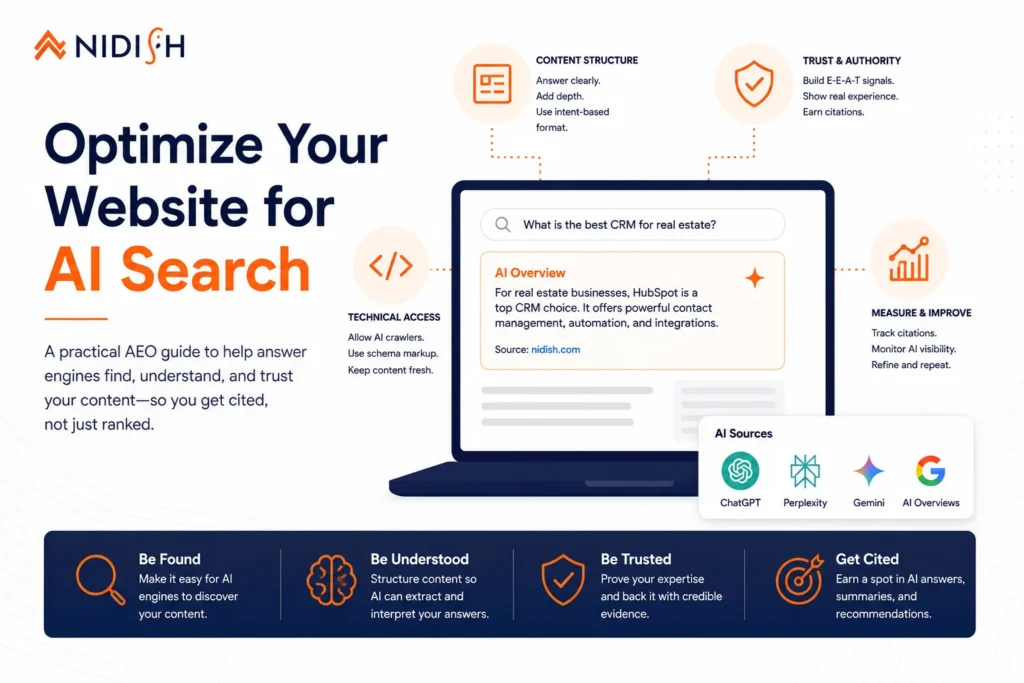
To optimize your website for AI search, structure content so it answers a specific question clearly within the first few sentences, then support that answer with depth, credible sourcing, and clean technical access for AI crawlers. The core work spans four areas: content structure matched to search intent (definitional, process, comparison, or decision), technical access (crawler permissions and schema markup), trust signals (E-E-A-T, first-party data, author credibility), and measurement (tracking citation and extraction rates across ChatGPT, Perplexity, and Google AI Overviews rather than traditional rankings alone).
Why You Need to Optimize Your Website for AI Search Now
The shift here is bigger than most SEO conversations acknowledge. Zero-click search now accounts for roughly 68% of Google searches, and ChatGPT alone serves close to 900 million weekly users, which means a meaningful and growing share of research now happens entirely inside an AI conversation, with a synthesized answer replacing the click to your website altogether.
Google AI Overviews now appear in nearly 55% of all Google searches, and Gartner has projected traditional organic search volume could decline 25 to 50% by 2026 as this shift continues. Ranking on page one still matters, but it’s no longer the whole game. The real question becoming just as important is whether an AI system will actually find your content, trust it, and use it when constructing an answer, which is exactly what it means to optimize your website for AI search in practice.
How Do Answer Engines Decide What to Cite? (Why This Governs How You Optimize Your Website for AI Search)
Before optimizing anything, it helps to understand the mechanism, because AEO tactics only make sense once you know what they’re actually influencing.
Most major AI systems, ChatGPT, Perplexity, Gemini, and Google’s AI Overviews, rely heavily on retrieval-augmented generation, pulling in current information from live web search rather than relying purely on what the underlying model learned during training. This is a meaningful shift industry experts have pointed to directly, with search visibility becoming one of the most reliable ways to influence what an LLM says about you, since these systems increasingly lean on real-time search results to construct accurate, current answers.
That means working to optimize your website for AI search improves three specific things at once: whether an answer engine can find the relevant content in the first place, whether it can clearly understand what that content actually says, and whether it has enough reason to trust and justify using it in a generated answer. Miss any one of those three when you try to optimize your website for AI search, and the other two don’t matter, content the crawler can’t access never gets a chance to be understood or trusted.
The Four Content Intent Types You Need to Optimize Your Website for AI Search
This is the part most AEO advice skips entirely, treating all content as if one structural template fits every page. It doesn’t. Search intent inside AI answer engines generally falls into four distinct buckets, and each one needs a genuinely different page design, not just a shared “answer box at the top” formula.
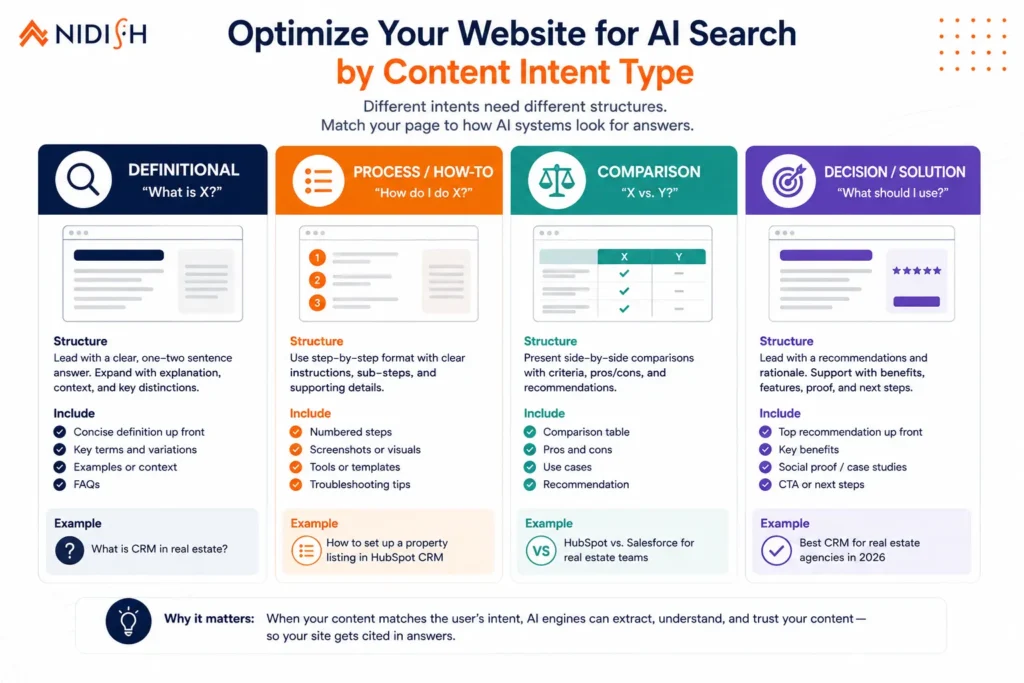
Definitional intent: (“what is X”), the first structure to get right when you optimize your website for AI search. These pages need to lead with a concise, plain-language answer in the first sentence or two, the exact thing a snippet or AI Overview would want to lift directly, then expand with explanation, context, and relevant distinctions. Burying the definition under three paragraphs of preamble is the single most common mistake on this type of page.
Process intent: (“how to do X”). These need ordered, numbered workflows, not narrative prose describing steps in paragraph form. Concrete examples, checklists, and a troubleshooting section for what goes wrong at each step all increase how usable the content is for an AI system trying to extract a clean, reusable sequence.
Comparison intent: (“X vs Y”). These pages perform best with genuinely balanced tables, explicit evaluation criteria, and a direct recommendation tied to specific scenarios, not just prose that vaguely gestures at pros and cons. An AI system extracting a comparison needs the criteria to be scannable and the verdict to be explicit.
Decision intent: (“best AEO agency,” “which CRM should I use”). These need real evaluation frameworks, not just a ranked list. What criteria matter, how those criteria trade off against each other, and specific scenarios pointing toward specific answers.
Building every page on your site with the same generic “answer, then explain” template, regardless of which of these four intents it’s actually serving, is why so much content aiming to optimize a website for AI search underperforms despite technically having a summary box up top.
The Technical Layer: How to Optimize Your Website for AI Search at the Crawler Level
Content structure means nothing if the AI system can’t reach or parse the page in the first place, and this is the part of AEO that gets skipped most often because it requires a developer, not just a content edit.
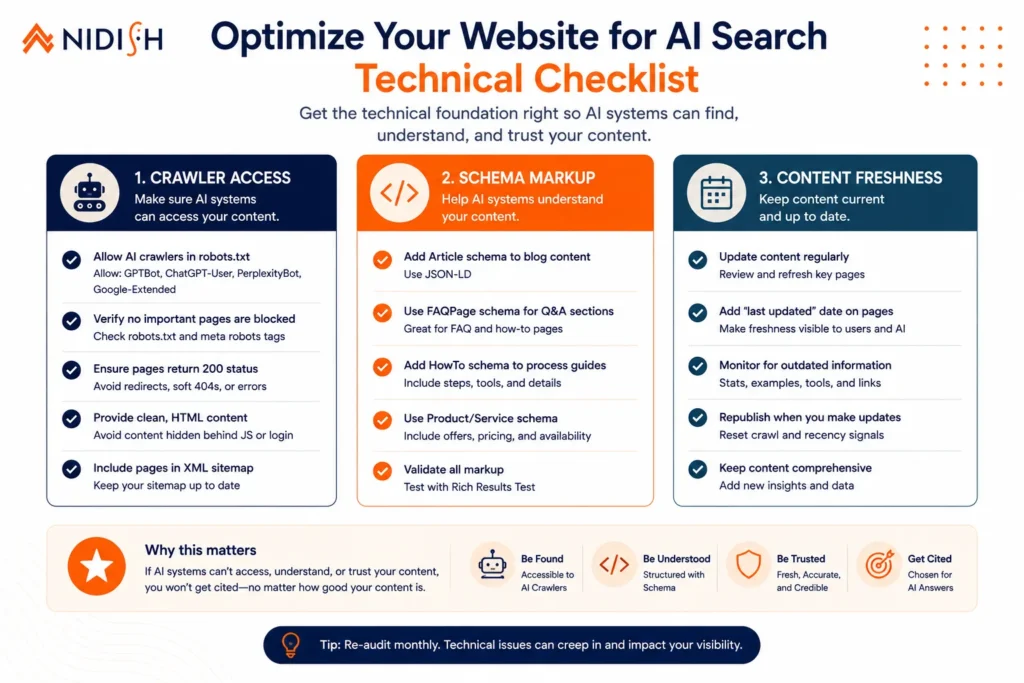
Crawler access: This is the single most skipped step when businesses try to optimize their website for AI search. If you want your pages to appear as sources in ChatGPT search specifically, your site needs to explicitly allow OAI-SearchBot, OpenAI’s dedicated crawler, rather than assuming standard search engine crawler rules automatically cover it. Checking your robots.txt file for this specifically, rather than assuming it’s covered by a blanket “allow all” rule, is a five-minute technical check most businesses have simply never done.
Schema markup: Structured data doesn’t just help traditional search engines understand a page, it gives AI systems an unambiguous, machine-readable version of your content’s meaning, reducing the interpretation work an LLM has to do before it can confidently cite you. FAQPage schema, HowTo schema, and Article schema with clear author and organization markup all reduce that ambiguity directly.
Content freshness: Another factor that quietly determines how well you optimize your website for AI search over time. Answer engines weigh recency heavily, particularly for high-intent, decision-stage content. A page with an outdated publish date and no visible update history is a weaker citation candidate than one showing clear, recent maintenance, regardless of how good the underlying content actually is.
E-E-A-T: The Trust Layer Behind Any Real Attempt to Optimize Your Website for AI Search
Content structure and technical access get you found and understood. Trust signals are what get you actually cited over a competing source saying something similar.
AEO leans heavily on the same E-E-A-T framework Google has used for search quality for years, Experience, Expertise, Authoritativeness, and Trustworthiness, alongside first-party data and clear answer-first structure, because these are exactly the signals an AI system uses to judge whether a source is safe to rely on when generating an answer that a user will treat as fact.
In practice, building the trust layer needed to optimize your website for AI search means visible author credentials on content that claims expertise, first-party data or original research rather than only aggregating what other sources already say, and citations of your own that model the same sourcing behavior you want an AI system to extend to you. Content that reads as generic, unattributed, and indistinguishable from a dozen other pages saying the same thing rarely wins the citation, even if it technically answers the question correctly.
How to Measure Whether You’ve Actually Optimized Your Website for AI Search
This is the step most businesses skip entirely, because AEO measurement doesn’t map cleanly onto the keyword-ranking dashboards teams are used to.
The simplest measurement approach is direct and manual: pick five to ten common questions in your specific niche, ask each one to ChatGPT, Perplexity, and Google AI Overviews, and track how many of the resulting answers actually cite or reference your content. Hitting a citation rate above roughly 60% on your core topic area is a reasonable signal you’ve built real topical authority in that space, not just published content about it.
Beyond manual spot-checks, which remain the most accessible way to confirm you’ve started to optimize your website for AI search successfully, Google added dedicated generative AI performance reporting inside Search Console in June 2026, giving a first real data source for AI-driven visibility rather than relying purely on manual testing. Specialized platforms built specifically for this, tools tracking AI citation frequency, brand mentions, and referral traffic from AI platforms directly, have also emerged as this category has matured, worth evaluating once manual spot-checks confirm you’re getting real traction worth tracking systematically.
Why Website Architecture Quietly Limits How Well You Can Optimize Your Website for AI Search
This is a technical dependency most AEO content never mentions, and it’s directly relevant if your site runs on a CMS with theme-based page templates, which is most business websites.
AI tools that generate or edit pages, and increasingly, AI crawlers extracting structured answers from your existing pages, both depend heavily on how cleanly your underlying template separates distinct content zones: a clear answer block, a defined FAQ section, properly nested heading hierarchy. A page built on loosely structured templates, inconsistent heading levels, and content crammed into generic text blocks gives both AI generation tools and AI extraction crawlers far less to work with, regardless of how well-written the actual content is.
This is a core part of any real effort to optimize your website for AI search, and we’ve covered this exact dependency in more technical depth in our piece on how your HubSpot theme structure affects Breeze AI’s output quality, the same underlying principle, that structure determines the ceiling on what AI tools can do with your content, applies just as directly to how cleanly an outside AI search engine can extract and cite your pages, not just how HubSpot’s own AI tools generate them.
A Practical First 30 Days to Optimize Your Website for AI Search
Given everything above, a genuinely practical starting sequence looks like this, rather than trying to overhaul an entire site’s content architecture at once.
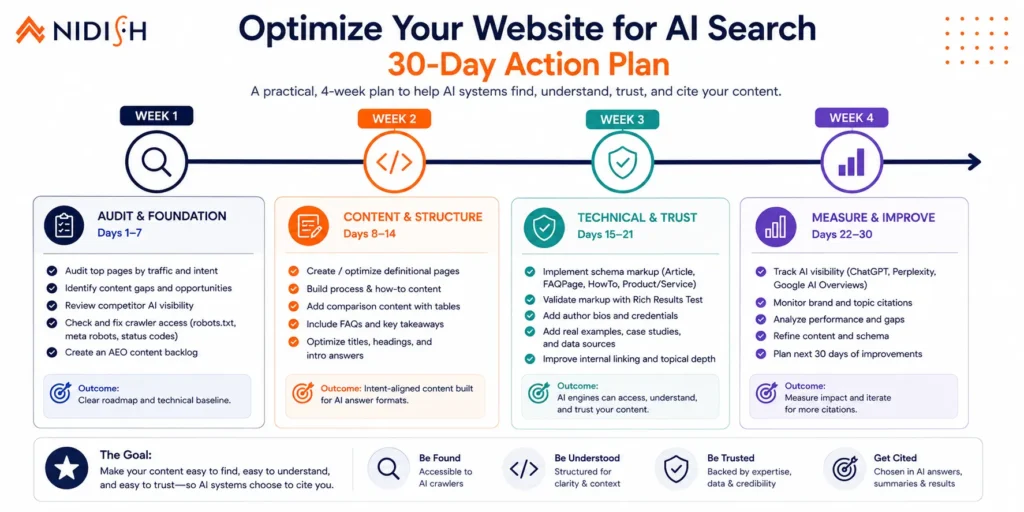
Week 1: Audit and classify
This is where any serious plan to optimize your website for AI search actually starts. Pick your ten highest-traffic or highest-intent pages and classify each one by intent type, definitional, process, comparison, or decision. Most sites discover a handful of pages awkwardly straddling multiple intents, which is itself a structural problem worth fixing.
Week 2: Fix the technical foundation
Confirm OAI-SearchBot and other major AI crawlers aren’t being blocked, add or audit FAQPage and Article schema on your priority pages, and check publish and update dates are visible and current.
Week 3: Restructure your top pages by intent
Rewrite the top of each priority page to lead with a direct, extractable answer matched to its actual intent type, a plain-language definition, a numbered process, a comparison table, or an explicit decision framework, rather than a generic summary paragraph.
Week 4: Establish your baseline and start measuring
By this point you’ve done the real work to optimize your website for AI search, now it’s time to confirm it’s paying off. Run the manual five-to-ten question test across ChatGPT, Perplexity, and Google AI Overviews for your core topic area, and set a realistic, modest goal, even one or two confirmed citations is a meaningful early signal, since AEO measurement is still a maturing discipline without the reporting depth traditional SEO has had for years.
Common Mistakes When You Try to Optimize Your Website for AI Search
- Treating AEO as a content-only exercise: Technical crawler access and schema markup matter just as much as writing quality, and skipping them caps the ceiling of even excellent content.
- Using the same page structure regardless of intent: A comparison page structured like a definitional page, or vice versa, gives an AI system a poor match between what it needs and what it finds.
- Chasing AI citations with generic, unattributed content: Without real E-E-A-T signals, first-party data, visible expertise, original sourcing, content tends to lose the citation to a source that demonstrates more credibility, even on an identical topic.
- Measuring AEO with traditional ranking tools alone: Keyword position doesn’t tell you whether an AI system is actually citing you, that requires direct testing against the AI platforms themselves.
- Optimizing once and moving on: A one-time push to optimize your website for AI search fades quickly, since content freshness is a real, ongoing weighting factor, not a one-time setup task.
How Nidish Can Help You Optimize Your Website for AI Search
We build AEO structure into the content we produce by default now, the quick-answer boxes, question-phrased subheadings, and FAQ schema you’ll notice across our own recent blog work aren’t decorative, they’re the same practical structure covered in this guide, applied consistently. If you want your existing content audited against this framework, or a content and technical foundation built specifically to optimize your website for AI search from the start rather than retrofitted later, that’s exactly the kind of project we take on. Our HubSpot implementation services page covers the broader technical foundation work, and if your current site’s theme structure might be limiting what’s possible here, our piece on HubSpot theme architecture and AI tools is a useful next read.
Frequently Asked Questions
What is the difference between AEO and SEO?
SEO focuses on ranking in traditional search engine results pages. AEO focuses on getting content cited or directly used as an answer inside AI systems like ChatGPT, Perplexity, and Google AI Overviews. The two overlap significantly and work best together, rather than as competing strategies.
How do I optimize my website for AI search specifically?
To optimize your website for AI search, structure content to match one of four intent types (definitional, process, comparison, or decision), confirm AI crawlers like OAI-SearchBot can access your site, add schema markup like FAQPage and Article, build visible E-E-A-T signals, and measure citation rates directly by testing your own content against ChatGPT, Perplexity, and Google AI Overviews.
How long does it take to see results after you optimize your website for AI search?
There’s no fixed timeline, since AI citation patterns shift as models update and re-crawl the web, but a reasonable early goal is one or two confirmed citations within the first month or two of focused work, with citation rate improving as topical authority builds over a longer period.
Do I need special tools to measure AEO performance?
Not initially. Manually asking your target questions directly to ChatGPT, Perplexity, and Google AI Overviews and checking whether your content is cited is a legitimate starting measurement. Specialized tracking tools become more useful once you’ve confirmed real traction worth monitoring systematically.
Does my website’s CMS or theme affect AI search visibility?
Yes. Clean heading hierarchy, clearly separated content zones, and well-structured FAQ sections make it easier for AI crawlers to extract and cite your content accurately. A loosely structured template with content crammed into generic blocks limits how well even strong writing can perform.


 Blog
Blog Case Studies
 Career