
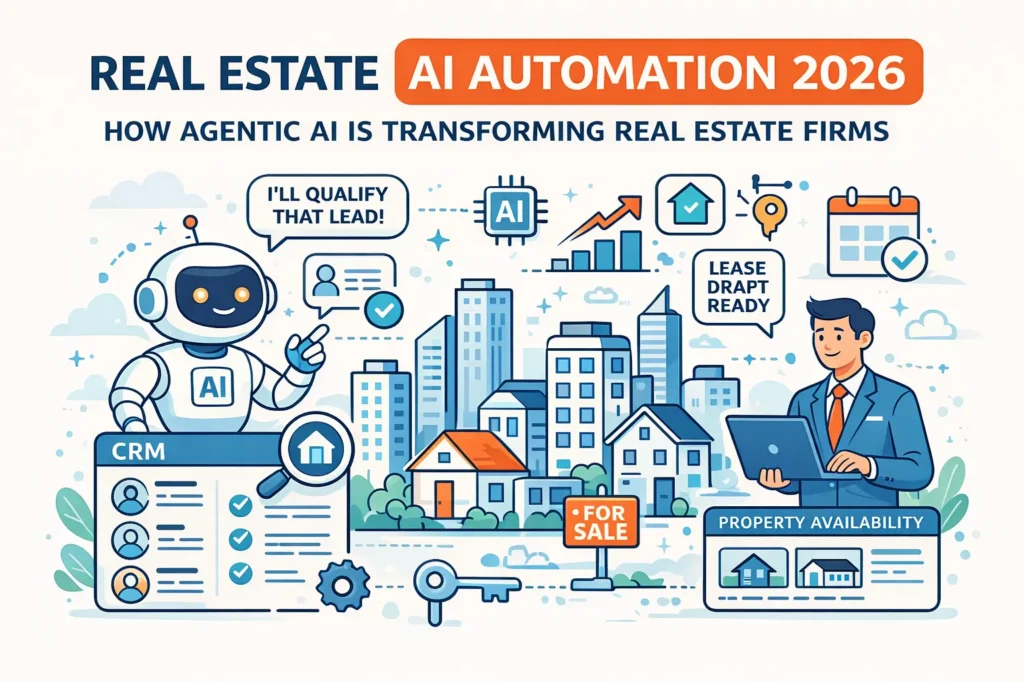
Introduction: The Shift from Chatbots to Intelligent Systems
For years, real estate firms have depended on chatbots to handle basic customer interactions—answering common questions, collecting contact information, and scheduling property visits. While useful, these tools were always limited in scope. They could respond, but they couldn’t act.
In 2026, that limitation is no longer acceptable.
The industry is rapidly moving toward agentic AI, where systems are capable of making decisions and executing tasks autonomously. This shift is redefining real estate AI automation, turning it from a support function into a core operational layer within modern brokerages.
Table of Contents
What is Agentic AI in Real Estate?
Agentic AI represents a significant evolution in automation. Instead of relying on predefined scripts or static workflows, these systems operate with a level of contextual awareness. They can interpret user intent, evaluate data, and take action across multiple steps without requiring manual intervention.
In a real estate environment, this means AI is no longer just assisting your team it is actively participating in operations. From qualifying leads to managing listings and generating documents, agentic AI functions as a digital extension of your workforce embedded directly within your CRM.
From Chatbots to AI Agents: A Fundamental Shift
The difference between traditional chatbots and agentic AI is not incremental—it is architectural.
Chatbots are reactive by design. They wait for user input and respond based on predefined logic. Agentic AI, on the other hand, is proactive. It evaluates scenarios, initiates actions, and continuously adapts based on new data.
This shift transforms automation from a front-end interaction layer into a backend execution engine. Instead of assisting your processes, AI begins to run them.
How Agentic AI is Powering Real Estate AI Automation
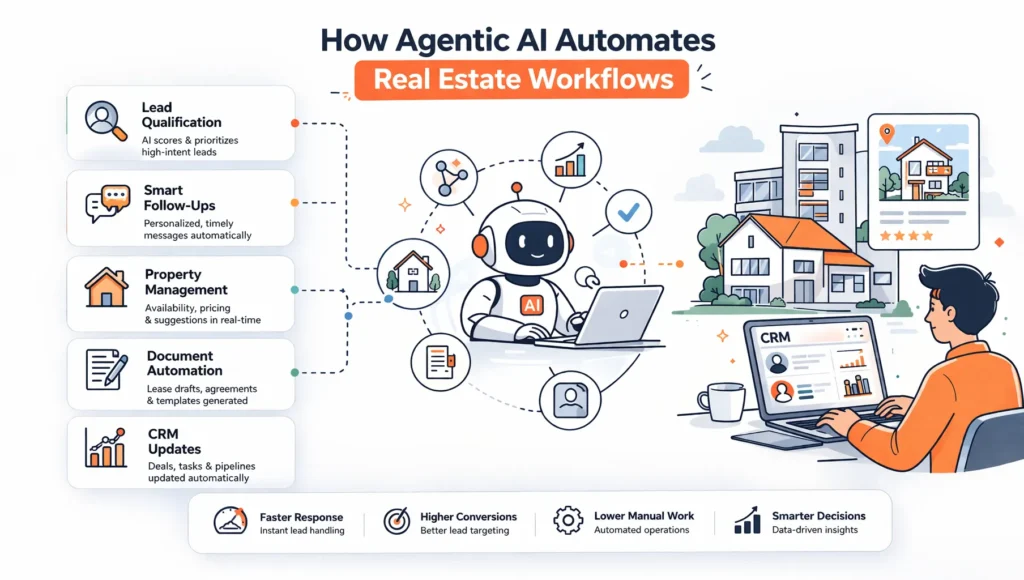
One of the most immediate impacts of agentic AI can be seen in lead qualification. Instead of manually reviewing inquiries or relying on basic form submissions, AI agents analyze multiple signals such as budget range, location preference, urgency, and engagement behavior to determine the quality of a lead. High-intent prospects are automatically routed to sales teams, while others are nurtured through personalized follow-ups.
Property management also becomes significantly more efficient. AI systems can check real-time availability directly within your CRM, ensuring that prospects always receive accurate information. If a property is unavailable, the system can instantly suggest alternatives, reducing friction in the buying or renting journey.
Follow-ups, which are often inconsistent in traditional workflows, become systematic and intelligent. Agentic AI tracks user interactions and triggers communication at the right moment, adapting messaging based on where the prospect is in the decision-making process. This creates a seamless and continuous engagement experience.
Perhaps one of the most transformative applications is document automation. Tasks such as drafting lease agreements, pre-filling client details, and ensuring compliance with templates can now be handled automatically. What once required hours of manual effort can now be completed in minutes with high accuracy.
All of these capabilities come together within the CRM. Instead of simply storing data, platforms like HubSpot become operational hubs where AI agents manage pipelines, update records, assign tasks, and trigger workflows. This is where real estate AI automation truly delivers value by turning systems into active participants in your business operations.
Why Real Estate Firms Are Adopting Agentic AI in 2026
The adoption of agentic AI is being driven by a combination of operational pressure and competitive necessity. Real estate firms are dealing with increasing volumes of inquiries, higher customer expectations, and the need for faster response times.
Agentic AI addresses these challenges by enabling firms to operate at scale without proportionally increasing resources. Tasks that previously required multiple team members can now be handled by automated systems, reducing costs while improving efficiency.
At the same time, customer experience improves significantly. Buyers and renters receive faster, more accurate responses, which directly impacts conversion rates. In a market where timing and responsiveness are critical, this creates a measurable competitive advantage.
How HubSpot Enables Advanced Real Estate AI Automation
HubSpot plays a central role in enabling agentic AI systems. Its flexibility allows businesses to go beyond standard CRM usage and build deeply integrated workflows tailored to their operations.
When combined with AI, HubSpot can act as the command center for your entire real estate process. Data flows seamlessly between systems, workflows are triggered automatically, and every interaction is tracked and optimized.
However, the true value does not come from out-of-the-box features. It comes from custom implementation—designing workflows, integrations, and automation layers that align with your specific business model.
The Nidish Approach: Beyond Plug-and-Play Automation
Most automation solutions in the market are template-driven. They offer quick deployment but lack the depth required to handle complex real estate workflows.
At Nidish, the approach is fundamentally different. Instead of applying generic solutions, we design custom agentic systems that integrate deeply with HubSpot and align with how your business actually operates.
This includes building intelligent workflows, connecting multiple data sources, and ensuring that automation is not just functional but scalable. The goal is not to add another tool, but to create a system where your operations can run with minimal manual intervention.
Challenges to Consider Before Implementation
While the benefits of agentic AI are significant, implementation requires careful planning. The effectiveness of automation depends heavily on the quality of your data and the clarity of your workflows.
Without structured data and well-defined processes, even the most advanced systems can produce inconsistent results. This is why successful implementation often involves refining existing operations before layering automation on top.
The Future: The Fully Agentic Real Estate Office
The direction is clear, real estate firms are moving toward fully agentic operations.
In this model, AI handles the majority of operational tasks, from lead intake to transaction management. Human agents focus on high-value activities such as relationship building, negotiations, and closing deals.
This shift is not about replacing people; it’s about enabling them to operate more effectively by removing operational bottlenecks.
Conclusion
The transition from chatbots to agentic AI represents a fundamental shift in how real estate businesses function.
Real estate AI automation is no longer limited to improving efficiency it is redefining operational structure.
Firms that embrace this change will be better positioned to scale, compete, and deliver exceptional client experiences in an increasingly digital market.
How Nidish Can Help
At Nidish, we help real estate firms build advanced, HubSpot-powered real estate AI automation systems that go beyond basic workflows.
Whether your goal is to streamline lead management, automate property operations, or build a fully agentic CRM environment, our focus is on delivering solutions that are tailored, scalable, and built for long-term growth.


 Blog
Blog Case Studies
 Career