
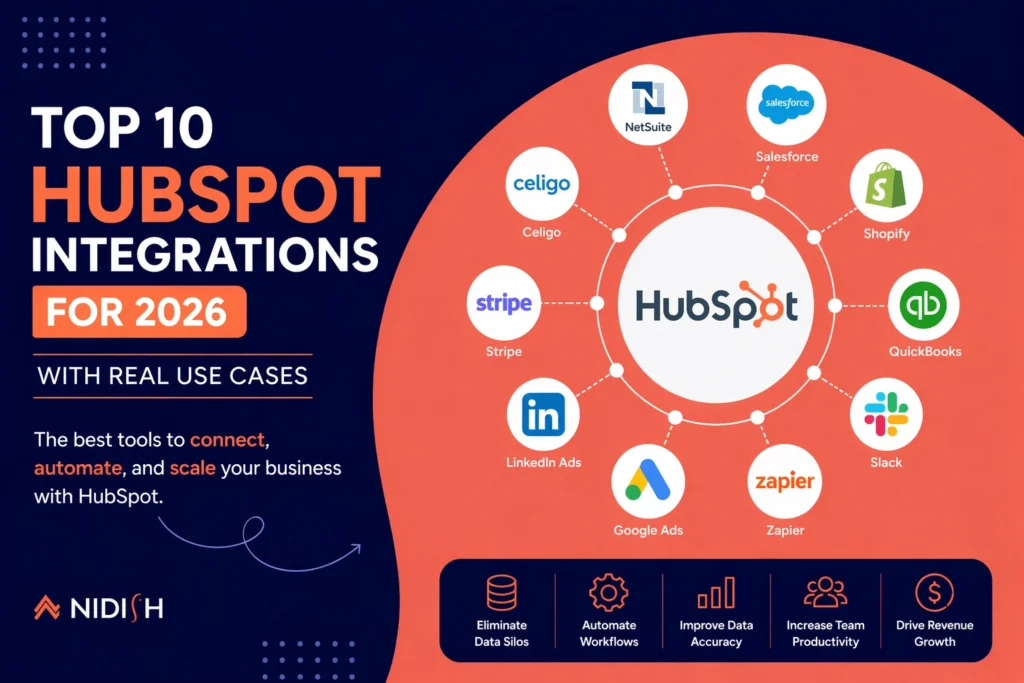
HubSpot integrations 2026 are no longer just about connecting tools. They are about building a fully connected system where CRM, ERP, marketing, and finance work together seamlessly.
If you’re exploring the best HubSpot integrations, you’re likely trying to solve issues like data silos, manual workflows, and lack of visibility across teams..
This guide breaks down the top HubSpot CRM integrations that actually drive efficiency, backed by real-world use cases.
Table of Contents
Why HubSpot Integrations Matter
As businesses scale, HubSpot integrations 2026 are becoming essential for eliminating data silos and improving cross-team visibility. A well-planned HubSpot integrations 2026 strategy focuses on connecting the right systems rather than integrating everything at once.
When HubSpot is properly integrated:
- Sales, marketing, and finance operate on the same data
- Reporting becomes reliable
- Manual work is reduced significantly
The result is a connected system that supports faster growth.
Top 10 HubSpot Integrations for 2026
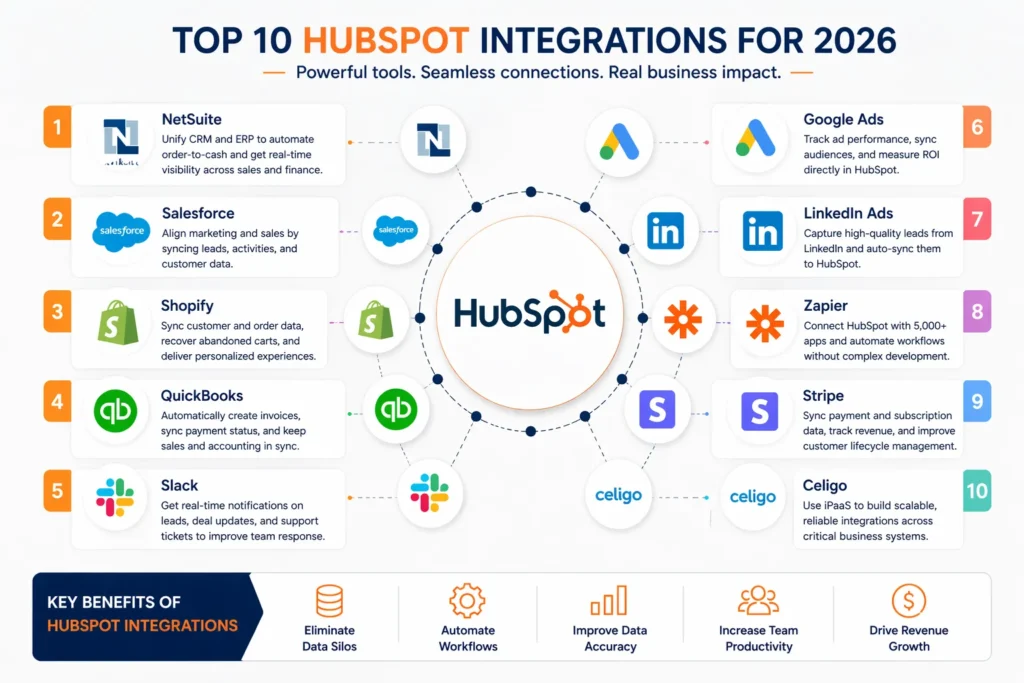
1. NetSuite + HubSpot
For companies looking at a HubSpot NetSuite integration, the goal is typically to connect CRM with ERP and eliminate gaps between sales and finance.
Real use case: A manufacturing company connects HubSpot with NetSuite so that when a deal is closed, customer data automatically flows into the ERP. Invoices are generated without manual input, and finance teams get real-time visibility into revenue.
This kind of CRM ERP integration significantly reduces operational delays and improves accuracy across systems.
2. Salesforce + HubSpot
Many enterprises evaluate a HubSpot Salesforce integration when they want to align marketing and sales without replacing existing systems.
Real use case: Marketing teams manage campaigns in HubSpot, while sales teams operate inside Salesforce. Leads are captured, nurtured, and then synced seamlessly into Salesforce with full engagement history.
This approach ensures better conversion tracking and eliminates the common disconnect between marketing and sales pipelines.
3. Shopify + HubSpot
E-commerce businesses often rely on a HubSpot Shopify integration to bring customer behavior into their CRM.
Real use case: An online store syncs purchase data from Shopify into HubSpot, allowing marketing teams to build personalized campaigns, automate abandoned cart recovery, and segment customers based on buying patterns.
This integration plays a key role in improving customer retention and lifetime value.
4. QuickBooks + HubSpot
A HubSpot QuickBooks integration is commonly used by service-based businesses that want better alignment between sales and accounting.
Real use case: Deals created in HubSpot automatically generate invoices in QuickBooks. Payment status updates are reflected back into the CRM, giving sales teams complete visibility into outstanding revenue.
This reduces billing delays and improves financial tracking.
5. Slack + HubSpot
Teams that need faster communication often implement a HubSpot Slack integration to stay updated in real time.
Real use case: Whenever a high-value lead is created or a deal moves stages, notifications are sent to Slack channels. This allows teams to respond quickly without constantly checking the CRM.
It is a simple integration, but it has a direct impact on responsiveness and team alignment.
6. Google Ads + HubSpot
A HubSpot Google Ads integration is essential for companies focused on improving marketing ROI.
Real use case: A SaaS company connects its ad campaigns with HubSpot to track which keywords and campaigns generate actual revenue, not just clicks. This enables smarter budget allocation and better campaign optimization.
7. LinkedIn Ads + HubSpot
For B2B companies, a HubSpot LinkedIn Ads integration helps streamline lead generation and follow-ups.
Real use case: Leads from LinkedIn forms are automatically pushed into HubSpot, where workflows assign them to sales reps and trigger immediate follow-ups.
This reduces response time and improves lead conversion rates.
8. Zapier + HubSpot
When businesses need flexibility, a HubSpot Zapier integration becomes highly valuable.
Real use case: Companies use Zapier to connect HubSpot with niche tools that do not have native integrations. This allows automation of repetitive workflows without heavy development work.
This is especially useful for startups and growing teams looking for scalable automation.
9. Stripe + HubSpot
A HubSpot Stripe integration is commonly used by SaaS and subscription-based businesses.
Real use case: Payment data from Stripe syncs into HubSpot, allowing teams to track subscription status, revenue, and customer lifecycle in one place.
This creates a more accurate and real-time revenue reporting system.
10. Celigo + HubSpot
For companies dealing with complex systems, a HubSpot Celigo integration provides a scalable solution.
Real use case: A business uses Celigo as an integration layer to connect HubSpot with NetSuite and Shopify. Instead of building multiple point-to-point integrations, everything runs through a centralized system.
This approach improves scalability and reduces long-term maintenance complexity.
Comparison Table: Best HubSpot Integrations for 2026
| Integration | Best For | Business Function | Key Benefit |
| NetSuite | Mid to large companies | ERP + Finance | Full order-to-cash automation |
| Salesforce | Enterprises | Sales + Marketing | CRM alignment |
| Shopify | E-commerce brands | Sales + Marketing | Customer behavior tracking |
| QuickBooks | SMBs | Accounting | Faster invoicing |
| Slack | All teams | Communication | Real-time alerts |
| Google Ads | Marketing teams | Advertising | ROI tracking |
| LinkedIn Ads | B2B companies | Lead generation | High-quality leads |
| Zapier | Startups & SMBs | Automation | Flexible integrations |
| Stripe | SaaS & subscriptions | Payments | Real-time revenue data |
| Celigo | Enterprises | Integration layer | Scalable architecture |
How to Choose the Right HubSpot Integrations 2026
With experience across multiple industries, Nidish helps businesses implement HubSpot integrations 2026 that are scalable, reliable, and aligned with revenue operations.
Start by identifying:
- Where manual processes exist
- Which systems are not connected
- What data is missing for decision-making
Many businesses make the mistake of over-integrating too early. A better approach is to start with core integrations like CRM + ERP or CRM + marketing automation, and expand gradually.
How Nidish Can Help You Set Up HubSpot Integrations
Implementing the right HubSpot integrations is not just about connecting tools. It requires a clear data architecture, proper field mapping, workflow design, and long-term scalability planning.
What Nidish Delivers
- Integration strategy aligned with business goals
- End-to-end implementation across CRM, ERP, and marketing systems
- Custom workflow automation to reduce manual work
- Clean data mapping and governance setup
- Ongoing optimization as systems scale
Proven Experience
Nidish has worked with companies across SaaS, manufacturing, real estate, and services to implement HubSpot CRM integrations that directly improve revenue operations.
The focus is always on building a connected system where marketing, sales, and finance operate with shared, reliable data.
Final Thoughts
The real value of HubSpot is unlocked when it becomes part of a connected system rather than a standalone tool.
Choosing the right HubSpot integrations 2026 strategy can significantly impact how efficiently your business scales.


 Blog
Blog Case Studies
 Career