
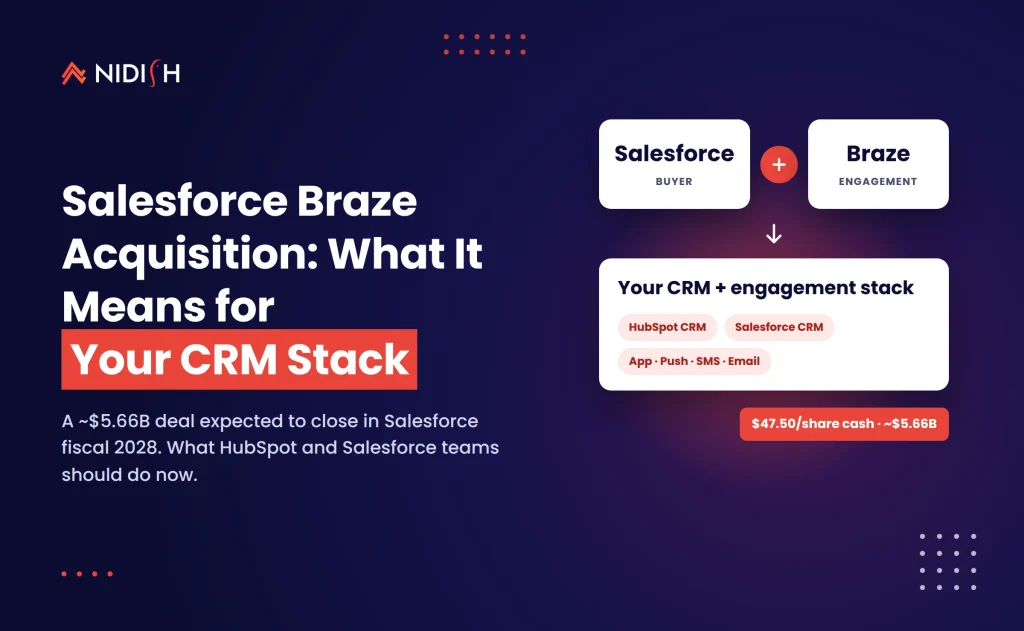
Salesforce just bought the tool many of its own customers used to avoid Marketing Cloud. That is the uncomfortable headline inside the Salesforce Braze acquisition, announced on October 20, 2026.
The deal values Braze at roughly $5.66 billion, and it will not close until Salesforce’s fiscal 2028, which starts in February 2027. So nothing breaks this week. But if your CRM is HubSpot or Salesforce and Braze sends your app, push, SMS or email messages, you now have a roadmap question you didn’t have a month ago.
This guide covers what was announced, who it affects, the four realistic paths for your stack, and the checklist we would run before your next Braze renewal.
Table of Contents
Key takeaways
- The deal: Salesforce agreed to buy Braze for $47.50 per share in cash, an enterprise value of about $5.66 billion, announced October 20, 2026.
- The timing: Closing is expected in Salesforce’s fiscal 2028 (from February 2027), pending Braze shareholder and regulatory approval. Until then, Braze runs independently.
- The plan: Salesforce says Braze will strengthen Marketing Cloud’s cross-channel personalization and connect to Data 360, Customer 360 and Agentforce.
- The unknown: Neither company has published post-close pricing, packaging or a roadmap for customers whose CRM isn’t Salesforce.
- The move now: Don’t migrate in a panic. Map your data flows, tighten renewal terms, and keep your customer data in a place you control.
What is the Salesforce Braze acquisition?
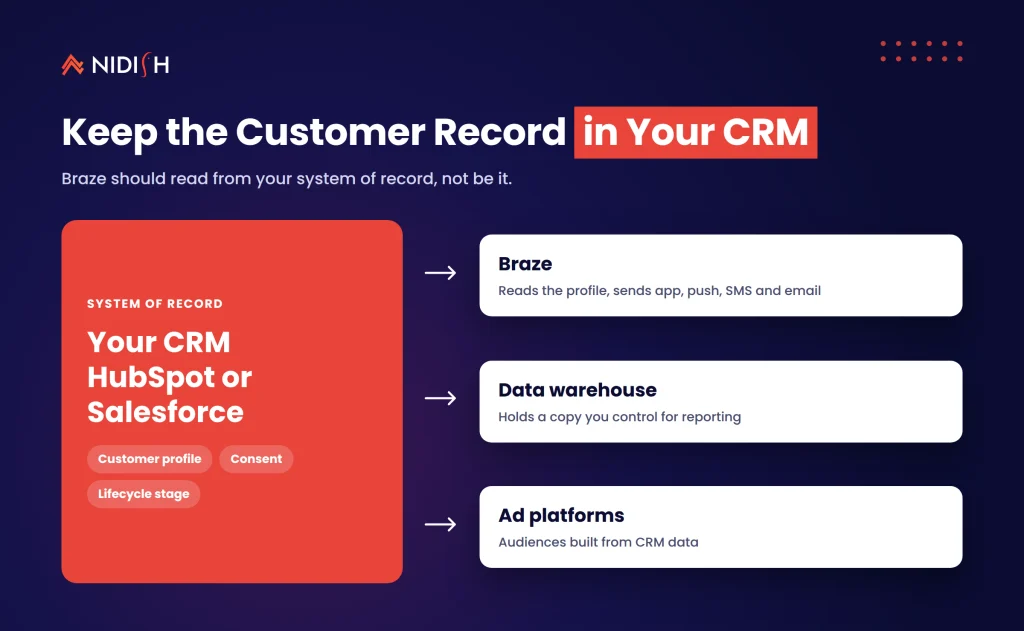
The Salesforce Braze acquisition is a definitive agreement for Salesforce to buy Braze, a customer engagement platform, for $47.50 per share in cash. According to Salesforce’s announcement, that is an enterprise value of approximately $5.66 billion.
The offer was about 58% above Braze’s closing price of $30.04 on October 19, as CMSWire reported. Braze serves about 2,770 customers, including Canva, Instacart and Venmo. Its strength is real-time engagement. It turns live behavior, such as an abandoned cart or a dropped onboarding step, into a message within moments.
Salesforce says Braze’s real-time engagement and AI decisioning will complement Data 360, Customer 360 and Agentforce. Within Customer 360, Braze is expected to strengthen Marketing Cloud’s cross-channel personalization. Closing requires Braze shareholder approval and the required regulatory approvals.
Why Salesforce wants Braze
Salesforce wants Braze for real-time, in-the-moment engagement across apps, mobile and messaging. Analyst Shay Boloor of Futurum Equities told Reuters that Salesforce is buying “a real-time engagement layer that its marketing business has historically lacked.”
There is a pattern here. Salesforce bought ExactTarget in 2013, and it became the foundation of Marketing Cloud. Later acquisitions, such as Krux and Datorama, were folded into the same family. If history holds, Braze will eventually become part of how Salesforce packages and sells marketing, not just a separate logo on the price list.
The AI angle matters too. Agentforce agents are only as useful as the actions they can take. A real-time messaging engine gives those agents a way to act on a customer signal while it still matters.
Braze has also been moving in that direction itself. CMSWire notes that Braze’s Operator Connect, launched in beta at Forge 2026, lets teams build campaigns from Claude, ChatGPT, Microsoft Copilot and other MCP-compatible tools.
Who the Salesforce Braze acquisition affects
The deal touches four groups differently. Find yours.
Salesforce CRM + Braze customers
You stand to gain the most. Native connections between Salesforce data and Braze journeys are the obvious first integration target. Your risk is packaging: bundles that make you buy more of Marketing Cloud than you need.
Salesforce CRM + Marketing Cloud customers
Expect an overlap period. Salesforce hasn’t said how Braze will sit beside Marketing Cloud’s existing email, mobile and journey tools. Don’t rebuild journeys on a module that may be repositioned.
HubSpot CRM + Braze customers
This is the group with the most open questions. Many teams run HubSpot for sales and B2B marketing and Braze for product and lifecycle messaging.
That works today through APIs, a CDP, or an iPaaS tool. Nobody has said those connections will get worse. Nobody has promised they will get better either.
Teams evaluating Braze right now
You can still buy it, and nothing in the announcement changes how Braze sells today. But you are now buying into a future Salesforce product, so price that into the contract.
What Braze customers have been told
Braze has been clear about the period before closing and open about the period after it. In its customer email, filed with the SEC as additional proxy materials, Braze tells customers: “Your existing contract continues as is.”
The same email says Braze “will continue to build as Braze” and that Bill Magnuson will remain CEO. On life after the deal closes, it is candid: “These are possibilities, and no decisions have been made yet.”
Both companies also say they share “an open, composable approach” across the data, tools and partners customers already use. That is a statement of intent, not a contract term. MarTech’s analysis makes the same point and suggests buyers watch what Salesforce consolidates and what it keeps separate.
In short: your Braze contract and account team continue today. Pricing, packaging and non-Salesforce integrations after early 2027 are unanswered.
Your four realistic options
Most teams have four paths. The right one depends on where your customer data lives and who owns your CRM. The table below is how we would frame the decision with a client.
| Option | Best fit | Main upside | Main risk | When to decide |
|---|---|---|---|---|
| Stay on Braze, change nothing yet | Any team with a renewal after early 2027 | Zero disruption, keep what works | Post-close pricing and roadmap unknown | Review at each renewal |
| Consolidate on Salesforce (CRM + Marketing Cloud + Braze) | Salesforce-first B2C brands | Fewer vendors, native data path | Bundling and lock-in | After the roadmap is published |
| Move lifecycle messaging into HubSpot Marketing Hub | HubSpot-first, mostly email and B2B journeys | One CRM, one data model | Weaker fit for high-volume app and push | Any time; scope it carefully |
| Re-platform to another engagement tool | Teams with a warehouse-first data stack | Vendor independence | Migration cost and journey rebuild | Only with a clear reason |
The first row is the honest default for most teams. A deal that closes in 2027 isn’t a reason to rip out working infrastructure in 2026.
The HubSpot row deserves a caveat. HubSpot Marketing Hub handles email, forms and B2B nurture well, but app-heavy, push-heavy consumer programs are not its home ground.
If most of your Braze volume is in-app and push, moving it into a CRM is usually the wrong fix. If your Braze use is mostly email journeys, consolidating into HubSpot can simplify your stack. Our HubSpot vs Salesforce comparison covers where each CRM fits more broadly.
If you’re weighing this for your own stack, we design and maintain the connections between HubSpot, Salesforce and engagement tools for teams like yours. See how we approach HubSpot integration →
A 7-step checklist before your next Braze renewal
Run this checklist now, while nothing has changed. It takes a few days of work, and it turns a future scramble into a calm decision.
1. Map every data flow in and out of Braze
List each source (CRM, warehouse, app SDK, CDP) and each destination. Note who owns each connection.
2. Find your system of record
Decide which system owns the customer profile, consent and unsubscribe status. If the honest answer is “Braze”, that is your biggest risk.
3. Move the source of truth to a place you control
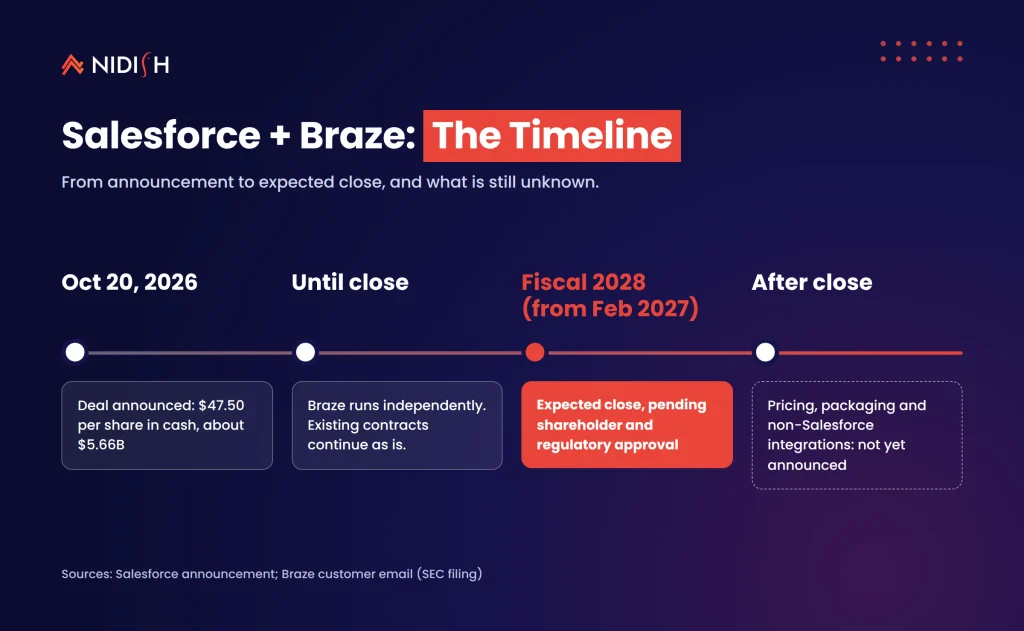
A CRM or a cloud data warehouse should hold the master profile, with Braze reading from it. Our guide to composable, AI-ready CRM stacks explains the pattern.
4. Document every journey and trigger
Export or record each live campaign’s entry rules, branches and suppression logic. Undocumented logic is what makes migrations slow.
5. Read your contract before the renewal window
Check the term length, renewal notice period, price-increase caps and data-export rights. Ask for any change-of-control language to be explained in writing.
6. Ask your account team direct questions
For example: “Will our HubSpot connection be supported after close?” Get answers by email, and ask your legal team how much weight those answers carry.
7. Set a review date
Put a calendar check in the quarter after the deal closes, when post-close plans should be clearer.
The mistake we see constantly in vendor transitions is skipping step 2. Teams discover too late that consent flags, or the only clean copy of a customer’s history, live inside the tool they want to leave. Our CRM data migration checklist goes deeper on that problem.
What the Salesforce Braze acquisition means for HubSpot users
For HubSpot users, the Salesforce Braze acquisition mainly raises an integration question, not an urgent migration one. Braze can connect to HubSpot today through APIs, CDPs and iPaaS tools. Braze has told partners that its partner ecosystem “remains central to how Braze serves customers.”
The practical risk comes later. If Salesforce invests most of its integration effort in Data 360 and Agentforce, connections to non-Salesforce CRMs may still work but receive less attention. That isn’t announced. It is a scenario worth planning for.
Three moves reduce that exposure:
Own the integration layer
Use a connection you control, such as HubSpot’s APIs, a CDP, or an iPaaS tool, rather than one that depends on a single vendor’s roadmap. Our breakdown of native vs custom HubSpot integrations covers the trade-offs.
Keep consent and lifecycle stage in HubSpot
Push them to Braze, rather than syncing them back from Braze.
Unify revenue data outside the messaging tool
Your CRM and finance systems, not your messaging tool, should hold the numbers your leadership reports on.
What it costs to stay flexible
Staying flexible is cheaper than migrating. The work is mostly documentation and integration hygiene, not new licences.
Typical ranges from our implementation work, which vary with the number of journeys and data sources:
- Data-flow and contract audit: usually a few days for a mid-sized stack.
- Moving the system of record to your CRM or warehouse: often two to six weeks, depending on data quality.
- A full engagement-platform migration: usually measured in months, because every journey, template and suppression rule has to be rebuilt and tested.
Pricing for Braze, Marketing Cloud and HubSpot changes often. Treat any figures you see as accurate only at the time of writing, and confirm them with each vendor.
Common mistakes to avoid
Panic-migrating before close
The deal isn’t expected to close until Salesforce’s fiscal 2028. Rushing a migration now trades a theoretical risk for a guaranteed cost.
Signing a long renewal without protections
A three-year term with no price-increase cap is a bet on a roadmap nobody has seen. Negotiate the cap and the export rights first.
Letting the messaging tool own the customer
If Braze holds your only reliable profile, any change in its ownership becomes your problem. Move that ownership upstream.
Assuming “composable” is a promise
It is a stated direction. Verify it against what ships after close.
How Nidish approaches this
We don’t sell engagement platforms, so our advice isn’t tied to one. We start by mapping where your customer data lives and which system owns consent. Then we make sure HubSpot or Salesforce, not a messaging tool, holds the master record, and we build the connections so you can swap tools later without rebuilding your CRM. For an example of our cross-CRM work, see our HubSpot and Salesforce SSO case study.
Frequently asked questions
When will the Salesforce Braze acquisition close?
Salesforce expects the deal to close in its fiscal year 2028, which begins in February 2027. Closing depends on Braze shareholder approval and the required regulatory approvals. Until then, Braze operates as an independent public company, and existing contracts continue as written.
How much is Salesforce paying for Braze?
Salesforce agreed to pay $47.50 per share in cash, an enterprise value of approximately $5.66 billion. That price was about 58% above Braze’s closing share price of $30.04 on October 19, 2026, the day before the deal was announced. The deal is all cash, so Braze shareholders would not receive Salesforce stock.
Will my Braze contract change?
Not before close. Braze has told customers, “Your existing contract continues as is.” After close, no decisions have been announced on pricing, packaging or contract terms. Review your renewal date, notice period and price-increase protections now, so you aren’t negotiating under time pressure later.
Will Braze still integrate with HubSpot after the acquisition?
Braze has told partners that its ecosystem “remains central to how Braze serves customers,” and existing agreements continue. Nothing has been announced about non-Salesforce integrations after close. The safest approach is to own your integration layer, using HubSpot’s APIs, a CDP or an iPaaS tool, so you’re not dependent on one vendor’s roadmap.
Will Braze replace Salesforce Marketing Cloud?
Salesforce hasn’t said that. Its stated plan is for Braze to strengthen Marketing Cloud’s cross-channel personalization within Customer 360. How Braze will sit alongside Marketing Cloud’s existing email, mobile and journey tools, and how it will be packaged, has not been announced.
Should we migrate off Braze now?
Usually not. The deal isn’t expected to close until 2027, and Braze says existing contracts continue unchanged. A better move is to document your journeys, move your customer system of record into your CRM or warehouse, and tighten renewal terms. That keeps every option open at low cost.
Where to start
The Salesforce Braze acquisition doesn’t force a decision today. It does reward teams that know where their customer data lives and who owns each connection. Start with the checklist above, put your renewal date in the calendar, and revisit once Salesforce publishes its post-close plans.
If you’d like a second opinion, book a 30 minute call. We’ll tell you honestly whether you should stay put, consolidate, or simply fix your data flows and wait.


 Blog
 Case Studies
 Career