
Custom software vs CRM customization: the decision most businesses make by accident
Most businesses never actually make the custom software vs CRM customization decision deliberately. They default into customization, one workflow rule at a time, one custom field at a time, one “can you just make it do this one thing” request at a time, until eighteen months later they’re maintaining something closer to a second, unmanaged application than a configured CRM. Nobody signed off on building custom software. It just happened, field by field.
This post is about making the custom software vs CRM customization decision on purpose instead. It covers what CRM customization actually costs over time, the five specific signs your business has crossed from smart configuration into effectively building software, the math that determines when a real custom build pays for itself, and what custom software does not solve, because it solves fewer problems than most build decisions assume.
We build both sides of this custom software vs CRM customization trade-off. We customize CRMs for a living and we build custom software for a living, often for the same client, which is exactly why this decision matters more than most agencies are willing to admit.
Table of Contents
Custom Software vs CRM Customization: The Real Question Nobody Frames Correctly
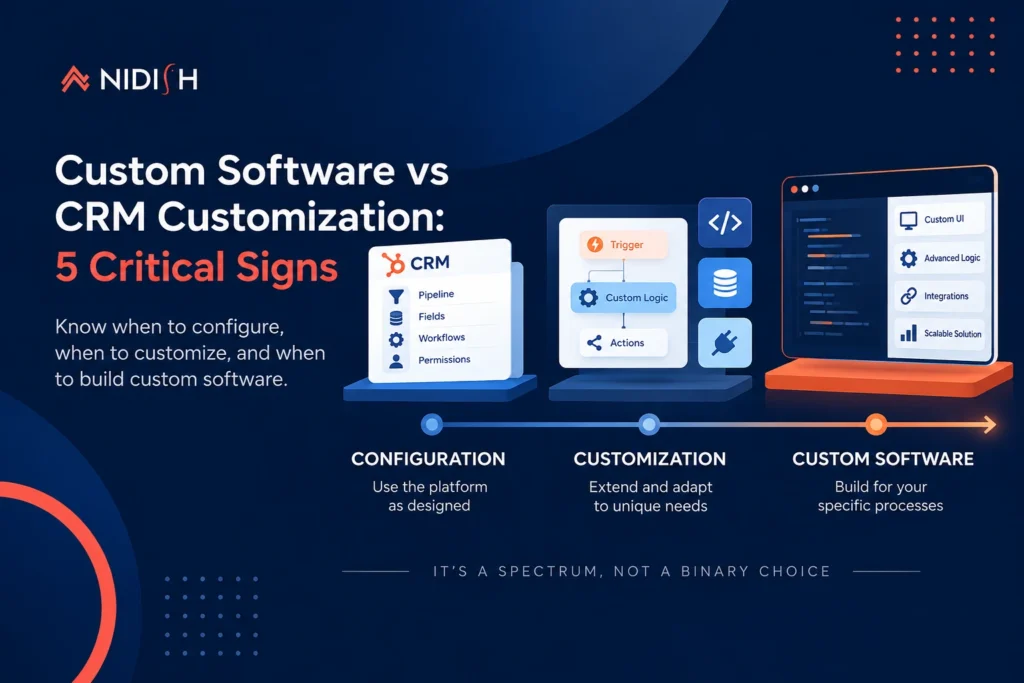
Most teams frame this as “should we customize our CRM or build custom software,” as if it’s a binary choice made once, upfront. It isn’t. It’s a spectrum, and almost every business slides along it gradually without ever making the decision explicitly.
The better question in any custom software vs CRM customization discussion is not whether to customize. Nearly every CRM implementation needs some configuration, that’s expected and healthy. The better question is where on that spectrum your business currently sits, and whether the direction you’re drifting in is still the right one for what you’re actually trying to solve.
The Configuration-to-Build Spectrum Behind Every Custom Software vs CRM Customization Decision
It helps to think in three distinct levels, because businesses rarely jump straight from “off the shelf” to “fully custom.” They drift through a middle zone first, and that middle zone is where most of the silent cost accumulates.
Level 1: Configuration
Pipeline stages, custom fields, standard workflow rules, permission sets. This is smart, expected, and every business should start here. It uses the platform’s own tools the way they were designed to be used.
Level 2: Customization
Custom objects, complex automation logic, custom code actions, third-party app stacking. This is where things get genuinely ambiguous, and where most businesses spend years without realizing how far they’ve drifted.
Level 3: Custom software
A purpose-built application, sometimes standalone, sometimes a genuine extension layer sitting on top of a CRM, built around your specific process rather than the platform’s general-purpose approximation of it.
The spectrum matters because the real custom software vs CRM customization decision isn’t “configuration versus custom software.” It’s “how much Level 2 customization is worth absorbing before Level 3 becomes the more honest, less expensive answer.”
What Does CRM Customization Actually Cost Over Time in the Custom Software vs CRM Customization Trade-off?
This is the part most businesses underestimate, because customization costs are almost invisible in the moment and only visible in aggregate.
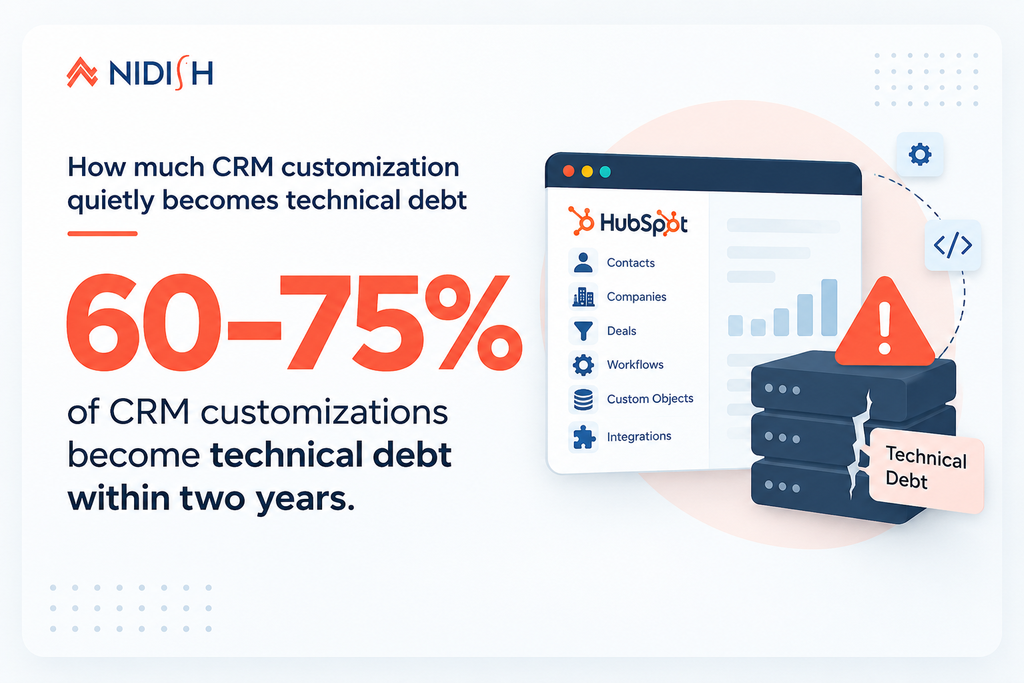
Research across CRM implementations found that 60 to 75% of CRM customizations become technical debt within two years, meaning the customization requires significant rework, refactoring, or outright replacement to keep functioning as the platform evolves around it. Over a three-year window, heavily customized CRM builds commonly run 40 to 67% higher total cost of ownership than an equivalent, less-customized implementation, a gap that widens further in regulated industries where every custom piece of logic needs separate compliance validation.
The maintenance burden compounds quietly. Custom Salesforce instances require an average of 1,200 developer hours annually just for maintenance, according to industry analysis, hours spent keeping existing customization functional rather than solving new problems. Every platform update becomes a risk event rather than a routine release, because nobody can fully predict which piece of accumulated custom logic a given update might quietly break.
Custom Software vs CRM Customization: Five Signs You’ve Crossed the Line
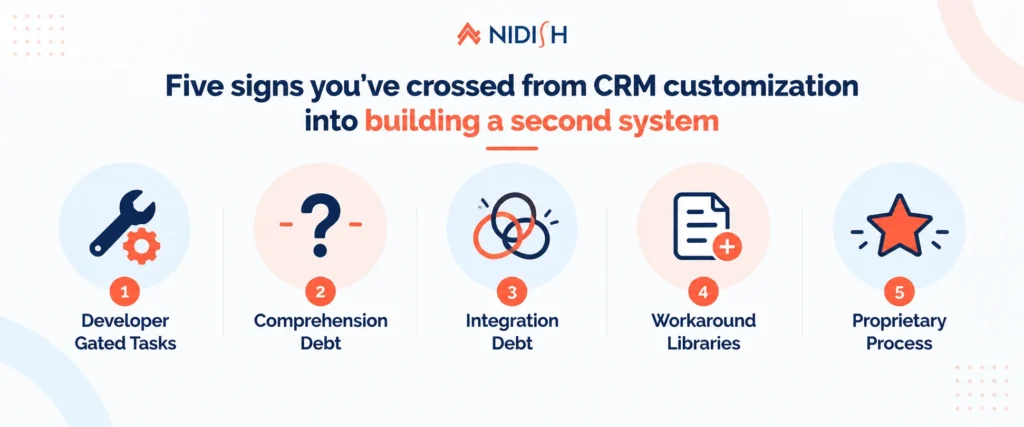
1. Routine tasks require developer involvement.
When sending a standard campaign, updating a pipeline stage, or generating a basic report requires pulling in a developer, the tool has stopped removing friction and started creating it. A CRM exists specifically to remove that friction. If it no longer does, the customization has quietly inverted its own purpose.
2. Comprehension debt has replaced code debt as the real risk
The code still runs. The person who understood why it was built that way is gone. This is a distinct and often more dangerous risk than technical debt itself, because it’s invisible on a budget line until something breaks and nobody on the team can explain what the workflow was actually supposed to do.
3. Integration debt is accumulating faster than you’re solving it
Point-to-point integrations stitched between a CRM, an ERP, and a logistics or billing platform solve an immediate problem but create a brittle, tangled dependency web that becomes progressively more expensive to maintain, and increasingly resistant to any future architectural change.
4. You’re maintaining a library of workarounds just to use the tool you’re paying for
If your team has an internal document titled something like “how we actually use the CRM,” listing exceptions, manual steps, and things to avoid clicking, that document is itself evidence the platform is no longer solving the problem it was bought to solve.
5. The process you’re customizing around is your actual competitive advantage
This is the one legitimate reason to lean toward building rather than continuing to customize. If the workflow in question is something a competitor could replicate by buying the same CRM license, it’s very likely not worth owning the code for. If it’s a proprietary process, a differentiated customer experience, or a data model that genuinely produces insight nobody else has, owning that logic starts to matter in a way generic customization can’t fully capture.
The Math Behind Custom Software vs CRM Customization: When Building Actually Pays Off
Here’s where a lot of build decisions go wrong, they get made on gut feeling about frustration level rather than actual numbers.
A useful framework: custom development needs to deliver roughly four to five times the value of continued configuration or customization to justify its added cost, because the price gap between the two paths is usually substantial. For a mid-sized team, ongoing platform subscription costs over a multi-year period frequently land in the tens of thousands, while a genuinely custom build for the equivalent capability can run into the hundreds of thousands once real engineering time, testing, and multi-level project management are factored in.
That cost gap isn’t a reason to avoid building in every custom software vs CRM customization decision. It’s a reason to be honest about whether your specific situation clears that four-to-five-times bar. For the large majority of businesses, it doesn’t, which is exactly why custom development is genuinely justified in a relatively small share of cases, specifically when the customization represents real intellectual property, when no marketplace solution covers the actual requirement, or when the process itself is the business’s differentiator rather than an operational detail.
What Custom Software Does Not Solve in the Custom Software vs CRM Customization Debate
This is the section most vendors selling custom development skip, and it matters as much as the case for building.
It does not fix adoption problems: As many as 50 to 55% of CRM projects fail, and the overwhelming majority fail due to poor adoption and mismanaged change management, not the underlying technology. A poorly implemented, poorly adopted custom system loses to a well-implemented off-the-shelf CRM just as often as the reverse is true. Building custom software does not automatically solve a people problem.
It does not remove maintenance burden, it relocates it: In-house or custom-built software still needs systematic maintenance, security review, and technical debt management. Without a clearly defined operating model and experienced ownership, a custom build accumulates its own version of the exact problem it was meant to escape, just without a vendor’s platform team absorbing part of that burden for you.
It does not happen quickly: Complex custom development projects commonly average six to twelve months, with genuinely enterprise-scale implementations running eighteen to twenty-four months. That’s a real delay in time-to-value compared to configuring or customizing an existing platform, and it needs to be weighed honestly against how urgently the underlying problem needs solving.
It does not remove the need for good architecture: A custom build without an experienced architect and a clear operating model is exactly how a company ends up back in the same failure pattern years later, just with different code.
What This Looks Like in Practice
Take a concrete version of this custom software vs CRM customization decision, and how it plays out for most B2B services businesses eventually facing it: a quoting process that has outgrown a CRM’s native deal properties.
At Level 1: configuration, quotes are tracked as deal stages with a handful of custom properties for price and terms. This works fine for straightforward, single-line-item sales.
At Level 2: customization, the business has added tiered pricing logic, approval workflows with conditional branching, and custom code actions pulling data from an external pricing system mid-workflow. Each addition solved a real problem. Together, they’ve quietly built a pricing engine inside a tool that was never designed to be one, maintained by whoever last touched the workflow and increasingly fragile against every HubSpot platform update.
At Level 3: custom software, that pricing logic gets extracted into a purpose-built quoting application with its own data model, still connected to the CRM through a clean API rather than living inside a stack of workflow actions nobody fully understands anymore. The CRM goes back to doing what it does well, tracking the relationship and the deal, while the genuinely complex, proprietary pricing logic lives somewhere built specifically to handle it.
The point of walking through this custom software vs CRM customization example isn’t to say every business ends up at Level 3. Most don’t, and shouldn’t, per the math above. It’s to show what the drift from one level to the next actually looks like from the inside, incremental, individually reasonable, and only visible as a pattern once you step back and look at the whole thing at once.
A Custom Software vs CRM Customization Decision Framework You Can Actually Use
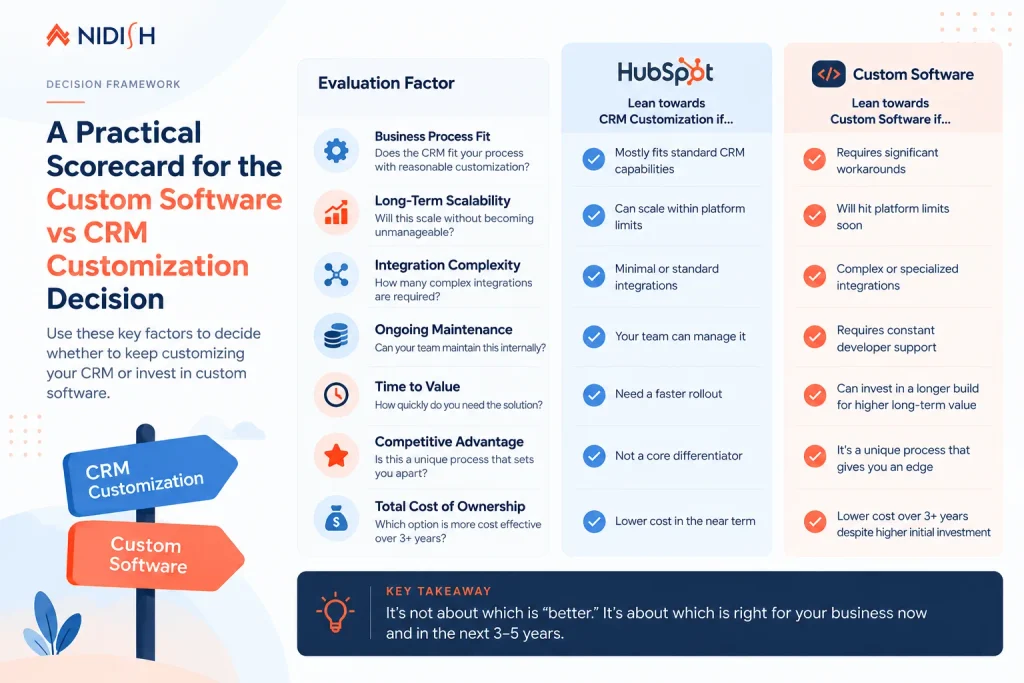
| Custom Software vs CRM Customization Signal | Points toward configuration or customization | Points toward custom software |
|---|---|---|
| Frequency of routine tasks needing a developer | Rare | Constant |
| Process being encoded | Standard across your industry | Genuinely proprietary |
| Number of stitched integrations | Few, stable | Many, brittle, growing |
| Team’s ability to explain existing logic | Clear, documented | Comprehension debt, tribal knowledge only |
| Time-to-value needed | Weeks | Months acceptable |
| Estimated value versus a 4-5x cost multiple | Doesn’t clear it | Clearly clears it |
| Available engineering leadership and ongoing capacity | Limited | Present and committed |
No single row in this custom software vs CRM customization scorecard should decide the call on its own. The pattern across several rows, not one isolated frustration, is what actually indicates which side of the spectrum a business belongs on.
Common Mistakes in the Custom Software vs CRM Customization Decision
- Deciding based on frustration rather than math: A bad week with a clunky workflow is not the same evidence as a documented pattern of comprehension debt and integration sprawl.
- Assuming custom software removes maintenance entirely: It relocates the maintenance burden to your own team rather than eliminating it, and that team needs to be resourced accordingly.
- Building something a competitor could buy off the shelf: A recurring mistake in the custom software vs CRM customization decision. If the capability isn’t genuinely differentiating, the ongoing cost of owning custom code rarely justifies itself against a mature CRM feature doing roughly the same job.
- Underestimating comprehension debt specifically: Technical debt gets budgeted for. Comprehension debt, the risk that nobody left on the team understands why something was built the way it was, rarely does, until the moment it becomes urgent.
- Treating this as a one-time decision: The right answer at ten employees is not automatically the right answer at two hundred. Revisiting where you sit on the spectrum periodically matters more than getting the call perfectly right once.
How Nidish Approaches the Custom Software vs CRM Customization Decision
We don’t default to selling whichever side of this we happen to specialize in, we do both CRM implementation and customization work and genuine custom software development, often for the same client at different points in their growth. That’s exactly why the custom software vs CRM customization decision gets an honest answer from us rather than a predetermined one.
If you’re weighing this exact custom software vs CRM customization question for a specific workflow, our piece on building a custom application layer on top of your CRM covers that specific architecture question in more depth.
If the customization in question is automation-heavy, our guide to HubSpot’s custom coded workflow actions covers exactly where that tool’s real limits sit before a custom build becomes the better call, and our HubSpot custom objects guide covers the same question one level down, at the data-model layer specifically. Our custom software development services page covers what a real build looks like when that’s genuinely the right answer, and our HubSpot implementation services page covers the configuration and customization side when that’s where you actually belong.
Frequently Asked Questions
Custom software vs CRM customization, how do I know which one I need?
In any custom software vs CRM customization decision, the clearest signals are routine tasks requiring a developer, integration debt accumulating faster than it’s resolved, comprehension debt where nobody can explain existing customizations, and a process that represents genuine competitive advantage rather than a standard industry workflow. One signal alone rarely justifies a build, a pattern across several does.
What percentage of CRM customizations become technical debt?
Research indicates 60 to 75% of CRM customizations become technical debt within two years, requiring significant rework or replacement to remain functional as the platform evolves.
Is custom software more expensive than CRM customization?
Usually, upfront and often over time as well. Custom development typically needs to deliver four to five times the value of continued customization to justify the cost difference, a bar that most businesses do not actually clear.
Does custom software fix CRM adoption problems?
No. As many as 50 to 55% of CRM projects fail primarily due to poor adoption and change management, not the underlying technology. A poorly adopted custom build fails for the same reasons a poorly adopted CRM does.
How long does building custom software actually take?
Complex custom development commonly averages six to twelve months, with enterprise-scale builds running eighteen to twenty-four months. This is a real delay compared to configuring or customizing an existing platform and should be weighed against how urgently the problem needs solving.
Where This Goes Next
Most businesses don’t lose the custom software vs CRM customization decision by choosing wrong. They lose it by never actually making the decision at all, drifting from configuration into customization into something closer to unmanaged software without ever pausing to ask whether the spectrum they’re sliding along still matches what the business actually needs.
If you’re not sure which side of the custom software vs CRM customization spectrum you’re currently on, that’s a genuinely useful conversation to have before the next workflow request, not after the eighteenth one. Book a 30 minute call. We’ll tell you honestly whether it’s a configuration fix or a real architecture decision.



 Blog
Blog Case Studies
 Career