
Introduction
Behavioral health and addiction treatment organizations rely on multiple systems to manage admissions, patient records, marketing activities, and operational reporting. When these systems operate independently, teams often struggle with data silos, manual processes, and limited visibility into the patient journey.
Our client was using HubSpot to manage marketing, lead generation, and admissions outreach, while Kipu served as the organization’s Electronic Health Record (EHR) platform. The lack of integration between these systems created operational inefficiencies and limited the organization’s ability to track prospects from initial inquiry through admission.
Nidish designed and implemented a custom HubSpot Kipu integration that connected marketing, admissions, and patient management workflows, creating a seamless flow of information across both platforms.
Table of Contents
Client Background
The client is a multi-location behavioral health organization providing addiction treatment and recovery services. Their marketing and admissions teams relied on HubSpot to manage inquiries, nurture prospects, and track lead activity.
At the same time, Kipu served as the organization’s primary platform for patient management, admissions processing, and clinical operations.
As lead volume increased, manually transferring information between HubSpot and Kipu became increasingly difficult, resulting in delays, duplicate records, and limited reporting visibility.
Challenges
Before the integration, the client faced several operational challenges.
1. Manual Admissions Data Entry
Admissions staff were required to manually transfer prospect information from HubSpot into Kipu, increasing administrative workload and introducing opportunities for error.
2. Disconnected Marketing and Admissions Data
Marketing teams had limited visibility into which leads ultimately became admitted patients, making it difficult to measure campaign effectiveness.
3. Duplicate and Inconsistent Records
Customer and patient information often became inconsistent across systems, creating reporting and operational challenges.
4. Delayed Lead Processing
Manual workflows slowed response times and delayed the admissions process, impacting the overall patient experience.
5. Limited Revenue Attribution
Leadership lacked complete visibility into the relationship between marketing investments, admissions activity, and patient acquisition outcomes.
Our Approach
We began by analyzing the organization’s admissions workflows, marketing processes, and patient intake procedures.
Our objective was to create a secure and scalable integration that would automatically synchronize critical information between HubSpot and Kipu while maintaining compliance with organizational data management requirements.
The integration strategy focused on improving operational efficiency, reducing manual effort, and creating complete visibility throughout the patient acquisition journey.
Solution
Nidish developed a custom HubSpot Kipu integration using the APIs and integration capabilities available across both platforms.
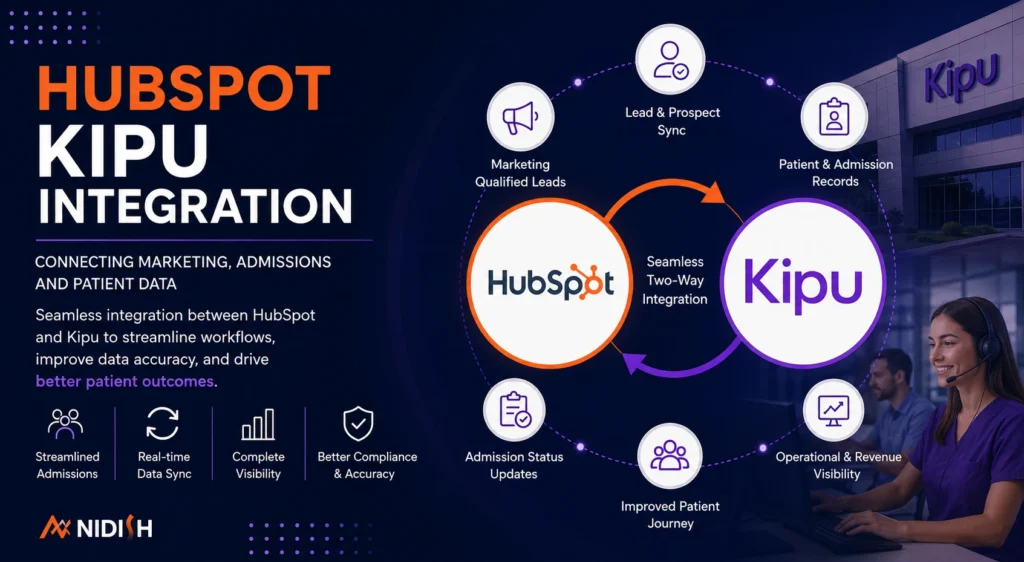
The solution established automated synchronization between HubSpot and Kipu, allowing admissions teams to work with accurate and up-to-date information without requiring duplicate data entry.
When a qualified prospect reached a predefined stage in HubSpot, relevant information was automatically transferred into Kipu to support the admissions process. Likewise, key patient status updates could be synchronized back into HubSpot, allowing marketing and leadership teams to gain greater visibility into outcomes.
The integration created a connected ecosystem where marketing, admissions, and operational teams could work from a unified source of truth.
Implementation Highlights
The custom integration included several key capabilities:
- Automated lead and admissions record synchronization
- Real-time transfer of prospect information between HubSpot and Kipu
- Admission status updates within HubSpot
- Automated workflow triggers based on patient lifecycle stages
- Data validation and duplicate prevention processes
- Secure API-based communication between systems
- Centralized reporting and operational visibility
- Scalable architecture to support future organizational growth
The solution was designed to ensure reliable performance while reducing the administrative burden placed on admissions teams.
Results
Following implementation, the client experienced measurable improvements across marketing, admissions, and operational workflows.
Reduced Administrative Work
Automated synchronization significantly reduced manual data entry requirements and allowed staff to focus on higher-value activities.
Faster Admissions Processing
Admissions teams gained immediate access to qualified prospect information, accelerating intake and enrollment workflows.
Improved Data Accuracy
Automated data synchronization eliminated many of the inconsistencies that previously existed between HubSpot and Kipu.
Enhanced Marketing Attribution
Marketing teams gained visibility into the complete patient acquisition journey, allowing them to better understand campaign performance and ROI.
Greater Organizational Visibility
Leadership teams could access more accurate reporting and gain a clearer understanding of admissions performance, lead sources, and operational outcomes.
Conclusion
Managing admissions, marketing, and patient information across disconnected platforms can create unnecessary complexity and operational inefficiencies.
By implementing a custom HubSpot Kipu integration, Nidish helped the client create a connected operational ecosystem that streamlined admissions workflows, improved data accuracy, and increased visibility across the patient journey.
The integration transformed HubSpot and Kipu into a unified platform that supports both growth and operational excellence.
At Nidish, we specialize in designing custom HubSpot integrations that connect critical business systems, automate workflows, and help organizations create scalable processes that drive measurable results.



 Blog
Blog Case Studies
 Career