
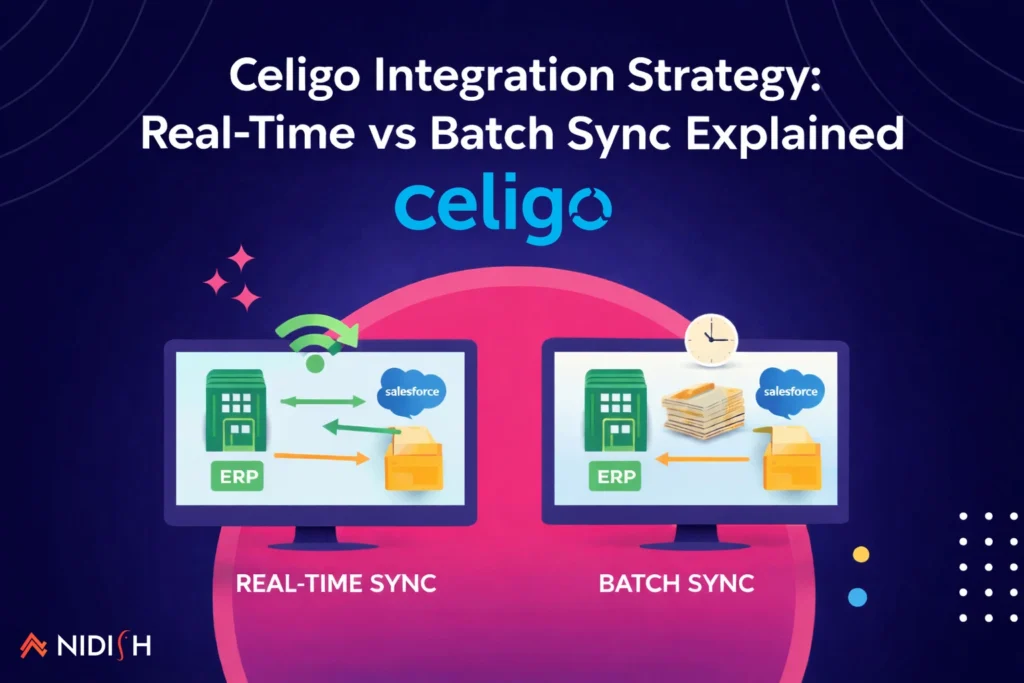
Most integration projects do not fail because of the platform. They fail because of poor decisions around data flow.
This is where a well-defined Celigo integration strategy makes the difference.
When working with Celigo, one of the most important architectural decisions is choosing between real-time vs batch sync. On paper, it sounds like a simple technical choice. In practice, it determines how reliable, scalable, and cost-efficient your entire system will be.
Table of Contents
Why Celigo Integration Strategy Is a Business Decision
Many teams approach integrations as a backend task. But in reality, your Celigo integration strategy directly impacts revenue visibility, operational efficiency, and system performance.
You start noticing problems when:
- Reports do not match across systems
- Sales and finance teams rely on different data
- Automation workflows behave inconsistently
These are the same issues often uncovered during a RevOps audit, where the root cause is almost always poor data movement rather than tool limitations.
This becomes even more critical when you are dealing with CRM ERP integration, where timing and accuracy define how smoothly your revenue operations run.
Real-Time Sync: Fast but Not Always Smart
Real-time sync is often treated as the gold standard. Data moves instantly, systems stay aligned, and everything feels responsive.
But speed alone does not define a good Celigo integration strategy.
Real-time sync makes sense in situations where timing directly affects outcomes. For example:
- Lead creation that triggers immediate sales action
- Deal closures that update billing systems
- Customer updates that impact support workflows
In these cases, delay is not acceptable.
However, what most teams miss is the operational cost behind real-time sync.
It requires:
- Continuous API calls
- Strong error handling
- High system uptime
If any system in the chain fails, the entire flow breaks instantly. This is why real-time sync must be designed alongside CRM data modeling best practices, ensuring dependencies are clearly defined before implementation.
Batch Sync: Slower, But Often More Reliable
Batch sync works differently. Instead of reacting instantly, it processes data at scheduled intervals.
This approach is often underestimated, but in many cases, it is the backbone of a stable Celigo integration strategy.
Batch sync works better when:
- You are handling large volumes of data
- Immediate updates are not required
- System performance needs to be protected
For example, syncing thousands of records between CRM and ERP systems in real time can overwhelm APIs. In such scenarios, batch processing is not just efficient, it is necessary.
Real-Time vs Batch Sync: What Actually Works
The real question is not real-time vs batch sync. The real question is how to use both effectively.
A mature Celigo integration strategy rarely relies on a single approach. It combines both, based on business context.
A practical structure looks like this:
- Real-time sync for critical events like lead creation or deal updates
- Batch sync for reporting data, historical updates, and bulk processing
This hybrid approach balances speed and system stability without overloading your infrastructure.
Where Most Integration Strategies Fail
One pattern shows up repeatedly in failed implementations.
Teams assume real-time sync is always better.
It is not.
Overusing real-time sync leads to:
- API rate limit issues
- Increased system load
- Higher failure rates
On the other hand, relying only on batch sync creates delays that impact decision-making.
The real strength of a Celigo integration strategy lies in understanding where each method fits.
Integration Architecture: The Layer Most Teams Ignore
Choosing between sync types is only one part of the equation. The bigger challenge is designing how data flows across systems.
A strong Celigo integration strategy considers:
- Which system is the source of truth
- How data moves between systems
- What dependencies exist between workflows
This is where broader concepts come into play, such as:
- Customer data architecture
- Data consistency in CRM systems
- Real-time vs batch data sync
Ignoring this layer is what turns integrations into long-term maintenance problems.
A Practical Scenario (Where Strategy Matters)
Consider a business integrating CRM with ERP.
If everything is real-time:
- Every update triggers API calls
- Systems slow down under load
- Failures increase during peak activity
If everything is batch-based:
- Sales teams see outdated deal data
- Finance works with delayed revenue numbers
A well-designed Celigo integration strategy solves this by splitting responsibilities.
Critical updates happen instantly. Bulk updates happen in intervals.
This is what separates scalable systems from fragile ones.
How Nidish Approaches Celigo Integration Strategy
At Nidish, we do not start with tools. We start with how your business operates.
Our approach to Celigo integration strategy focuses on:
- Mapping your end-to-end data flow
- Identifying where real-time vs batch sync fits naturally
- Aligning integrations with your overall RevOps framework
- Ensuring long-term scalability, not just short-term fixes
We have seen that most integration issues are not technical. They are architectural.
Book a Strategy Call
If your integrations feel unreliable, slow, or overly complex, it is usually a strategy issue.
Book a call with Nidish to:
- Audit your current integration setup
- Identify inefficiencies in your data flow
- Build a scalable Celigo integration strategy tailored to your business
Final Thoughts
The discussion around real-time vs batch sync is often oversimplified. It is not about choosing speed over stability.
A strong Celigo integration strategy finds the right balance.
When done right, your integrations stop being a bottleneck and start becoming a foundation for growth.



 Blog
Blog Case Studies
 Career