
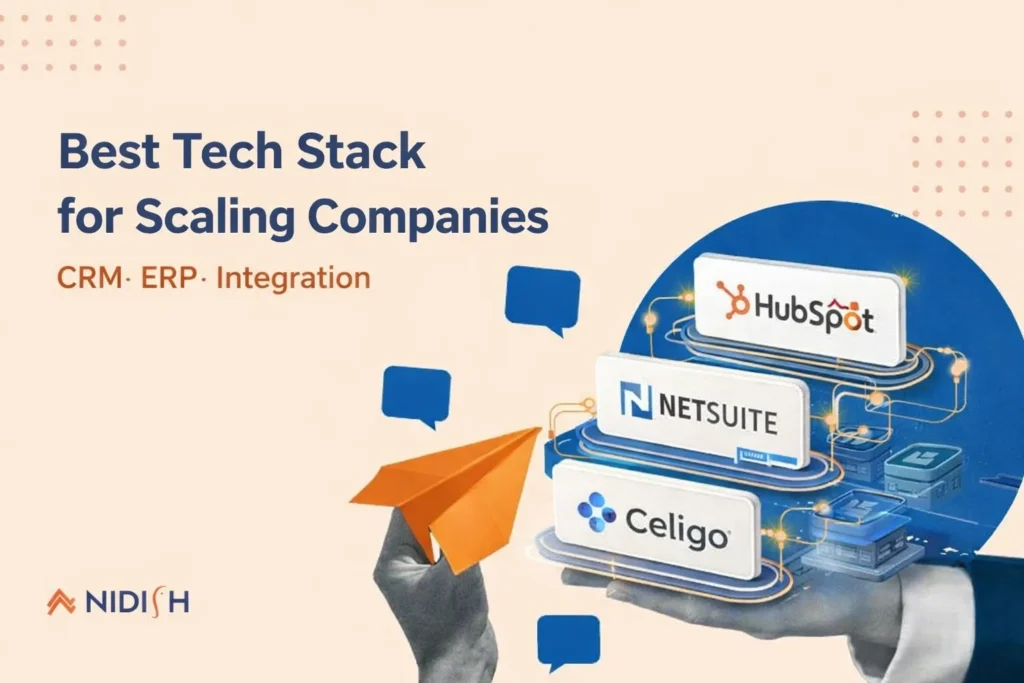
Choosing the Best Tech Stack for Scaling Companies in 2026 is no longer just about selecting the right tools. It is about building a system that can handle growth without breaking.
Most companies hit a point where growth slows down, not because of demand, but because their systems cannot keep up. Data gets fragmented, teams rely on manual work, and decision-making becomes slower.
This is exactly why defining the Best Tech Stack has become a strategic priority for leadership teams, not just IT departments.
Table of Contents
Why the Best Tech Stack for Scaling Companies Matters
As businesses grow, complexity increases across sales, marketing, and operations. Without a connected system, every department starts working in silos.
This often leads to issues that are commonly uncovered during a RevOps audit, where gaps in the lead-to-cash journey create inefficiencies and revenue leakage.
When companies fail to invest in the Best Tech Stack for them, they usually experience:
- Mismatched data between sales and finance
- Lack of visibility into revenue performance
- Increasing manual effort across teams
A well-designed stack solves these problems by creating a unified flow of data.
CRM: The Core of the Best Tech Stack for Scaling Companies
At the center of the Best Tech Stack for Companies is CRM. Platforms like HubSpot CRM go far beyond contact management.
They act as the operational layer for:
- Lead generation and nurturing
- Sales pipeline management
- Marketing automation
- Customer engagement
However, CRM alone is not enough. Its true value depends on how well it is structured and integrated.
For example, businesses leveraging HubSpot AI agents are now automating lead qualification and follow-ups at scale. This shows how CRM is evolving from a system of record into a system of action.
ERP: The Financial Layer of the Best Tech Stack for Scaling Companies
The second critical component in the Best Tech Stack for Companies is ERP.
Systems like NetSuite manage financial operations such as billing, invoicing, and revenue recognition.
The challenge arises when CRM and ERP are disconnected. Sales teams close deals in CRM, while finance processes them separately in ERP. This disconnect leads to inconsistent reporting.
This is why many growing companies focus on CRM ERP integration to unify their front-office and back-office operations.
Integration: The Backbone of the Best Tech Stack for Scaling Companies
The most important, yet often overlooked, component of the Best Tech Stack for Companies is the integration layer.
Tools like Celigo enable seamless communication between systems.
A strong integration strategy helps:
- Sync data between CRM and ERP
- Eliminate duplicate records
- Maintain a single source of truth
- Enable real-time or batch data flows
If you look at advanced implementations like HubSpot custom integrations, the difference is clear. Companies that invest in integration early scale faster because their systems stay aligned.
What the Best Tech Stack for Scaling Companies Looks Like in 2026
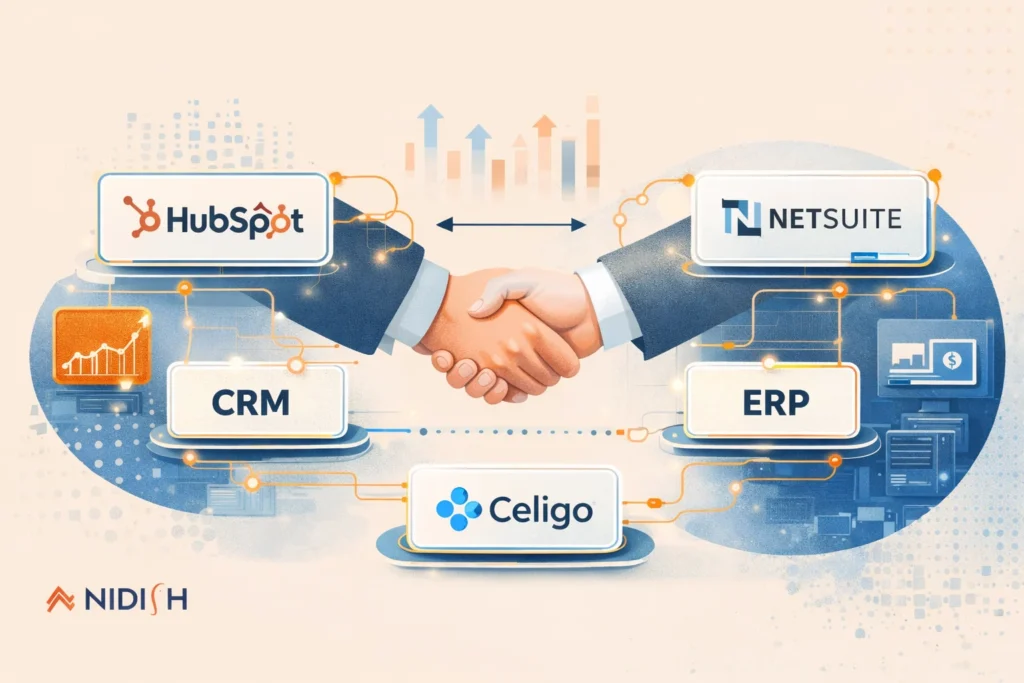
A modern stack is not just a combination of tools. It is a connected ecosystem.
A proven structure includes:
- CRM → HubSpot CRM
- ERP → NetSuite
- Integration → Celigo
This combination creates a unified revenue system where:
- Sales, marketing, and finance share the same data
- Reporting becomes consistent and reliable
- Automation reduces operational workload
This is what defines the Best Tech Stack for Companies today.
Common Mistakes While Building the Best Tech Stack for Scaling Companies
Even with the right tools, execution mistakes can limit scalability.
One common issue is implementing systems in isolation. Without a clear integration plan, data starts diverging quickly.
Another mistake is ignoring data structure. As explained in HubSpot custom integrations, even the best integrations fail if the underlying data model is weak.
Companies also underestimate the impact of sync strategies. Decisions like real-time vs batch sync can significantly affect performance and reporting.
Moving Toward a Unified Revenue System
The concept of the Best Tech Stack for Companies is evolving.
Leading organizations are no longer thinking in terms of separate tools. Instead, they are building unified revenue systems where:
- Data flows seamlessly across the entire lifecycle
- Automation supports every stage of growth
- Insights are consistent across teams
This approach aligns closely with what is discussed in CRM ERP integration and RevOps audit strategies, where the focus is on eliminating inefficiencies across the system.
How Nidish Builds the Best Tech Stack for Scaling Companies
At Nidish, building the Best Tech Stack for Scaling Companies is not about tool selection alone. It is about designing a scalable system.
The approach includes:
- Structuring CRM for long-term growth
- Aligning ERP workflows with revenue processes
- Implementing robust integrations across systems
- Ensuring clean and scalable data architecture
This is similar to how advanced HubSpot implementation projects are executed, where the focus is on building systems that evolve with the business.
Book a Strategy Call
If your current systems feel disconnected, the problem is not the tools. It is the architecture behind them.
A properly designed Best Tech Stack for Scaling Companies can transform how your business operates.
- Evaluate your current tech stack
- Identify gaps in CRM, ERP, and integration
- Build a scalable system aligned with your growth goals
Final Thoughts
The Best Tech Stack for Scaling Companies in 2026 is not about adding more tools. It is about connecting the right ones.
A stack built on HubSpot CRM, NetSuite, and Celigo creates a strong foundation for growth.
When these systems are aligned, businesses gain clarity, efficiency, and control. That is what makes scaling sustainable.


 Blog
Blog Case Studies
 Career