

Overview
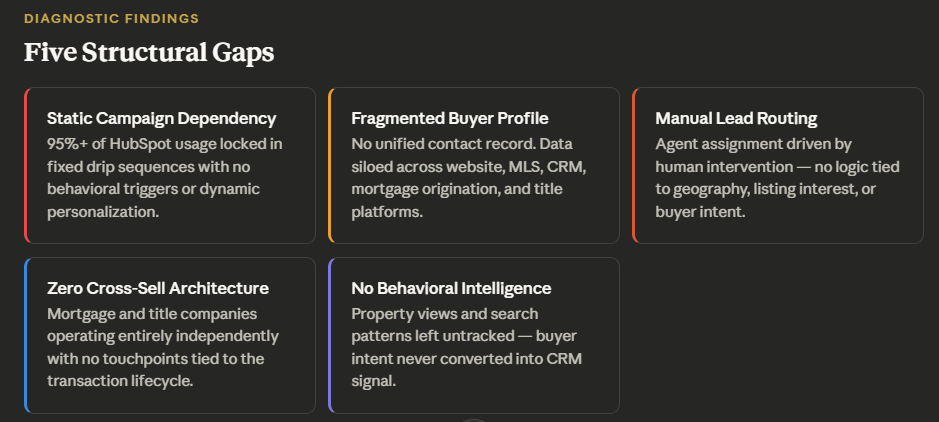
A large, multi-state real estate organization with integrated mortgage and title operations approached us at a point where their growth had started to expose deeper operational gaps.
While they had already invested in HubSpot, their internal teams including marketing, sales, and operations were working with different systems and limited visibility into actual buyer behavior.
Marketing was sending campaigns. Agents were following up manually. Mortgage and title teams operated in parallel.
But none of these functions were truly connected.
Table of Contents
Strategic Approach
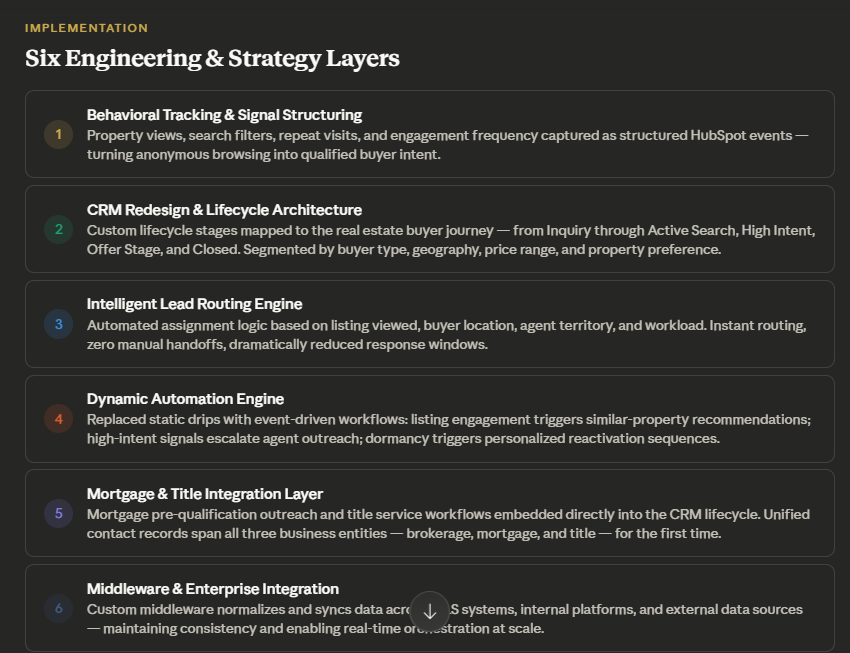
We repositioned HubSpot from a marketing execution tool → central revenue operating system, supported by a layered architecture:
- Data ingestion & normalization
- Behavioral intelligence capture
- CRM lifecycle modeling
- Automation orchestration
- Cross-entity revenue alignment
- Advanced reporting & attribution
Design Inspiration Below:
Solution Architecture
1. Data Foundation & System Integration
The transformation began by stabilizing the data layer. The organization was operating across multiple systems including MLS (Multiple listing service) feeds, a custom property website, a mortgage origination platform Encompass, and internal title processing tools SoftPro each holding partial and often inconsistent customer information.
In several cases, the same contact existed multiple times across systems with slight variations, making it difficult to reliably track activity or attribute revenue.
We introduced a unified data pipeline supported by a middleware layer built using APIs and synchronization logic, extending HubSpot’s native integration capabilities to ensure consistent, real-time data flow across systems.
This ensured that when a user interacted with a property on the website or submitted a form, that activity was immediately reflected against a single contact record regardless of which system it originated from.
Core capabilities introduced:
- Unified ingestion from MLS (multiple listing service)/listings, website behavior, mortgage, and title systems
- Real-time sync and data consistency across platforms
- Single contact identity across all business units
Outcome: A dependable, scalable data foundation that all downstream processes could rely on.
2. Behavioral Intelligence & CRM Lifecycle Design
With the data layer in place, the next step was to convert raw activity into meaningful intelligence. Previously, actions such as viewing listings or refining search filters were happening, but were not being captured in a structured way inside the CRM.
We implemented event-based tracking (via website tracking scripts and custom events) to capture behaviors such as:
- Property views
- Saved listings
- Search preferences (location, price range, property type)
For example, if a user repeatedly viewed homes in a specific ZIP code within a defined price range, the system would interpret this as a strong intent signal rather than generic browsing.
These signals were mapped into dynamic contact properties and used to drive segmentation, prioritization, and automation.
Lifecycle progression (simplified flow):
Inquiry → Active Search → High Intent → Property Engagement → Offer → Closed
The CRM was restructured to reflect how buyers actually move through the real estate journey – not how systems traditionally define pipelines.
For instance, a contact who had viewed multiple properties but had not yet submitted a form was still classified as “Active Search” rather than remaining invisible in the system.
This allowed both marketing and agent teams to act earlier in the journey, rather than waiting for explicit inquiries.
Supported by:
- Intent scoring based on engagement patterns
- Segmentation across buyer type, geography, budget, and preferences
- Continuous updating of contact profiles based on behavior
Outcome: A CRM that functions as a live decision engine, not just a repository.
3. Intelligent Routing & Automation Engine
One of the most immediate operational challenges was lead routing. In the previous setup, leads were either manually assigned or distributed with limited context, often resulting in delayed follow-ups or mismatched agent assignments.
We implemented an automated routing engine that evaluates multiple factors in real time – such as property interest, geographic alignment, and agent availability.
For example, if a buyer engaged multiple times with listings in Austin, the system would automatically assign the lead to an agent covering that region, while also notifying them with full context of the user’s activity.
At the same time, automation shifted from static drip campaigns to behavior-driven workflows.
A typical sequence would look like:
- A user views a property → receives similar listings within minutes
- Repeated engagement within 24–48 hours → triggers agent outreach
- No activity for a defined period → initiates re-engagement sequence
Previously, these actions depended entirely on manual follow-up or were missed altogether.
Outcome:
- Near-instant lead response
- Higher engagement relevance
- Significant reduction in manual intervention
4. Cross-Entity Revenue Orchestration
Another key gap was the lack of coordination between brokerage, mortgage, and title operations. These functions were supported by separate systems, with little to no shared visibility.
By integrating mortgage workflows (e.g., pre-qualification status from lending systems) and title processes into the CRM lifecycle, we enabled the system to trigger relevant actions at the right time.
For example, once a buyer reached a high-intent stage, mortgage pre-qualification communication could be initiated automatically, while title workflows were activated closer to closing.
This reduced reliance on manual coordination between teams and ensured a more consistent customer experience.
For instance, buyers who progressed toward an offer stage could be automatically introduced to mortgage pre-qualification options, rather than waiting for manual handoffs between teams.
5. Reporting, Attribution & Revenue Visibility
The final layer focused on making the entire system measurable. Rather than relying on isolated reports, we built a centralized reporting structure within HubSpot that connects behavior, operations, and revenue outcomes.
Reporting was redesigned not just for visibility, but for usability by different teams. Previously, data existed but was either fragmented or difficult to interpret.
We built centralized dashboards within HubSpot that allowed leadership and operational teams to answer practical questions such as:
- Which leads are showing high intent right now?
- Where are deals dropping off in the funnel?
- How quickly are agents responding to new opportunities?
This shifted reporting from static review to day-to-day operational decision-making.
Leadership visibility includes:
- Funnel conversion and velocity
- Real-time high-intent lead tracking
- Agent response and performance metrics
- Campaign vs behavior-driven impact
- Cross-entity revenue contribution
Outcome: Decision-making moved from assumption to real-time, data-backed clarity.
6. Scalability & System Design
The architecture was designed not just for current operations, but for long-term scale. Middleware and integrations were built to be modular, allowing new systems, markets, or business units to be incorporated without reworking the foundation.
This ensures that as the organization grows, the system evolves with it – without introducing new fragmentation.
Outcome: A future-ready framework capable of supporting multi-region expansion and increasing operational complexity.
Results
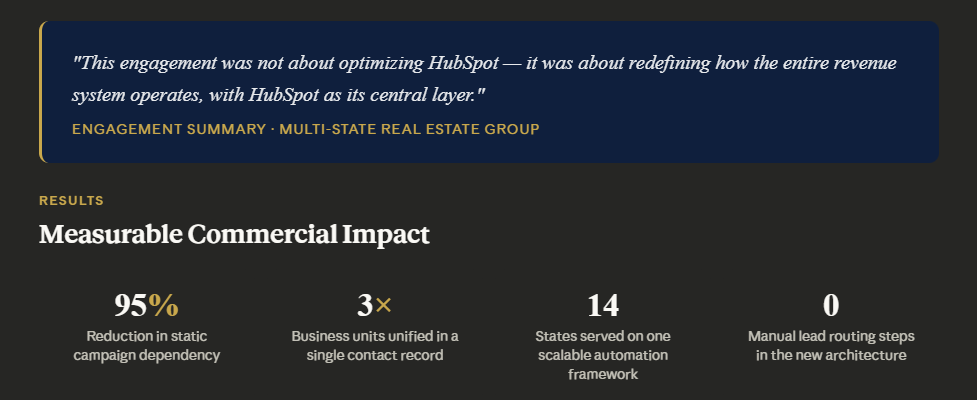
The transformation was not just a tool upgrade it was a shift from disconnected execution to a fully orchestrated, data-driven revenue system, where teams that once operated in silos began working from a shared platform with full visibility into the same customer journey.
Operational & Commercial Impact
These improvements became visible as the system began aligning data, behavior, and team workflows into a single coordinated process.
- ~95% reduction in reliance on static campaigns
- End-to-end buyer visibility across all business units
- Real-time lead routing with zero manual intervention
- Significant improvement in response times and engagement rates
- Activation of previously untapped mortgage and title revenue streams
- Unified reporting across marketing, sales, and operations
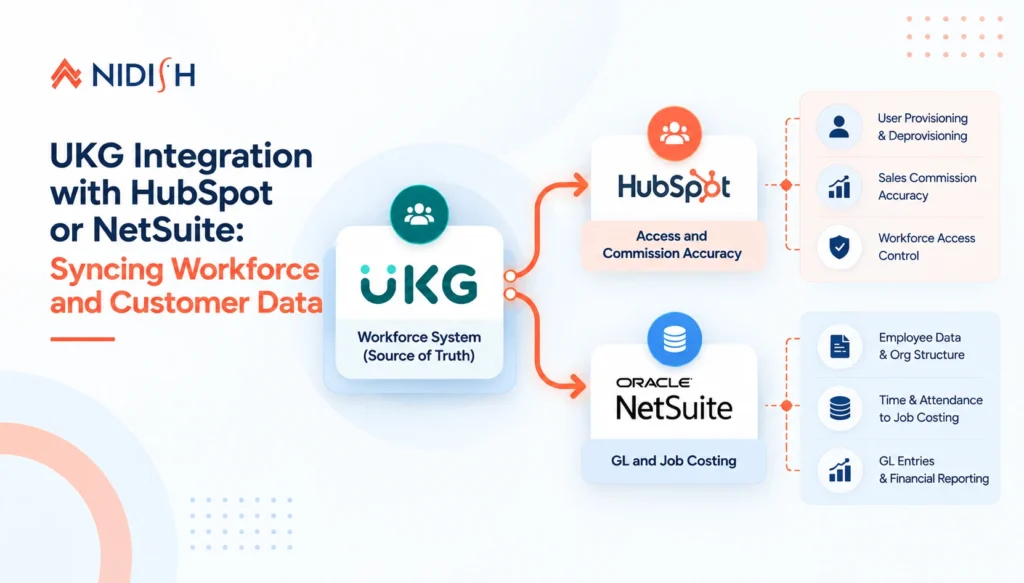
Design inspiration below:


 Blog
Blog Case Studies
 Career