
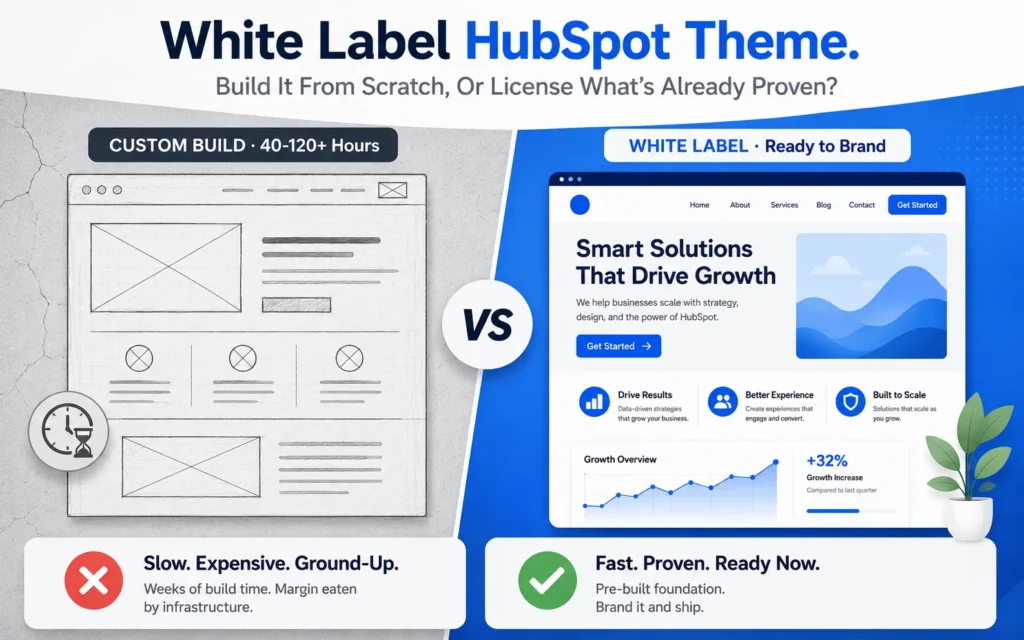
Every agency hits this decision eventually: build a custom HubSpot theme for the new client, or license one that’s already built and already maintained. Here’s the actual math behind that call.
Quick answer: A white label HubSpot theme is a pre-built CMS theme your agency licenses, brands, and delivers as its own work, without the client knowing who built the underlying structure. It’s the smarter call for most SMB and mid-market website projects because it moves 40 to 120+ hours of build time off your plate. Custom development still wins when a client’s site genuinely needs to look and function unlike anything else in its category.
Table of Contents
What Does a White Label HubSpot Theme Actually Mean?
A white label HubSpot theme is a pre-built CMS theme that an agency licenses from a third-party developer and deploys under its own brand. The client sees your agency’s name on the proposal and the invoice, not the theme provider’s.
This is different from white-label development services, where you’re outsourcing build hours to another team but still constructing something from scratch for every client. With a white-labeled theme, the foundation already exists. You’re configuring and branding it, not building it.
That distinction matters because most of what gets written about “white label HubSpot” online is actually about the second thing: outsourced dev labor, not this one. If you’ve already read a few of those guides, the model below is going to look different.
The Real Cost of Building a Custom Theme for Every Client
Custom HubSpot theme builds typically run somewhere between 40 and 120+ development hours depending on complexity: discovery, module architecture, responsive testing, browser QA, and then ongoing maintenance every time HubSpot ships a platform update. According to HubSpot’s own developer documentation, theme architecture decisions made early on directly affect how much rework is needed down the line, which is exactly the kind of cost that’s easy to underestimate at the proposal stage.
None of that is wasted effort on a flagship client where the website is the differentiator. But on a $3,000 to $8,000 website engagement, those hours are most of your margin, and they’re hours you’re spending on infrastructure instead of on the strategy and content work clients actually came to you for.
This is the calculation every agency eventually runs into: the build hours don’t shrink just because the client’s budget is smaller. A white-labeled theme changes that equation by moving the infrastructure cost from “every project” to “once, paid for by someone else, amortized across every agency that licenses it.”
When Licensing a White Label HubSpot Theme Is the Better Call
A few situations where white label HubSpot theme licensing clearly wins:
- Mid-market and SMB website projects where the budget doesn’t support 80+ hours of custom build time, but the client still expects a polished, professional result.
- Volume periods when your pipeline has three or four website builds stacked up and your dev bench is the bottleneck, not your sales team.
- Standardized verticals like manufacturing, professional services, and B2B SaaS, where the page types and conversion patterns are well understood and don’t need to be reinvented per client.
- New service lines, for agencies adding website builds as a new offering who don’t yet want to carry the overhead of an in-house theme architecture.
In each of these, the client doesn’t lose anything. They still get a unique brand application, custom content, and your strategic input. What they don’t get billed for is you reinventing the underlying structure that a well-maintained theme already solved.
When Custom Development Is Still Worth It
This isn’t a case for licensing everything. Custom builds are the right call when:
- The client’s information architecture is genuinely unusual (multi-entity organizations, complex product catalogs, non-standard navigation patterns)
- The website is meant to be a flagship differentiator and the client is paying for that
- There’s a specific integration or interaction pattern no existing theme supports
- You’re building something you intend to productize yourself later
A reasonable rule of thumb: if you’re explaining to the client why their site needs to look and behave differently from anyone else’s in their category, build custom. If you’re explaining why their site needs to look professional, load fast, and be easy to maintain, a white-labeled HubSpot theme does that job for a fraction of the time. For a deeper look at where those limits sit, see HubSpot Theme Customization Limits.
How White Label HubSpot Theme Licensing Works in Practice
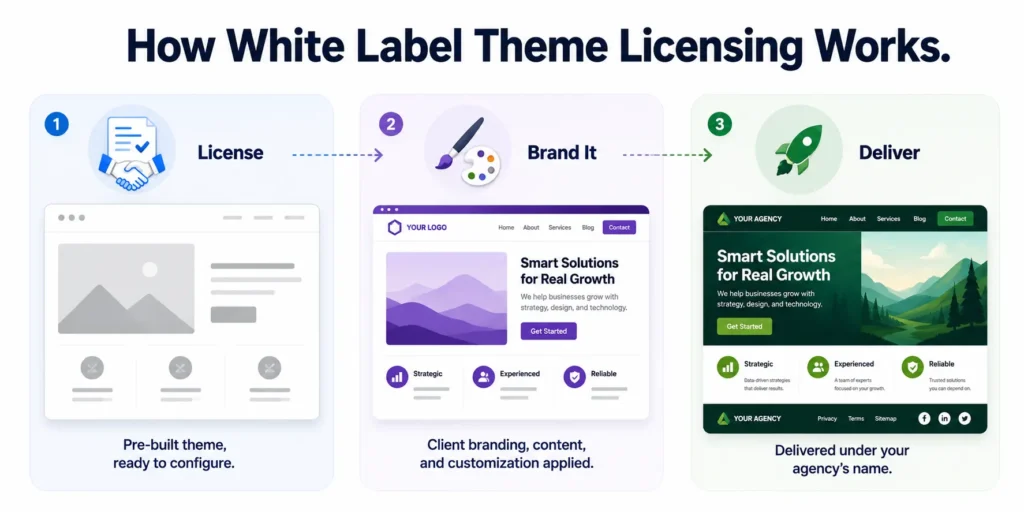
The model is simpler than most agencies expect. You license an existing, actively maintained theme, apply the client’s branding, content, and any agreed customizations, and deliver it as your own work. The client relationship, invoicing, and ongoing support stay entirely with your agency.
Nidish runs a referral commission program covering both of its premium HubSpot Marketplace themes, Siloh Pro and Commerce Craft, for agencies that want this option without managing theme infrastructure themselves. Details are on the white-label partnership page at White Label Partnership, and it’s worth a direct conversation if you want the specifics of how commission and delivery work for your agency’s volume. You can Book a Call with Us to walk through it.
Industry benchmarks on agency margin, like those tracked by Clutch’s agency pricing research, consistently show that infrastructure and build hours are where fixed-price web projects lose the most margin, which lines up with what most agencies find once they run their own numbers.
What to Check Before You White Label Any Theme
Licensing isn’t risk-free if the underlying theme isn’t actually maintained. Your agency’s name is now attached to it. Before you commit to reselling a HubSpot theme under your brand, the checks are the same ones we laid out for buyers in general: last-updated date on the marketplace listing, version number and update cadence, and whether the provider has a track record beyond this one product.
We covered the full five-point version of this check in Is Your HubSpot Theme Still Maintained, and it’s worth running through it on any theme before your agency’s name goes on it. If you’re still comparing options, Best HubSpot Themes in 2026 rounds up the current field.
FAQ
Is white-labeling a HubSpot theme the same as reselling it?
Functionally, yes. You’re licensing a pre-built theme and presenting it as part of your own deliverable, under your own brand, with your agency handling the client relationship.
Do clients know they’re getting a licensed theme instead of a custom build?
That depends on your agency’s disclosure practices, not the theme provider’s. Most white-label arrangements keep the underlying vendor confidential, similar to how a printer doesn’t disclose its paper supplier.
Can I still customize a white-labeled HubSpot theme for each client?
Yes. A well-built theme is designed for branding, module rearrangement, and content customization per client. What you’re not doing is rebuilding the underlying architecture from zero each time.
What margin difference does licensing actually make?
It varies by project scope, but the time saved is concentrated in the phases clients never see: architecture, module-building, and cross-browser QA. That’s exactly the time that’s hardest to bill transparently on a fixed-price website project.


 Blog
Blog Case Studies
 Career