

UKG time and attendance is one of the most critical components of a workforce management environment because it directly influences payroll accuracy, labor compliance, operational efficiency, and employee confidence in the system. Organizations that extract long-term value from UKG do not treat time and attendance as a static configuration. They view time and attendance within UKG as a living operational process that must evolve alongside workforce policies and business complexity.
This article explains how organizations optimize time and attendance in UKG environments, based on delivery experience and operational realities rather than high-level feature descriptions.
Table of Contents
Why UKG Time and Attendance Optimization Matters
UKG time and attendance functions as the system of record for employee work hours, pay rules, and labor calculations. When this system is not aligned with how the workforce actually operates, the impact is immediate and measurable. Payroll teams face frequent adjustments, managers lose trust in reported hours, and compliance teams struggle to validate audit data.
Organizations that invest in optimizing time and attendance within UKG typically see cleaner payroll cycles, fewer retroactive corrections, and stronger adoption across operational teams. This is why time and attendance is often the first area assessed during enterprise UKG optimization initiatives.
Align Workforce Policies Before Configuring UKG Time and Attendance
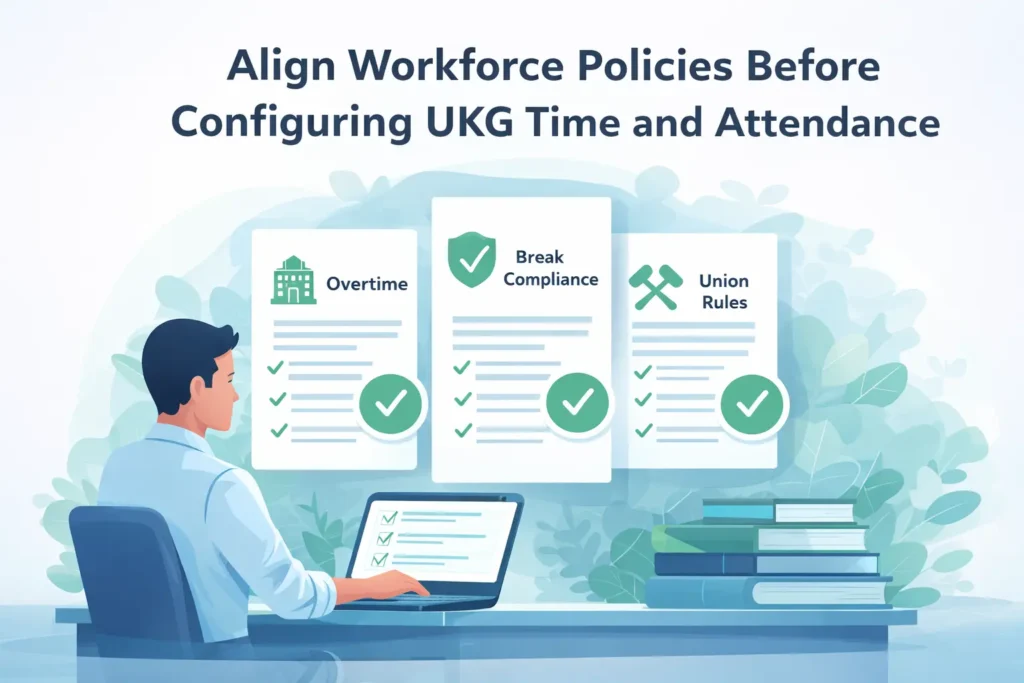
Successful optimization starts well before configuration begins. High-performing organizations ensure that workforce policies are clearly defined, documented, and validated across HR, payroll, and operations. The UKG timekeeping framework is highly flexible, but that flexibility must be grounded in policy clarity.
Key policy areas that directly impact time and attendance optimization include:
- Overtime and premium pay policies
- Break and meal compliance requirements
- Shift differentials and pay codes
- Union rules and location-specific labor regulations
When these policies are accurately translated into system logic, the UKG time tracking setup becomes predictable, scalable, and easier to govern over time. This policy-first approach is a core principle followed in mature UKG Consulting Services engagements.
Designing Punch Collection Around Real Workforce Behavior
UKG time and attendance supports multiple punch collection methods, including physical clocks, web-based punches, mobile punches, and integrations with access control systems. Optimization does not mean enabling every available option. It means selecting punch methods that align with how employees actually work.
Organizations that design punch collection around real workforce behavior reduce exception volume, improve data accuracy, and increase employee trust in UKG time and attendance. This alignment is especially important for distributed teams, regulated environments, and multi-location operations.
Using Exception Management as a Control Mechanism
Exception management is one of the most powerful optimization levers within UKG time and attendance. Mature organizations do not attempt to eliminate exceptions entirely. Instead, they configure the system to surface meaningful exceptions early and route them to the right stakeholders.
Well-optimized UKG time and attendance environments typically use exception management to:
- Identify potential issues before payroll close
- Assign clear ownership to managers or payroll teams
- Reduce reactive cleanup and manual adjustments
- Surface operational trends related to staffing and scheduling
Over time, exception data from UKG time and attendance becomes a valuable input for workforce planning and continuous improvement.
Synchronizing Scheduling With UKG Time and Attendance Rules
Time and attendance optimization cannot be separated from scheduling. In UKG, scheduling logic and UKG time and attendance rules must work together to produce consistent outcomes. When schedules do not reflect expected work patterns, timekeeping data becomes unreliable even if rules are technically correct.
Organizations that achieve consistency align shift templates, expected punch behavior, and time rules during design and testing. This alignment is a defining characteristic of strong UKG workforce scheduling and timekeeping practices, where scheduling decisions actively support accurate time capture rather than creating downstream exceptions.
Using UKG Workforce Analytics to Refine Time and Attendance
Optimized organizations rely on data-driven insights to improve their workforce operations. UKG workforce analytics plays a critical role in refining UKG timekeeping by turning raw time data into actionable trends.
By reviewing analytics related to exceptions, overtime usage, early clock-ins, and late clock-outs, organizations can identify systemic issues before they escalate. Over time, UKG workforce analytics helps teams fine-tune labor rules, improve scheduling accuracy, and reduce unnecessary payroll costs, all while strengthening confidence in the UKG time tracking system data.
Establishing Governance for Long-Term UKG Time and Attendance Optimization
The UKG time tracking system optimization does not end at go-live. Workforce policies evolve, labor regulations change, and organizational structures become more complex. Without governance, even well-designed systems gradually lose accuracy.
Effective governance for UKG time and attendance typically includes:
- Clear ownership of timekeeping configuration and rules
- Structured change management for policy or system updates
- Regular reviews of exception trends and compliance alignment
This governance model ensures that UKG time and attendance remains aligned with business needs and regulatory requirements over time.
How Nidish Helps Optimize UKG Time and Attendance
Nidish works with organizations at different stages of their UKG journey, including implementation, migration, post-go-live optimization, and ongoing support. Our approach to time and attendance in UKG focuses on aligning workforce policies, operational workflows, and system governance into a stable and scalable model.
We help organizations translate complex labor policies into accurate UKG rule logic, reduce exception volume without compromising compliance, and align scheduling, timekeeping, and payroll processes. By combining delivery experience across industries with structured optimization frameworks, Nidish enables organizations to maintain reliable, payroll-ready UKG timekeeping environments.
Final Thoughts
Optimizing time and attendance in UKG requires more than technical configuration. It requires disciplined policy alignment, realistic operational design, analytics-driven refinement, and long-term governance. Organizations that treat UKG time and attendance as a strategic workforce capability consistently achieve better payroll accuracy, stronger compliance posture, and higher system adoption.




 Blog
Blog Case Studies
 Career