
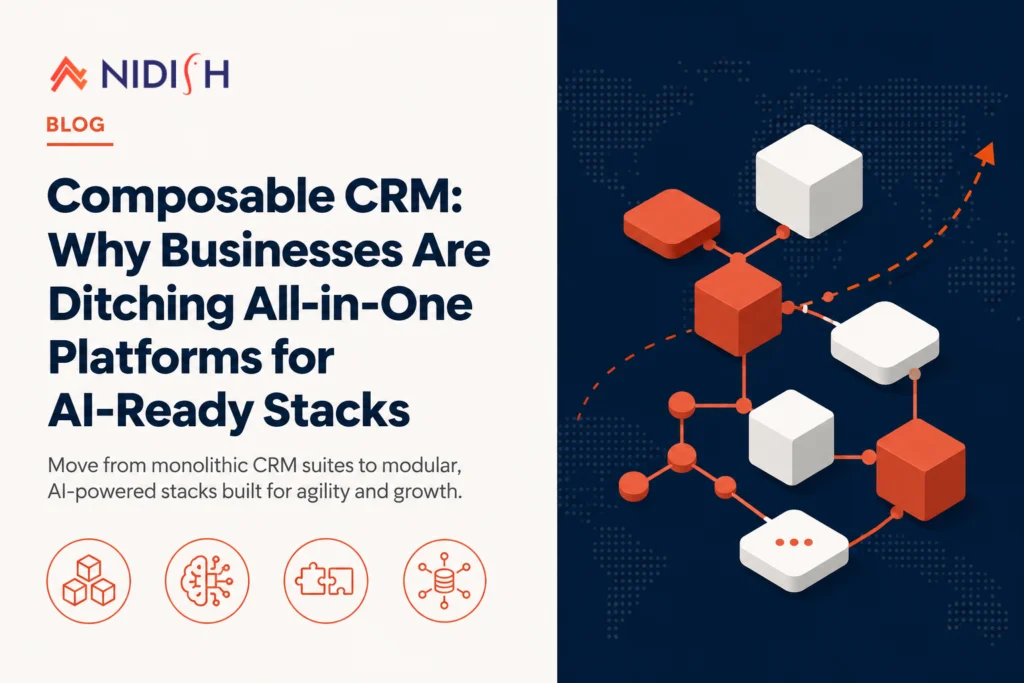
For most of the last two decades, buying a CRM meant picking one platform and building your entire revenue operation around it. Sales, marketing, service, reporting, all locked into a single vendor’s roadmap, a single vendor’s pricing, and a single vendor’s idea of what your business should look like. That model is starting to crack, and composable CRM is the reason why.
The shift isn’t cosmetic. It’s showing up in where the money is actually going. Recent industry analysis points to nearly half of new CRM-related investment now flowing into data architecture, AI infrastructure, and analytics, rather than additional software licenses. That’s a meaningful reallocation, and it tells you something important: businesses aren’t just buying more CRM anymore, they’re rebuilding how CRM connects to everything else.
This article breaks down what composable CRM actually means, why all-in-one platforms are losing ground specifically because of AI, what a real composable CRM stack looks like in practice, and how to know whether your business should be making this move now or waiting it out.
Table of Contents
Quick Answer
Composable CRM is an approach where a business builds its customer relationship management capability from a core CRM plus a set of best-fit, connected tools, rather than relying on one monolithic all-in-one platform for every function. The appeal has accelerated alongside AI, because a modular CRM stack can plug in specialized AI tools for forecasting, data enrichment, or automation without waiting on one vendor to build every feature internally. It trades some setup complexity for long-term flexibility and faster access to new capabilities.
What Is Composable CRM, Exactly?
Composable CRM takes its name from composable architecture in software more broadly, the idea that instead of one giant application doing everything, you assemble a system from smaller, interchangeable components that each do one thing well and connect through APIs.
Applied to CRM, that means your core system of record (contacts, deals, accounts) stays in one platform, while specific functions, email marketing, call intelligence, data enrichment, forecasting, customer support, get handled by tools purpose-built for that job, all synced back to the same customer record.
Contrast that with the traditional all-in-one CRM model, where sales, marketing, service, and reporting all live inside one platform’s walls, and every new capability depends on that vendor building it, pricing it, and shipping it on their own timeline.
All-in-One CRM vs Composable CRM: What’s Actually Different
The distinction isn’t just architectural, it changes how a business operates day to day.
All-in-one CRM gives you one login, one vendor relationship, and generally faster initial setup since everything is pre-integrated by design. The tradeoff is that you’re limited to whatever that vendor has built, and you’re often paying for entire feature suites your team barely touches. One widely cited figure from recent CRM research puts feature utilization at under half, meaning a large share of businesses are paying for capability they aren’t using inside their all-in-one suite.
Composable CRM flips that tradeoff. You get to pick the best tool for each specific job, sales forecasting from one vendor, conversation intelligence from another, marketing automation from a third, all connected to a shared core. That means faster access to innovation, since you’re not waiting on one company’s product roadmap for every new feature. It also means more integration work up front, and more vendors to manage over time.
Neither model is universally right. The businesses moving toward composable CRM tend to be ones that have outgrown generic tooling and need something that fits their actual process, not a one-size-fits-most suite.
Why Businesses Are Ditching All-in-One Platforms
A few forces are driving this shift at the same time, and they’re reinforcing each other.
Feature bloat without feature fit
All-in-one platforms are built to serve as many industries and use cases as possible, which means most businesses end up with a system that’s simultaneously overbuilt in places they don’t need and underbuilt in the specific area that actually matters to them.
Vendor lock-in fatigue
When your entire revenue stack lives inside one platform, switching later means rebuilding everything, not just replacing one tool. Businesses that have been burned by this once are increasingly reluctant to repeat it, favoring modular CRM setups where a single underperforming tool can be swapped without touching everything else.
AI is moving faster than any single vendor can keep up
This is the big one, and it’s the real accelerant behind the composable CRM trend right now. Specialized AI tools for lead scoring, sentiment analysis, call transcription, and forecasting are shipping new capability constantly. A composable CRM stack lets a business adopt the best AI tool for a specific job the moment it’s useful, instead of waiting for their all-in-one vendor to eventually build an equivalent feature, if they build it at all.
Budget priorities have shifted
As noted above, businesses are now directing a large share of new CRM investment into data architecture and AI infrastructure rather than straight licensing costs. That’s a structural signal that businesses see more value in owning their data layer and plugging in best-fit AI tools than in paying more for a bigger version of one platform.
The AI Angle: Why Composable Stacks Are Built for AI, Not Just Flexibility
It’s worth being specific about why AI is the real catalyst here, not just a talking point layered on top of an existing trend.
Modern AI CRM capabilities, agentic assistants that summarize calls, draft follow-ups, score leads, and flag at-risk deals, tend to be built by specialized vendors moving fast in a narrow lane. Gartner’s widely cited prediction that 40% of enterprise apps will include task-specific AI agents by the end of 2026 reflects just how quickly this specialization is happening. An all-in-one CRM vendor building a comparable in-house AI feature is competing against dozens of specialized teams whose entire business is that one capability.
A composable CRM architecture sidesteps that bottleneck. Instead of your CRM vendor being the ceiling on what AI you can access, your core system becomes a hub that specialized AI tools plug into. Need better call intelligence? Add a dedicated conversation AI tool. Need sharper forecasting? Add a purpose-built predictive analytics layer. Each piece stays replaceable as better tools emerge, which matters enormously in a category moving as fast as AI currently is.
This is also where connected data quietly becomes the real foundation of the whole approach. AI recommendations are only as good as the data feeding them, and a composable CRM stack depends on every connected tool sharing a consistent view of the customer, not five different partial pictures. Businesses that adopt composable architecture without solving the data-sync problem first tend to end up with smarter-sounding tools working off inconsistent information, which is arguably worse than no AI at all.
What Does a Composable CRM Stack Actually Look Like?
In practice, a composable CRM setup usually has a few consistent layers, even though the specific tools vary by business.
The core CRM
This is your system of record, contacts, companies, deals, pipeline stages. Platforms like HubSpot, Pipedrive, Salesforce, or Zoho typically anchor this layer, chosen based on team size, sales process, and budget rather than which one claims to do the most things.
The AI and automation layer
Purpose-built tools for lead scoring, conversation intelligence, forecasting, or content generation connect into the core CRM, each handling one job well rather than being a bolted-on feature inside a bigger suite.
The integration layer
This is what actually makes composable CRM work rather than becoming five disconnected tools wearing a trench coat. iPaaS platforms like Celigo, or custom API integrations, keep data flowing consistently between the CRM, ERP systems like NetSuite or Odoo, and any specialized AI tools in use, so every piece of the stack is working off the same customer reality.
The reporting and data layer
Increasingly, businesses are centralizing this separately from any single tool, pulling data from the CRM and every connected system into a unified reporting layer rather than relying on whatever dashboard the core CRM happens to ship with.
Skip that integration layer, and composable CRM stops being an advantage and starts becoming exactly the fragmented mess it was supposed to fix.
The Trade-offs Nobody Talks About
It’s worth being honest about the downsides, because composable CRM isn’t automatically the right answer for everyone.
More vendors to manage: Instead of one support contact, you now have several, each with its own contract, renewal date, and potential downtime.
Integration is the make-or-break factor: A composable stack lives or dies on how well its pieces stay connected. Poorly maintained integrations turn a modular CRM setup into a worse version of the data silos it was meant to eliminate.
Higher setup complexity: All-in-one platforms win on initial simplicity for a reason. Composable CRM generally requires more upfront planning and, often, outside expertise to architect correctly.
Ongoing maintenance overhead: Every connected tool is a potential point of failure. Someone on your team, or an outside partner, needs to own keeping the whole stack in sync as individual tools update or change their APIs.
None of these are reasons to avoid composable CRM. They’re reasons to go in with a clear plan rather than assembling tools reactively as needs come up.
How to Know If Your Business Should Go Composable
A composable CRM approach tends to make the most sense when:
- Your current all-in-one platform has clear gaps in one specific area (forecasting, service, marketing) that would require a costly upgrade tier to fix
- You’ve outgrown generic tooling and need something that matches your actual sales or service process
- You’re already running a CRM alongside an ERP or other operational system that needs to stay in sync
- You want to adopt new AI capabilities as they emerge, rather than waiting for one vendor’s roadmap
- You have, or are willing to bring in, the integration expertise to keep everything connected properly
If none of those apply yet, and your current all-in-one CRM is covering what you need, there’s no urgency to rebuild your stack just because composable CRM is the trend of the moment. The right architecture is the one that matches where your business actually is, not where the industry conversation happens to be pointing.
How Nidish Can Help
This is, honestly, close to the exact problem we work on every day. We’re not tied to one CRM platform, we work across HubSpot, Pipedrive, Salesforce, and Zoho, and we handle the integration layer that makes a composable CRM stack actually hold together, connecting CRM systems to NetSuite, Odoo, and Celigo rather than leaving each tool to operate in its own silo.
If you’re weighing whether to move toward a composable CRM setup, or you’ve already got several tools that aren’t talking to each other the way they should, that’s exactly the kind of architecture problem we help sort out. No pressure to commit to a full rebuild today, sometimes the right first step is just fixing the one connection that’s currently causing the most pain.
Frequently Asked Questions
What is composable CRM in simple terms?
Composable CRM means building your customer relationship management setup from a core CRM plus several best-fit tools connected together, instead of relying on one all-in-one platform to handle every function.
Is composable CRM the same as a modular CRM?
Yes, the terms are generally used interchangeably. Both describe the same shift away from monolithic, single-vendor platforms toward a connected stack of specialized tools.
Is composable CRM better than an all-in-one CRM?
Neither is universally better. All-in-one platforms offer faster setup and a single vendor relationship, while composable CRM offers more flexibility and faster access to specialized AI tools, at the cost of more integration work.
Does composable CRM work for small businesses?
It can, but it’s usually a better fit once a business has outgrown a generic all-in-one setup or already has multiple systems, like an ERP, that need to stay connected to the CRM. Very small teams often do fine with a simpler all-in-one platform initially.
What tools are needed to build a composable CRM stack?
At minimum, a core CRM platform, one or more specialized tools for functions like forecasting or conversation intelligence, and an integration layer, often an iPaaS platform, to keep everything synced.
Why is AI accelerating the shift to composable CRM?
Specialized AI vendors are shipping new capabilities faster than any single all-in-one CRM vendor can build in-house. A composable CRM architecture lets businesses plug in the best available AI tool for a given task without waiting on one company’s product roadmap.



 Blog
Blog Case Studies
 Career