
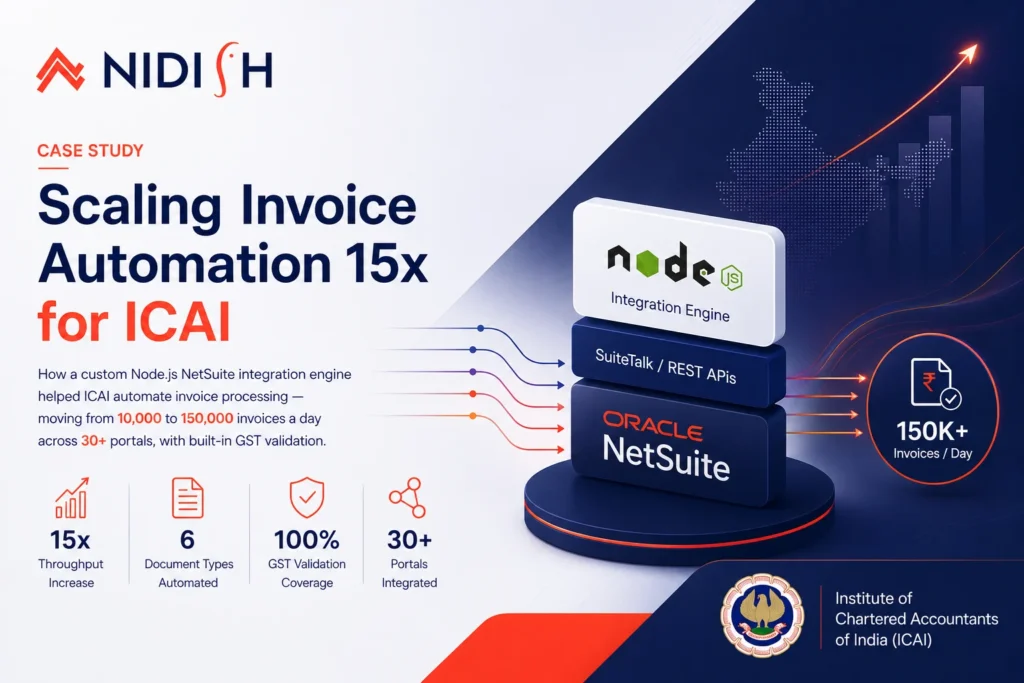
How a custom Node.js NetSuite integration engine helped the Institute of Chartered Accountants of India automate invoice processing — moving from 10,000 to 150,000 invoices a day across 30+ portals, with built-in GST validation.
CLIENT: Institute of Chartered Accountants of India (ICAI)
SECTOR: Government / Statutory Professional Body — India
PLATFORM: Oracle NetSuite ERP
STACK: Custom Node.js Middleware • SuiteTalk / REST APIs • GSTZen • Live Ops Dashboard
Table of Contents
At a Glance
This NetSuite integration case study shows how a custom Node.js integration engine replaced a slow, manual, error-prone invoicing process with high-volume invoice automation — sustaining peak statutory workloads without adding NetSuite licenses or headcount.
Key Takeaways
- 15x NetSuite performance gain: daily invoice creation scaled from ~10,000 to 150,000+ on the same Oracle NetSuite environment.
- Custom Node.js middleware: an event-driven NetSuite integration engine handles high-concurrency, I/O-bound API workloads efficiently.
- 30+ portal integrations: each source system maps to NetSuite through a process built for its specific use case.
- Built-in GST validation: GSTZen integration validates customer and tax data before records are written to NetSuite.
Full observability: an operations dashboard provides live logs, historic logs, flow toggles, and JSON/CSV log export.
Client Overview: Institute of Chartered Accountants of India (ICAI)
The Institute of Chartered Accountants of India (ICAI) is one of the largest professional accounting bodies in the world and a statutory institution established under an Act of the Indian Parliament. It governs the profession of chartered accountancy across the country, serving lakhs of members and students through a vast network of regional councils, branches, examination wings, and specialised institutes.
That scale comes with a financial footprint to match. Membership fees, examination charges, course enrolments, event registrations, publication sales, and dozens of other revenue streams flow in continuously from across India — each one ultimately needing to be recorded accurately inside the organisation’s accounting system of record, Oracle NetSuite.
When demand spikes — exam season, annual fee renewals, large enrolment drives — the volume of financial documents that must be created in NetSuite rises sharply and unforgivingly. The system that worked on an ordinary day simply could not keep up on the days that mattered most.
Problem Statement: A NetSuite Invoice Bottleneck
On paper, the existing setup did everything it was supposed to. In practice, it had hit a hard ceiling. The native and semi-manual approach to pushing transactions into NetSuite could create roughly 10,000 invoices in a day — a number that fell dramatically short of what ICAI actually needed during peak periods.
The constraints compounded one another:
- Throughput ceiling. NetSuite’s record-creation throughput, when driven the way it was being driven, throttled hard under load. Batches that needed to clear within hours were stretching across entire days, creating financial backlogs.
- Fragmented source systems. Revenue did not originate in one place. More than 30 separate institute and portal systems — examinations, membership, courses, events and more — each produced data in their own shape, on their own schedule, with their own quirks.
- No single way in. Each portal effectively needed its own logic for how a transaction should land in NetSuite. A one-size-fits-all import simply did not reflect how the business actually worked.
- Data quality risk. For a statutory body, GST compliance is non-negotiable. Customer and tax data arriving from upstream portals was inconsistent, and pushing unvalidated records into the books risked compliance exposure and painful reconciliation later.
Operational blindness. When something failed mid-process, there was little visibility into what had happened, where, or why. Diagnosing issues meant digging — and a stuck flow could go unnoticed until the numbers did not add up.
The organisation did not need a faster computer — it needed a fundamentally different way of moving financial data into NetSuite: one that was fast, resilient, observable, and tailored to how each of its 30+ portals actually behaved.
Solution: A Custom Node.js NetSuite Integration Engine
We designed and built a custom Node.js integration engine — a dedicated middleware layer that sits between ICAI’s portal ecosystem and NetSuite. Rather than treating NetSuite as the bottleneck, the engine treats it as an endpoint to be fed intelligently: batching, parallelising, validating and routing transactions so the ERP receives clean, well-formed records at a pace it can sustain.
The result was a leap from roughly 10,000 to over 150,000 invoices created in a single day — a 15x improvement — using the same NetSuite environment, achieved by changing how data reached it rather than what it ran on.
Why Node.js
The choice of Node.js was deliberate. Integration workloads of this kind are overwhelmingly I/O-bound — the system spends its time waiting on NetSuite APIs, portal endpoints, and validation services rather than crunching numbers locally. Node’s non-blocking, event-driven model is purpose-built for exactly this: thousands of concurrent in-flight API operations, orchestrated efficiently, with controlled concurrency so NetSuite is pushed to its sustainable limit but never past it.
A Process Per Use Case
Instead of forcing every portal through one rigid pipeline, we built a library of distinct, independently runnable integration processes. Each portal’s data maps to the right combination of NetSuite document types through the process that fits its specific business case — so an examination payment, a membership renewal, and a publication sale each follow the path that is correct for them.
The platform creates and manages the full financial document lifecycle in NetSuite:
- Customer Profiles — created and maintained in a three-layer hierarchy that mirrors ICAI’s organisational structure, so every transaction attaches to the correct entity.
- Sales Orders — capturing the commitment behind each fee, enrolment, or purchase.
- Customer Deposits — recording advance and upfront payments accurately.
- Customer Invoices — the high-volume core of the system, generated at scale.
- Customer Payments — applied and reconciled against the right invoices.
- Journal Vouchers — for adjustments and entries that fall outside the standard sales cycle.
The Three-Layer Customer Model
A recurring source of ERP mess is customer data that does not reflect how an organisation is actually structured. To prevent that, customer profiles are categorised across three layers, giving NetSuite a clean, consistent hierarchy regardless of which portal a record originated from. Reporting rolls up cleanly, duplicates are avoided, and every downstream document — order, invoice, payment — anchors to the right node in the structure.
GST Validation: Integrating GSTZen with NetSuite
Speed is worthless if the data is wrong. Because ICAI operates under strict Indian GST obligations, we integrated GSTZen directly into the pipeline as a validation gate. Before any customer or transaction record is written to NetSuite, it is checked against GSTZen — so tax and customer details are verified at the point of entry, not discovered to be faulty weeks later during reconciliation.
This shifted compliance from a downstream clean-up exercise to an upstream guarantee. Invalid or incomplete records are caught and handled before they can pollute the books, which protects the integrity of every report and filing that depends on NetSuite data.
Validate first, write once. By making GSTZen a mandatory gate rather than an afterthought, the platform turned GST compliance from a recurring risk into a built-in property of the system.
NetSuite Integration Dashboard: Live Logs & Flow Control
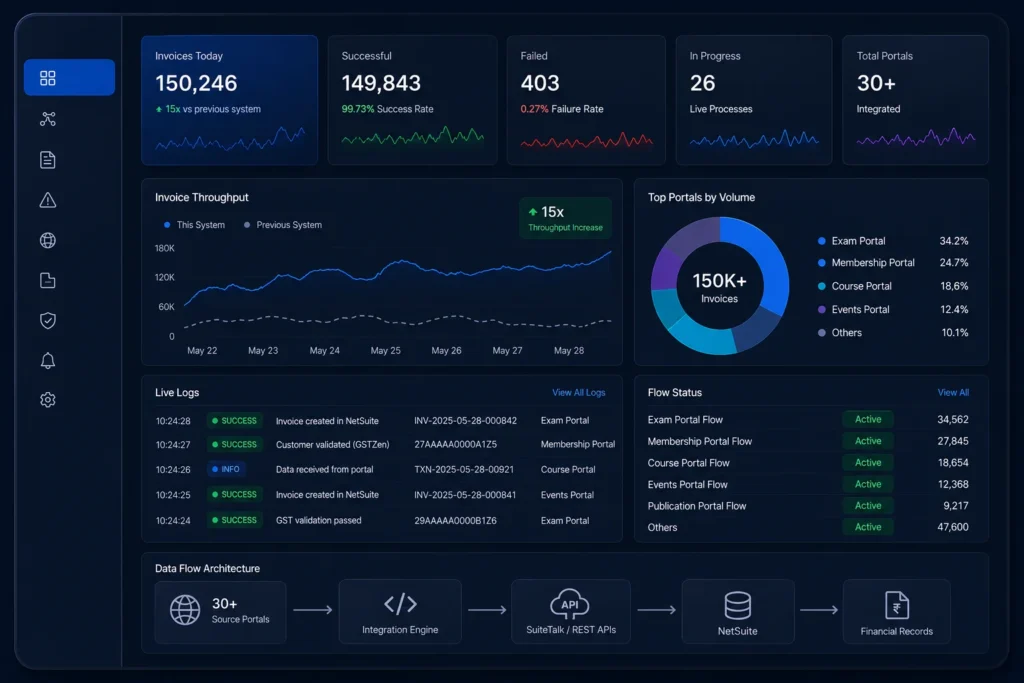
Automation at this scale only earns trust if the people responsible can see what it is doing. So alongside the engine, we delivered a dedicated control dashboard that turns a black-box pipeline into a transparent, operable system. From a single interface, the ICAI team can run the entire integration estate.
| Capability | What It Gives the Team |
| Enable / disable flows | Switch any individual integration flow on or off instantly — pause a portal for maintenance or isolate an issue without touching the rest of the system. |
| Live logs | Switch any individual integration flow on or off instantly — pause a portal for maintenance or isolate an issue without touching the rest of the system. |
| Historic logs | Review the complete history of past runs for auditing, troubleshooting, and trend analysis. |
| Export to JSON | Download logs in JSON for programmatic analysis, ticketing, or feeding into other tools. |
| Export to CSV | Download logs in CSV for finance and audit teams to open, filter, and reconcile in familiar spreadsheets. |
The combination of granular control and full-spectrum logging means problems are detected early, diagnosed quickly, and resolved without guesswork — and that every run leaves a defensible audit trail, which matters enormously for a statutory body.
NetSuite Integration Architecture
Conceptually, data flows through four stages, with the Node.js engine orchestrating each one:
- Ingest: 30+ portals feed their transaction data into the engine, each through the process built for its use case.
- Validate: Rcords are checked against GSTZen; only clean data proceeds.
- Transform & Route: Validated data is mapped to the correct NetSuite documents and the three-layer customer hierarchy.
- Load at Scale: Records are written to NetSuite using controlled concurrency, with every step logged for the dashboard.
| Core Engine | Custom application built in Node.js (event-driven, high-concurrency) |
| Target ERP | Oracle NetSuite — full financial document lifecycle |
| Validation | GSTZen integration as a pre-write compliance gate |
| Source Systems | 30+ institute and portal systems, each with a tailored process |
| Document Types | Customer Profile, Sales Order, Customer Deposit, Invoice, Payment, Journal Voucher |
| Observability | Live + historic logging, flow toggles, JSON/CSV export dashboard |
| Customer Model | Three-layer hierarchy for clean rollups and reporting |
Results: 15x Faster NetSuite Invoice Automation
The platform delivered a step-change in both capacity and confidence:
- 15x throughput: Daily invoice creation capacity rose from around 10,000 to over 150,000 — comfortably absorbing peak statutory workloads.
- Same ERP, no new licenses: The gain came entirely from how data reached NetSuite, not from expensive infrastructure or license expansion.
- Compliance by design: GSTZen validation at the point of entry made GST-clean data the default state, not a periodic remediation project.
- Unified, scalable integration: 30+ portals now feed NetSuite through purpose-fit processes, with headroom to add more without re-architecting.
- Full operational control: The dashboard gave the team real-time visibility, on-demand flow control, and exportable audit trails in JSON and CSV.
- Resilience under load: Controlled concurrency means NetSuite is driven to its sustainable maximum without being overwhelmed, even during the busiest days of the year.
From a 10,000-document ceiling to 150,000 a day — the same NetSuite, transformed by a smarter, faster, fully observable way of feeding it.
Why This NetSuite Integration Approach Worked
The temptation with an ERP bottleneck is to blame the ERP. The real insight here was that NetSuite was never the problem — the way data was being pushed into it was. By moving the intelligence into a dedicated Node.js engine, validating compliance upstream, tailoring a process to each portal, and wrapping the whole thing in an operable dashboard, we turned a hard ceiling into open headroom.
For an institution of ICAI’s scale and statutory importance, the outcome is not just faster invoicing. It is a financial backbone that holds steady on the days that matter most — accurate, auditable, and ready to grow.
Interested in scaling your own NetSuite environment?
We design custom integration platforms that make ERPs faster, cleaner, and easier to operate. Let’s talk about your data flows.
Frequently Asked Questions
Common questions about high-volume NetSuite integration, Node.js middleware, and GST validation.
How do you increase NetSuite invoice processing speed?
NetSuite’s record-creation throughput is usually limited by how data is pushed into it, not by the ERP itself. In this project, a custom Node.js integration engine batched and parallelised API calls with controlled concurrency, lifting daily invoice creation from around 10,000 to over 150,000 — a 15x gain — on the same NetSuite environment.
Why use Node.js for a NetSuite integration?
NetSuite integration work is overwhelmingly I/O-bound: the system spends most of its time waiting on NetSuite APIs, portal endpoints, and validation services. Node.js uses a non-blocking, event-driven model that is purpose-built for orchestrating thousands of concurrent API operations efficiently, which makes it ideal for high-volume invoice automation.
Can NetSuite integrate with multiple portals or source systems?
Yes. This platform connects 30+ separate institute and portal systems to NetSuite, with each source mapped through a dedicated process built for its specific use case. The architecture is scalable, so new portals can be added without re-engineering the core integration.
How is GST validation handled in NetSuite?
GST validation is built into the pipeline using a GSTZen integration. Every customer and transaction record is validated against GSTZen before it is written to NetSuite, so GST and customer data is verified at the point of entry rather than corrected later during reconciliation.
Which NetSuite documents can be automated?
The engine creates and manages the full financial document lifecycle in NetSuite: Customer Profiles (in a three-layer hierarchy), Sales Orders, Customer Deposits, Customer Invoices, Customer Payments, and Journal Vouchers — each routed through the process appropriate to the originating portal.
How do you monitor a high-volume NetSuite integration?
A dedicated operations dashboard provides full observability: operators can enable or disable individual integration flows, watch live logs in real time, review historic logs for auditing, and export logs in JSON and CSV for analysis and reconciliation.




 Blog
Blog Case Studies
 Career