
HubSpot CRM is often adopted during a company’s growth phase to bring structure to sales, marketing, and customer operations. While the platform itself is robust, many growing organizations fail to extract its full value due to flawed implementation and operational decisions. These issues usually do not surface immediately but compound over time and quietly limit scale.
This article breaks down the Common HubSpot CRM mistakes growing companies make, based on real-world implementation patterns, and explains how experienced teams avoid them.
Table of Contents
1. Implementing HubSpot Without a Business-Aligned CRM Strategy
One of the most damaging Common HubSpot CRM mistakes is treating CRM setup as a technical task instead of a business transformation initiative. Many teams configure pipelines, properties, and automation before clearly defining how leads move through marketing, sales, and customer success.
Without a documented revenue workflow:
- Deal stages do not reflect real buyer behavior
- Lead handoffs between teams are unclear
- Reporting becomes unreliable
HubSpot is flexible by design, which means poor strategy leads to poor structure.
Expert fix:
Before touching configuration, map your revenue process end to end. Define how leads qualify, how deals progress, and what outcomes trigger lifecycle changes. CRM architecture should mirror reality, not assumptions.
2. Weak Data Foundations That Undermine Everything Else
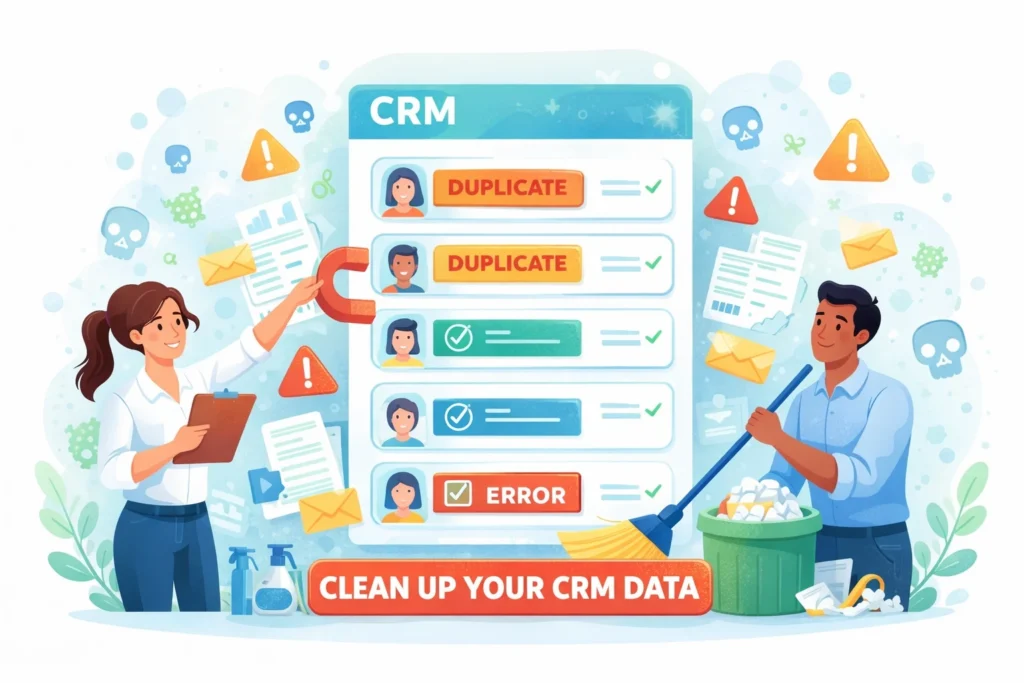
Bad data is one of the fastest ways to break CRM trust. A recurring pattern among scaling companies is importing legacy data without cleansing, normalization, or governance. This is one of the Common HubSpot CRM mistakes that quietly kills adoption.
Typical indicators include:
- Duplicate contacts and companies
- Inconsistent property values
- Incomplete records that block automation
Once sales teams stop trusting CRM data, usage declines rapidly.
Expert fix:
Clean data before migration. Define mandatory properties, standard formats, and validation rules. Establish ownership for ongoing data hygiene so quality does not decay as volume grows
3. Over-Automating Before Operational Maturity
Automation is powerful, but automation without operational clarity creates chaos. Many teams attempt to automate every possible action early on, resulting in conflicting workflows, unintended lifecycle changes, and sales confusion. This is one of the Common HubSpot CRM mistakes that directly impacts pipeline accuracy.
Examples include:
- Contacts skipping lifecycle stages
- Deals auto-updating without sales context
- Excessive internal notifications
Expert fix:
Automation should follow process maturity. Start with foundational workflows such as lead assignment, task reminders, and basic lifecycle updates. Document every workflow and review them quarterly as the business evolves.
4. Ignoring User Adoption and Behavioral Change
CRM success depends on people, not features. One of the most expensive Common HubSpot CRM mistakes is assuming teams will naturally adopt the platform without structured enablement.
Without training and reinforcement:
- CRM becomes an afterthought
- Data entry is inconsistent
- Reporting loses credibility
This problem compounds as teams grow and onboarding becomes harder.
Expert fix:
Treat CRM adoption as an ongoing program. Provide role-based training, not generic walkthroughs. Assign internal CRM champions who reinforce best practices and act as the first line of support.
5. Poor Integration Planning Across the Tech Stack
As companies scale, HubSpot must integrate cleanly with finance systems, support platforms, and external tools. A frequent and costly Common HubSpot CRM mistakes is deploying integrations without field mapping discipline or ownership.
Common outcomes include:
- Mismatched lifecycle stages
- Revenue data inconsistencies
- Broken attribution reporting
Expert fix:
Design integrations intentionally. Define which system owns each data point and how conflicts are resolved. Monitor sync health regularly and avoid unnecessary bidirectional syncing unless required.
6. Lack of CRM Ownership and Governance
When nobody owns HubSpot, everyone breaks it. One of the most overlooked Common HubSpot CRM mistakes in growing organizations is failing to assign accountability.
Without governance:
- Custom properties grow uncontrollably
- Automation logic becomes fragmented
- CRM standards erode over time
Expert fix:
Assign a dedicated CRM owner or RevOps lead. This role governs data structure, workflow creation, reporting standards, and system hygiene. As teams scale, formal governance becomes non-negotiable.
7. Misaligned Lifecycle Stages and Revenue Reporting
Lifecycle stages are foundational to HubSpot reporting, yet they are often poorly defined. This results in inflated lead numbers, inaccurate conversion rates, and misleading revenue forecasts. This is one of the Common HubSpot CRM mistakes that leadership usually notices too late.
Expert fix:
Define lifecycle stages collaboratively with marketing, sales, and leadership. Tie lifecycle progression to objective criteria such as qualification events or deal creation, not subjective judgment.
Where Expert Guidance Makes the Difference
Avoiding these mistakes requires more than platform knowledge. It requires understanding revenue operations, data architecture, and cross-team alignment. That is where experienced HubSpot partners add disproportionate value.
At Nidish, we help growing companies design HubSpot CRM systems that scale cleanly. Our approach combines strategy, technical execution, and governance to ensure HubSpot supports growth instead of slowing it down.
If you are looking to fix CRM inefficiencies or avoid them entirely, explore our HubSpot Consulting services to see how we help teams turn HubSpot into a reliable growth engine.
Final Takeaway
HubSpot CRM can accelerate growth or quietly restrict it. The difference lies in avoiding the Common HubSpot CRM mistakes that emerge as companies scale. With disciplined strategy, clean data, controlled automation, and clear ownership, HubSpot becomes a long-term operational advantage rather than a recurring headache.



 Blog
Blog Case Studies
 Career