
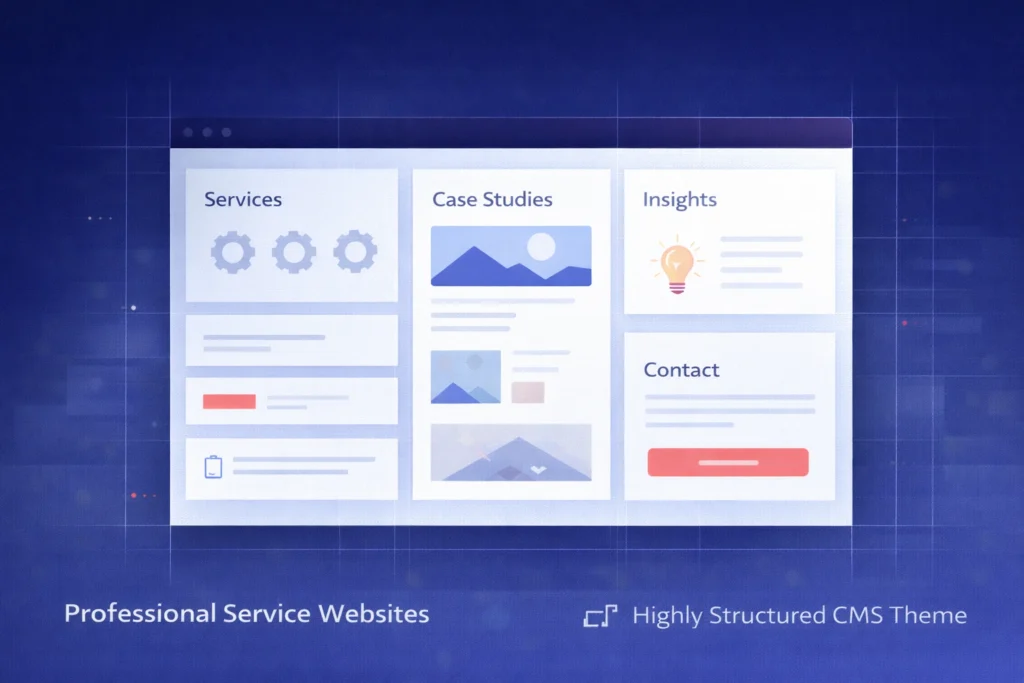
Professional service websites are fundamentally different from product or eCommerce sites. They are built on trust, clarity, and consistency, not impulse decisions. Whether you are a consulting firm, law practice, financial services provider, or agency, your website must communicate credibility while remaining easy to manage as your services evolve.
This is where many professional service teams struggle.
The issue is rarely content quality. More often, it is the lack of structure in the CMS theme powering the website. Without structured CMS themes, even well-designed professional service websites become difficult to scale, inconsistent to manage, and costly to maintain over time.
Table of Contents
What Makes Professional Service Websites Unique
Professional service websites typically grow content over time rather than launch fully formed. New service pages, insights, and case studies are added gradually as offerings evolve.
Many teams only realize the impact of poor structure months after launch, when routine updates become harder than expected. This is a common pattern we see in HubSpot CMS projects and is explored in detail in
Why Your HubSpot Website Feels Hard to Manage After 6 Months.
The Hidden Cost of Unstructured CMS Themes
An unstructured CMS theme often looks flexible at first. Editors can place anything anywhere. Over time, this freedom becomes a liability.
Common issues include:
- Service pages drifting away from brand consistency
- Custom sections duplicated across pages
- Increased dependency on developers
- Slower campaign execution
For agencies and consultants managing multiple client sites, this problem compounds quickly. It is one of the reasons many professionals move away from fully custom page builds, as discussed in
How Freelancers & Consultants Can Deliver Better HubSpot Websites Without Starting from Scratch.
What Are Structured CMS Themes
Structured CMS themes are designed with intentional constraints.
Instead of offering endless layout freedom, they provide:
- Predefined page templates
- Reusable section templates
- Modular content blocks
- Centralized global styling
This approach aligns closely with best practices for multi-industry HubSpot themes, where flexibility must coexist with consistency. You can see this principle applied in
Choosing a Multi-Industry HubSpot Theme That Works Across Industries.
Why Structure Matters More Than Visual Design
Visual polish attracts attention, but structure sustains performance.
Professional service websites rely heavily on:
- Clear content hierarchy
- Predictable layouts
- Consistent calls to action
When structure is missing, even strong content loses effectiveness. This becomes especially visible as websites expand into content-heavy formats such as blogs, guides, and insights libraries.
If your site includes educational or thought-leadership content, structure directly impacts how easily users and search engines navigate it.
The Role of Structured CMS Themes in SEO
SEO success is not only about keywords. It is also about how content is organized and rendered.
Structured CMS themes support SEO by:
- Enforcing semantic heading hierarchy
- Maintaining layout consistency across similar pages
- Improving mobile responsiveness
- Reducing technical debt over time
This is particularly important for professional services using content to support long sales cycles, similar to how HubSpot-powered content platforms are evaluated in
Can HubSpot Replace a Traditional LMS? What You Need to Know.
Why Modular CMS Design Works Better for Professional Teams
Professional service firms rarely operate with a single editor. Marketing, operations, leadership, and agencies all contribute.
A structured CMS theme:
- Reduces onboarding friction
- Prevents accidental layout breakage
- Enables faster publishing without approvals for every change
This modular approach mirrors how scalable HubSpot websites are built for long-term efficiency, not one-off launches.
Where Siloh Fits Into This Approach
Several HubSpot CMS themes aim to support structured website management. Siloh is designed around this philosophy rather than purely visual experimentation.
Without positioning it as a sales pitch, Siloh aligns with the principles discussed here:
- Modular section-based architecture
- Multiple page and system templates
- Global style controls for brand consistency
- Editor-friendly layouts for non-technical teams
For professional service websites, this kind of structure reduces operational friction and supports predictable growth, rather than forcing teams into repeated redesign cycles.
Structured CMS Themes Improve Collaboration
Structure improves collaboration by removing ambiguity.
When layout rules are clear:
- Content teams focus on messaging
- Editors work faster with fewer errors
- Agencies deliver with predictable outcomes
This collaborative clarity is critical for professional services where trust and expertise must be communicated consistently.
How to Evaluate a Structured CMS Theme
Before selecting a theme, professional service teams should assess:
- Availability of service-friendly page templates
- Presence of structured system pages
- Reusable and clearly defined sections
- Editor safety without layout compromise
- Centralized global styling
Themes that meet these criteria tend to scale better over time.
Final Thoughts
Professional service websites are not static assets. They evolve continuously.
Without structured CMS themes, that evolution introduces friction, inconsistency, and unnecessary cost.
A well-structured theme aligns design, content, and operations. For HubSpot CMS users, themes built with structure in mind, such as Siloh, demonstrate how long-term maintainability can coexist with flexibility.
The real value of a CMS theme is not how it looks at launch, but how reliably it supports growth over time.




 Blog
Blog Case Studies
 Career