
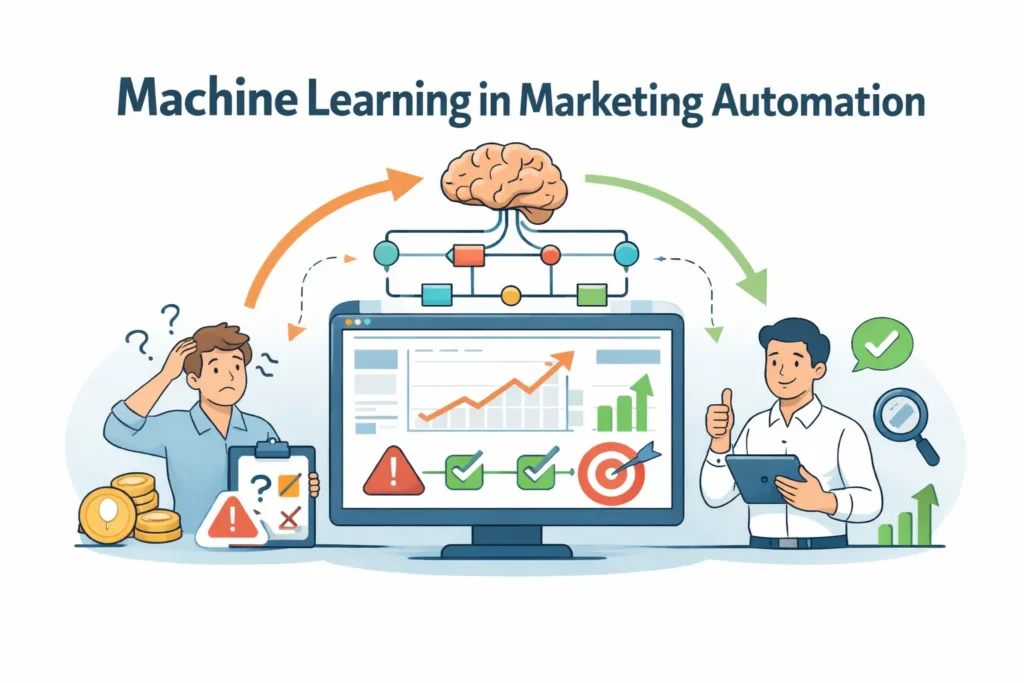
Modern marketing systems are no longer constrained by a lack of tools. They are constrained by decision quality. As volume, channels, and data sources multiply, the core challenge shifts from execution to judgment. What should happen, for whom, and when cannot be determined reliably through static rules alone. This is where machine learning becomes operationally relevant, not as a trend, but as an infrastructure layer for better decisions at scale.
Table of Contents
Why static automation breaks under growth
Traditional marketing automation was designed for predictability. Teams defined rules, triggers, and flows based on assumed behavior. That approach works when data is limited and change is slow. It fails when customer behavior shifts weekly, product lines expand, and attribution becomes fragmented.
Static logic creates three structural problems:
- Decisions are frozen in time, even as reality changes
- Optimization depends on manual analysis that rarely keeps pace
- Scaling complexity increases faster than headcount or governance
As organizations grow, these gaps surface as wasted spend, inconsistent experiences, and declining ROI. Systems that cannot learn eventually drift away from business reality.

The role of Machine Learning in Marketing Automation
At its core, Machine Learning in Marketing Automation introduces the ability for systems to adapt based on observed outcomes, not assumptions. Instead of asking teams to predefine every path, models evaluate patterns across large datasets and continuously refine decisions.
This shift enables automation to move from execution to judgment. Campaigns adjust based on response probability. Segmentation evolves as behaviors change. Timing, frequency, and prioritization improve without constant manual intervention.
More importantly, learning systems reduce the dependency on individual operators. Decision logic becomes embedded in the system rather than locked in personal expertise or outdated playbooks.
Learning systems versus rule engines
Rule engines operate on certainty. Learning systems operate on probability. That distinction matters when marketing inputs are noisy, incomplete, or contradictory.
Machine Learning in Marketing Automation excels in environments where:
- Customer intent is inferred, not declared
- Data quality varies across sources
- Outcomes matter more than prescribed paths
Rather than asking whether a lead meets fixed criteria, learning-based systems estimate likelihoods. They prioritize actions based on expected value, not static thresholds. This directly supports better decision-making under uncertainty.
Decision-making at scale without guesswork
As marketing organizations scale, the number of micro-decisions explodes. Which message to show. Which segment to prioritize. Which signal matters most. Human review does not scale to this volume.
This is where Machine Learning in Marketing Automation becomes an economic necessity. It allows systems to process millions of interactions and identify patterns that would never surface through manual analysis. Predictive analytics can inform resource allocation, forecast pipeline impact, and surface diminishing returns before budgets are wasted.
However, learning does not replace strategy. It operationalizes it. The business still defines goals, constraints, and acceptable risk. The system learns how to achieve those goals within defined boundaries.
Data quality is a governance issue, not a technical one
Machine learning performance is inseparable from data quality. In practice, data problems are rarely caused by missing fields. They are caused by inconsistent definitions, misaligned incentives, and weak ownership.
Without governance, learning systems amplify existing issues:
- Poor attribution skews optimization
- Inconsistent lifecycle stages confuse models
- Duplicate or stale records reduce signal strength
Effective use of Machine Learning in Marketing Automation requires treating data as an operational asset. That means clear ownership, documented definitions, and accountability for change. Governance is not overhead. It is what protects ROI.
From optimization to adaptability
Optimization assumes a stable environment. Modern marketing rarely offers one. Channels shift, buyers self-educate, and sales motions evolve. Systems must adapt, not just optimize.
This is where Machine Learning in Marketing Automation differentiates itself from advanced rule-based setups. Learning systems detect drift. They adjust weights, re-evaluate signals, and recalibrate decisions as conditions change.
Adaptability reduces the lag between market change and operational response. It protects performance without requiring constant rebuilds of automation logic.
Implementing learning responsibly
The question is not how to implement machine learning in marketing automation, but how to do so responsibly. Learning systems influence revenue, customer experience, and brand trust. Unchecked automation creates risk.
Responsible implementation includes:
- Clear decision boundaries defined by leadership
- Ongoing model review tied to business outcomes
- Human oversight for edge cases and exceptions
Improving decision quality with AI is not about removing humans from the loop. It is about placing them where judgment matters most.
Scaling without losing control
Many organizations hesitate to adopt learning-driven automation because they fear losing control. In reality, the opposite is true. Well-governed systems increase visibility into why decisions are made and how performance changes over time.
By governing Machine Learning in Marketing Automation as part of the broader revenue system, leaders gain consistency without rigidity. Decisions scale, accountability remains clear, and ROI becomes measurable across the entire lifecycle.
Nidish’s systems-first perspective
At Nidish, marketing automation is treated as a decision system, not a campaign engine. The focus is on how choices are made, governed, and improved over time. Machine learning is integrated where it strengthens judgment, not where it adds unnecessary complexity.
Nidish helps organizations redesign marketing automation around adaptability, governance, and long-term ROI. Learning systems are aligned to business strategy, data foundations are stabilized, and decision logic is made transparent. When Machine Learning in Marketing Automation is applied with discipline and systems thinking, it becomes a durable advantage rather than an operational risk.
This approach allows marketing organizations to scale with confidence, knowing their systems are learning responsibly and performing in service of measurable growth.




 Blog
Blog Case Studies
 Career