
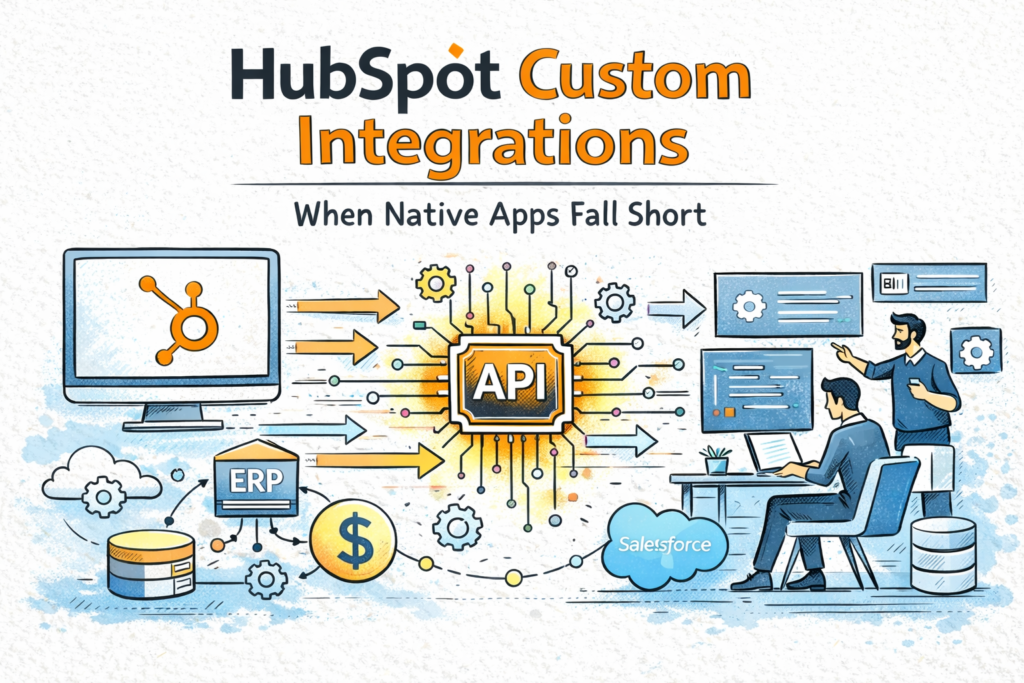
Growing teams often start with HubSpot’s marketplace apps and prebuilt connectors because they deliver fast wins. But as data models, revenue recognition rules, and operational boundaries get more sophisticated, packaged connectors hit hard limits. This is where HubSpot Custom Integrations begin to play a critical role in maintaining system reliability and data accuracy.
This article walks through real-world integration patterns, decision-making criteria, and implementation best practices so engineering and RevOps teams can choose the right path.
Table of Contents
HubSpot Custom Integrations
Understanding where to draw the line between “use a native app” and “build a custom connector” is the first technical decision every scaling organization faces. Native integrations solve simple, predictable syncs; custom integrations solve business-logic-heavy flows that must be deterministic, auditable, and resilient at scale.
In practice, teams turn to HubSpot Custom Integrations when CRM behavior must mirror internal operating rules rather than generic software assumptions.
Real-world use cases that need custom integrations
- Multi-entity companies that require one-to-many HubSpot accounts mapped to a single ERP for consolidated accounting
- Financial close workflows where deal → invoice → revenue recognition mappings must respect custom rules and timestamps
- High-volume event streams where latency, sequencing, and idempotency directly affect pipeline accuracy
- Legacy systems that expose nonstandard APIs or batch-only endpoints requiring transformation layers
These scenarios cannot be reliably solved with marketplace apps and are classic examples where HubSpot Custom Integrations become a necessity rather than an optimization.
Why native apps fail at scale
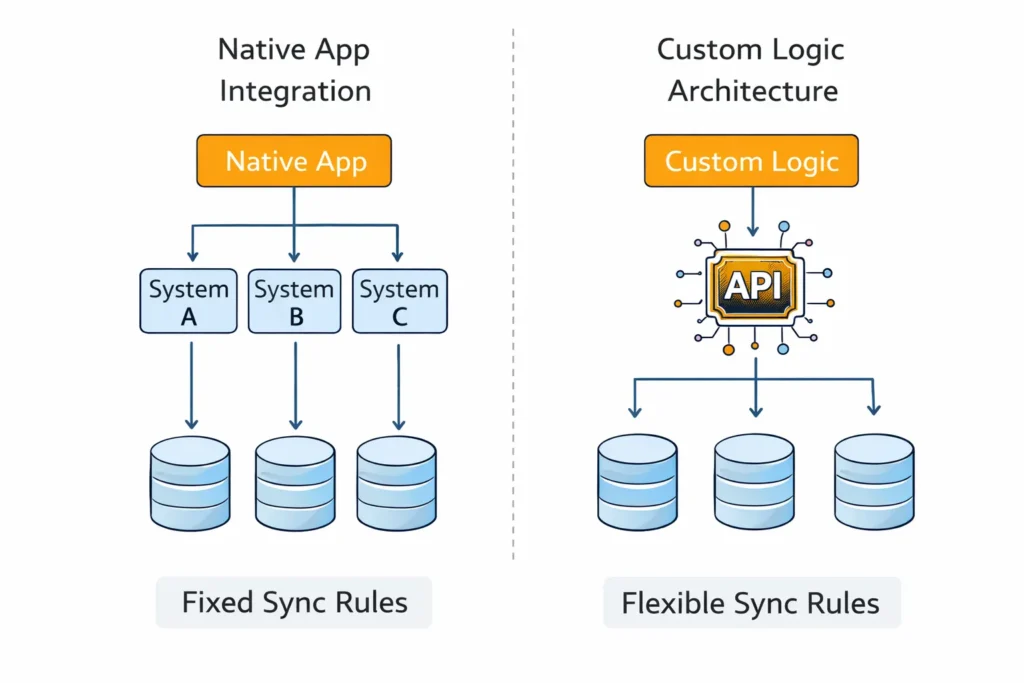
Native connectors are designed for breadth, not bespoke business logic. Common limitations include:
- Fixed field mappings with no support for compound business keys
- Limited retry logic and no compensating transactions when downstream systems fail
- Poor observability, often limited to surface-level sync errors
- Inconsistent support for custom objects and conditional workflows
When these gaps begin to affect revenue reporting or operational trust, HubSpot Custom Integrations provide the control needed to stabilize the ecosystem.
Technical decision-making: custom vs native
The decision should be based on three technical axes: correctness, cost, and operational risk.
- Correctness – If inaccurate data affects finance, compliance, or forecasting, custom integration logic is required.
- Cost – Native apps appear cheaper initially but often incur long-term costs through manual fixes and reporting workarounds.
- Operational risk – If failures require human intervention, the integration is already too fragile.
For organizations managing multiple systems, HubSpot Custom Integrations reduce risk by enforcing deterministic data movement instead of best-effort syncing.
What a production-grade custom integration must include
A robust integration architecture should include:
- API-first design with retry, backoff, and idempotency
- Canonical data models to prevent duplication and overwrite conflicts
- Event-level logging, alerting, and dead-letter queues
- Versioned schemas and backward-compatible updates
- Documentation and operational runbooks
These elements ensure HubSpot Custom Integrations behave like infrastructure, not brittle automation scripts.
Implementation pattern examples
- Middleware services consuming HubSpot webhooks and enriching data before pushing it into ERPs or data warehouses
- Nightly reconciliation jobs validating financial totals between HubSpot deals and accounting platforms
- Streaming connectors aggregating behavioral events before syncing structured insights back into HubSpot
For developers, HubSpot’s official API documentation remains a foundational resource
How Nidish helps businesses build integrations that scale
Nidish is a HubSpot expert with hands-on experience designing and deploying complex integration architectures. Rather than building point-to-point connectors, Nidish focuses on long-term system design, ensuring HubSpot Custom Integrations remain scalable, observable, and aligned with real business logic.
By combining CRM expertise with deep API and RevOps knowledge, Nidish helps organizations avoid technical debt while turning HubSpot into a true operational backbone.
Learn more about their HubSpot consulting and integration services
Final checklist before you build
Before committing to custom development, ask:
- Have system ownership and source-of-truth rules been clearly defined?
- Can native apps support required data guarantees and observability?
- Is the total cost of ownership understood beyond initial build cost?
- Is there a rollback and versioning strategy in place?
If the answer to any of these is no, HubSpot Custom Integrations are likely the correct technical path forward.



 Blog
Blog Case Studies
 Career