

In the high-stakes world of Revenue Operations, the “decision tree” has become a relic. For years, businesses relied on rigid, flowchart-style automation that forced prospects through a series of “If/Then” hoops. If a lead followed the script, they got a meeting; if they had a nuanced question, they were met with a generic “Contact Us” form and a 24-hour delay.
As of 2026, that friction is a choice one that costs companies revenue. The industry has shifted from static, reactive bots toward HubSpot AI Agents that act as autonomous extensions of the sales team.
At Nidish, we’ve spent the last two years helping clients move away from manual branching and toward “goal-oriented” orchestration. Here is how we are building the future of lead qualification.
Table of Contents
In the high-stakes world of Revenue Operations, the “decision tree” has become a relic. For years, businesses relied on rigid, flowchart-style automation that forced prospects through a series of “If/Then” hoops. If a lead followed the script, they got a meeting; if they had a nuanced question, they were met with a generic “Contact Us” form and a 24-hour delay.
As of 2026, that friction is a choice one that costs companies revenue. The industry has shifted from static, reactive bots toward HubSpot AI Agents that act as autonomous extensions of the sales team.
At Nidish, we’ve spent the last two years helping clients move away from manual branching and toward “goal-oriented” orchestration. Here is how we are building the future of lead qualification.
From Decision Trees to HubSpot AI Agents
The difference between the chatbots of the past and the agents of today is the difference between a script and a teammate. While legacy bots could only follow a pre-determined path, HubSpot AI Agents possess a “reasoning” layer.
- The Legacy Bot: Operates on fixed logic. It has no memory of a visitor’s previous interactions and cannot look at the CRM for context unless a human specifically maps every single property.
- HubSpot AI Agents (2026 Standard): These engines are built on HubSpot’s Breeze infrastructure. They don’t just follow steps; they pursue outcomes. If a lead’s objective is to solve a technical problem, the agent pivots the conversation to technical qualification rather than blindly asking for a phone number.
In modern HubSpot portals, we no longer spend our time building infinite branches. Instead, we build guardrails. We provide the agent with a knowledge base, access to CRM data, and a clear set of rules, trusting the agent to navigate the conversation to a successful close.
The 2026 Qualification Workflow: A Look Under the Hood
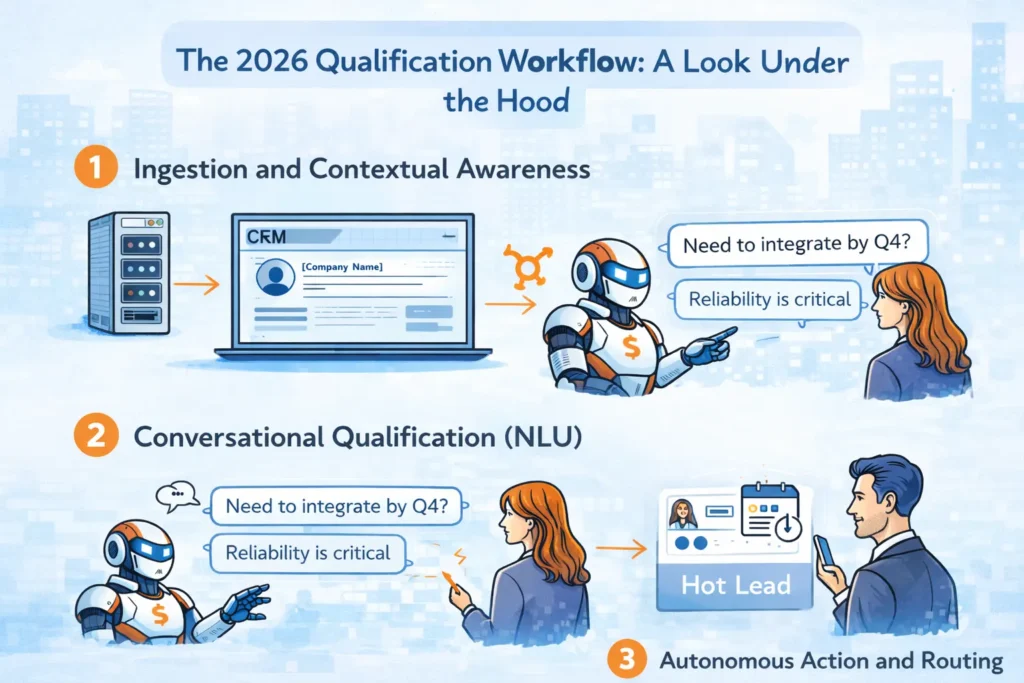
To understand how an AI-driven qualification workflow functions, one must look at the interplay between Breeze Intelligence and Operations Hub.
1. Ingestion and Contextual Awareness
In 2026, asking for a prospect’s company name or employee count is seen as a sign of operational inefficiency. Before the chat widget even opens, the system is working.
Using Breeze Intelligence, the CRM resolves the visitor’s IP address and enriches the contact record in real-time. When HubSpot AI Agents engage, they skip the basic interrogation and lead with context:
“I noticed you were looking at our Enterprise API documentation for [Company Name]. Are you looking to integrate by the end of this quarter?”
2. Conversational Qualification (NLU)
The shift to Natural Language Understanding (NLU) has finally killed the “button-only” interface. Prospects can now talk to the CRM like they talk to a human.
How HubSpot AI Agents Assess Intent
The agent doesn’t just scan for keywords; it analyzes intent and urgency. If a lead mentions they are “frustrated with current vendor downtime” and “need a solution before the holiday rush,” the agent identifies the Pain Point (Reliability) and Timeline (Q4).
Because HubSpot AI Agents have the authority to update custom properties on the contact record, they can instantly recalculate a lead’s priority. A lead with high urgency can bypass the standard nurture queue and be escalated to a “Hot Lead” routing workflow immediately.
3. Autonomous Action and Routing
The hallmark of a 2026 agent is its ability to take action rather than just collect data.
- The High-Value Path: For qualified leads, the agent checks the specific Account Executive’s calendar and books the meeting directly in the chat window.
- The Self-Serve Path: If a lead doesn’t meet the enterprise threshold, HubSpot AI Agents can autonomously provide a trial link or a discount code and enroll the prospect in a specific product-led growth (PLG) nurture sequence.
The Orchestration Layer: Operations Hub
A common pitfall I see is trying to run modern AI on messy, legacy data. We avoid this by using Operations Hub as the “sanitation layer.”
Before HubSpot AI Agents interact with a lead, we use scheduled workflows and programmable automation (JavaScript/Python) to clean the data. If a lead gives an informal job title like “Head of Growth,” Operations Hub normalizes it to “VP of Sales/Marketing” so the agent’s routing logic remains accurate. Without this layer, the AI is effectively guessing.
Governance: Maintaining the Human-in-the-Loop
A major concern for leadership is the fear of an agent “going rogue.” In 2026, my RevOps strategies include strict Governance Layers. When deploying HubSpot AI Agents, we implement:
- Confidence Thresholds: If the agent is less than 85% certain of an answer, it is programmed to hand the conversation off to a human specialist.
- The “Supervisor” Workflow: Random chat transcripts are flagged for manager review to ensure the brand voice remains intact.
- Strict Guardrails: System prompts are configured to prevent agents from discussing legal terms or unauthorized pricing discounts.
Preparing for the Future of Lead Qualification
The transition to an agent-based model is not a simple feature toggle; it is a strategic overhaul. For RevOps leaders, the priority is no longer about building better “chat flows,” but about building better data foundations.
We recommend three immediate steps:
- Audit the Knowledge Base: AI agents are only as smart as the documentation they have access to.
- Standardize CRM Properties: Ensure that “Lifecycle Stage” and “Lead Status” are defined by binary, measurable criteria.
- Pilot One High-Traffic Page: Replace a traditional chatbot with a HubSpot AI Agent on a high-intent page to measure the lift in conversion.
The technology is no longer the bottleneck the strategy is. At Nidish, we specialize in helping scaling enterprises move past the era of the “dumb bot” and into the era of intelligent, revenue-driving automation.



 Blog
Blog Case Studies
 Career