

Can HubSpot replace a traditional LMS is a question many teams begin asking only after HubSpot is already part of their stack.
Before committing to a platform, many teams want a clear answer to one question: can HubSpot replace a traditional LMS without introducing long-term complexity?
Initially, learning content lives in a separate LMS, marketing lives in HubSpot, and customer data lives in the CRM. Over time, this separation becomes inefficient. Reporting is fragmented, user data is duplicated, and managing multiple platforms slows teams down.
As a HubSpot services provider, we usually see this question emerge from real operational friction, not curiosity. Teams want to know whether HubSpot can support education and training use cases without introducing new complexity around structure, tracking, and maintenance.
This article explains what HubSpot can realistically replace, where it requires custom development, and when a traditional LMS is still the better choice.
Table of Contents
What traditional LMS platforms are designed to do well
Traditional learning management systems are built for structured, academic-style learning. Their core strength lies in control and enforcement.
They typically excel at:
- Enforced course and lesson progression
- Exams, quizzes, and grading logic
- Certificates and compliance reporting
- Transcript-style learner records
For regulated training or accredited education, these features are essential. However, that same rigidity often creates friction for business teams running onboarding, enablement, or customer education programs.
Most traditional LMS platforms:
- Offer limited design and branding flexibility
- Sit outside CRM and marketing workflows
- Store learner data separately from business systems
This gap is what pushes teams to consider HubSpot as part of their learning stack.
Where HubSpot fits naturally into learning experiences
HubSpot was not designed as a traditional LMS, but it performs strongly in areas that modern learning programs increasingly rely on.
Flexible content management
HubSpot CMS allows teams to manage content-rich websites without code. For learning-focused use cases, this makes it easier to:
- Maintain course catalogs and lesson pages
- Update learning content as products or processes change
- Keep design and branding consistent across education assets
This flexibility is particularly valuable for customer education and internal enablement, where content evolves frequently.
CRM-driven personalization
Unlike most LMS platforms, HubSpot is built around contacts and lifecycle stages. This enables:
- Personalized learning content based on user type or stage
- Automation triggered by engagement or completion signals
- Direct connection between learning activity and CRM data
For businesses focused on adoption, onboarding, or partner enablement, this alignment is often more valuable than rigid course mechanics.
Where HubSpot alone reaches its limits
Out of the box, HubSpot does not provide several features that traditional LMS platforms offer natively.
HubSpot does not offer:
- Exam scoring
- Certificate issuance
- Transcript-style reporting
That said, these capabilities are not impossible on HubSpot.
Through custom HubSpot development, teams can implement:
- Engagement or completion scoring using custom properties and workflows
- Certificate delivery triggered by defined milestones
- Progress tracking modeled through contact properties, lists, and automation
The key difference is intent. Traditional LMS platforms are built for academic assessment and compliance. HubSpot is designed to track behavior, engagement, and lifecycle progression.
This distinction is critical when evaluating whether HubSpot can replace a traditional LMS.
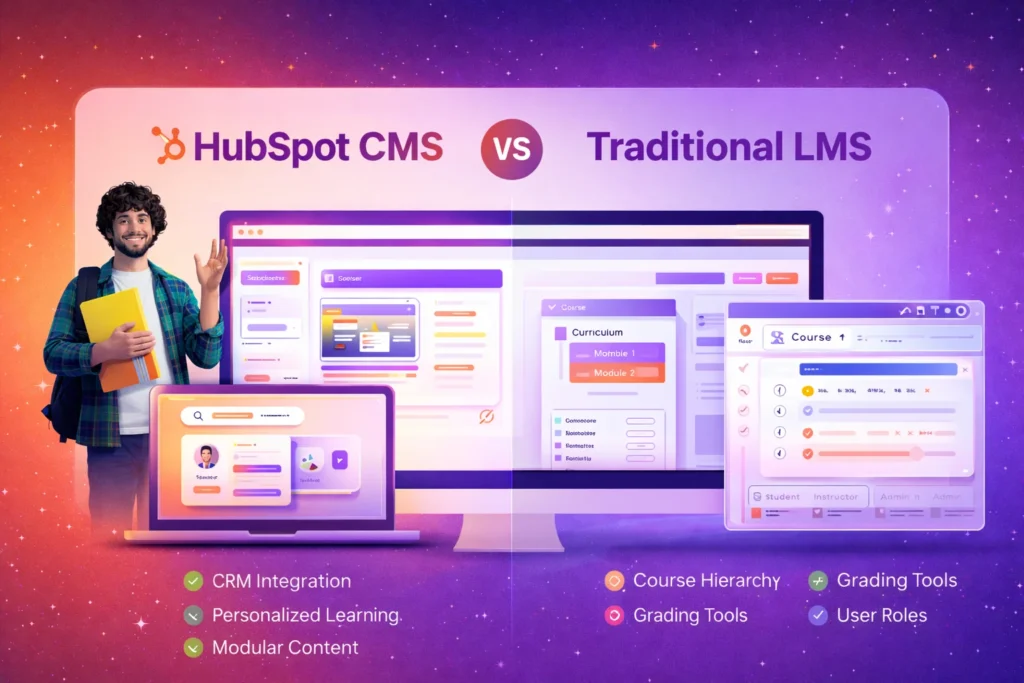
HubSpot vs Traditional LMS: What Actually Changes in Practice
| Area | Traditional LMS | HubSpot CMS (With Proper Setup) |
| Primary purpose | Academic and compliance-based learning | Business-driven learning and enablement |
| Course structure | Rigid course → module → lesson hierarchy | Flexible content structure using templates and modules |
| Design flexibility | Limited | High, full CMS control |
| Branding control | Often restricted | Full brand and UI control |
| Content updates | Slower, admin-heavy | Fast updates by marketing or ops teams |
| User management | LMS-specific users and roles | CRM contacts with lifecycle stages |
| Personalization | Role-based | Contact and behavior-based |
| Exam scoring | Native | Possible via custom development |
| Certificates | Native | Possible via workflows and automation |
| Transcript reporting | Native | Modeled via custom properties and reports |
| CRM integration | Often limited | Native and deeply integrated |
| Marketing automation | Minimal or external | Built-in HubSpot workflows |
| Maintenance effort | Platform-managed but rigid | Lower long-term effort with modular setup |
| Best suited for | Accreditation, exams, compliance | Onboarding, enablement, adoption |
This comparison highlights an important point. Traditional LMS platforms are optimized for academic control, while HubSpot excels when learning is part of a broader customer, partner, or employee journey.
Why theme structure becomes a real bottleneck
One of the most common reasons HubSpot-based learning projects struggle is theme selection.
Standard business themes are built for marketing pages, not structured learning content. Over time, this leads to:
- Inconsistent lesson layouts
- Duplicated sections and modules
- Increasing technical debt
A learning-focused HubSpot theme changes this dynamic by providing:
- Dedicated course and lesson templates
- Reusable modules designed for education use cases
- Consistent structure across learning pages
This is where EduLMS fits in quietly. It does not attempt to turn HubSpot into a traditional LMS. Instead, it provides the structural layer needed to manage courses, lessons, and learner profiles in a way that aligns with how HubSpot CMS actually works.
Can HubSpot Replace a Traditional LMS for Business Learning?
HubSpot works well as an LMS alternative when:
- Learning is content-driven rather than exam-driven
- Education supports onboarding, enablement, or retention
- CRM and marketing alignment is a priority
- Design flexibility and speed matter
Common use cases include:
- Customer onboarding academies
- Partner enablement portals
- Internal training and documentation hubs
- Event-based or cohort-style learning programs
In these scenarios, HubSpot functions as a learning experience platform, not a rigid LMS.
When a traditional LMS is still the better choice
A dedicated LMS remains the better option if your program requires:
- Formal accreditation
- Compliance-driven reporting
- Complex assessments and grading logic
In these cases, HubSpot can still support communication, engagement, and marketing, but should not replace the core learning system.
Making the right decision starts with architecture
The decision is not HubSpot versus LMS. It is about architecture and expectations.
A sustainable HubSpot-based learning setup requires:
- Intentional content modeling
- A learning-ready theme structure
- CRM-driven personalization
- Clear governance and ownership
Implementing this correctly often involves HubSpot CMS development, and when uncertainty exists, a HubSpot website audit can quickly surface structural gaps before scaling further.
Final thoughts
Can HubSpot replace a traditional LMS? In many business scenarios, the answer is yes, provided expectations are aligned and the platform is implemented correctly.
HubSpot is not designed to replicate academic LMS platforms feature by feature. Its strength lies in flexibility, personalization, and lifecycle-driven engagement. With the right structure and theme foundation, it becomes a powerful environment for modern education and enablement.
EduLMS supports this approach by providing learning-focused structure inside HubSpot CMS, without compromising the platform’s strengths.



 Blog
Blog Case Studies
 Career